

 South Sudan: Resistance to Holding Elections Perpetuates Insecurity
Presidential and Legislative Elections: December
The primary question shaping South Sudan’s electoral process in 2026 is whether elections will be held at all. South Sudanese politicians have postponed scheduled elections in 2015, 2018, 2020, 2022, and 2024, citing limited financial and logistical capacity to execute a national election in this expansive country of 12 million people. They have also been unable to execute the fundamental prerequisites to an election, such as a census, a voter registry (last revised in 2008), and a permanent constitution. As a result, President Salva Kiir has remained in power since 2009 despite having won only one election, held prior to South Sudan’s independence in 2011.
The failure to hold elections reflects the limited political will of incumbent South Sudanese politicians.
The failure to hold elections reflects the limited political will of incumbent South Sudanese politicians. They have little incentive to organize elections that may alter the status quo, which enables them to retain their positions indefinitely—and the prestige, influence, and financial benefits that accompany them.
The inaction also signals the impunity these political leaders feel from the need to periodically obtain a popular mandate, thereby affirming legitimacy for their continued time in power. The lack of commitment of these politicians to meet this minimal threshold of democratic governance, in turn, reflects the inability of South Sudanese citizens or international partners to generate sufficient pressure to establish this norm in Africa’s youngest nation.
The costs to South Sudan’s stability and development from this political stasis have been high. Rather than employing political forums for resolving differences, South Sudanese politicians have long relied on private militias. This has kept South Sudan in a near-perpetual state of conflict since 2013, in which an estimated 400,000 people have died. For much of the past decade, South Sudan has maintained the ignominious designation of having a greater percentage of its citizens classified as refugees (roughly a third) than any other country in Africa. This underscores the persistence and enduring fear generated by this violence, despite periodic ceasefires and peace agreements.
South Sudan ranks at the very bottom of the United Nations’ Human Development Index, and infant mortality rates have risen since independence, to 72 deaths per 1,000 live births—the highest in Africa. These abysmally low socioeconomic indicators have persisted despite the country generating an estimated $1.6 billion in oil revenues annually on average for much of the past decade. South Sudan also ranks 180th (out of 180 countries) in Transparency International’s Corruption Perceptions Index.
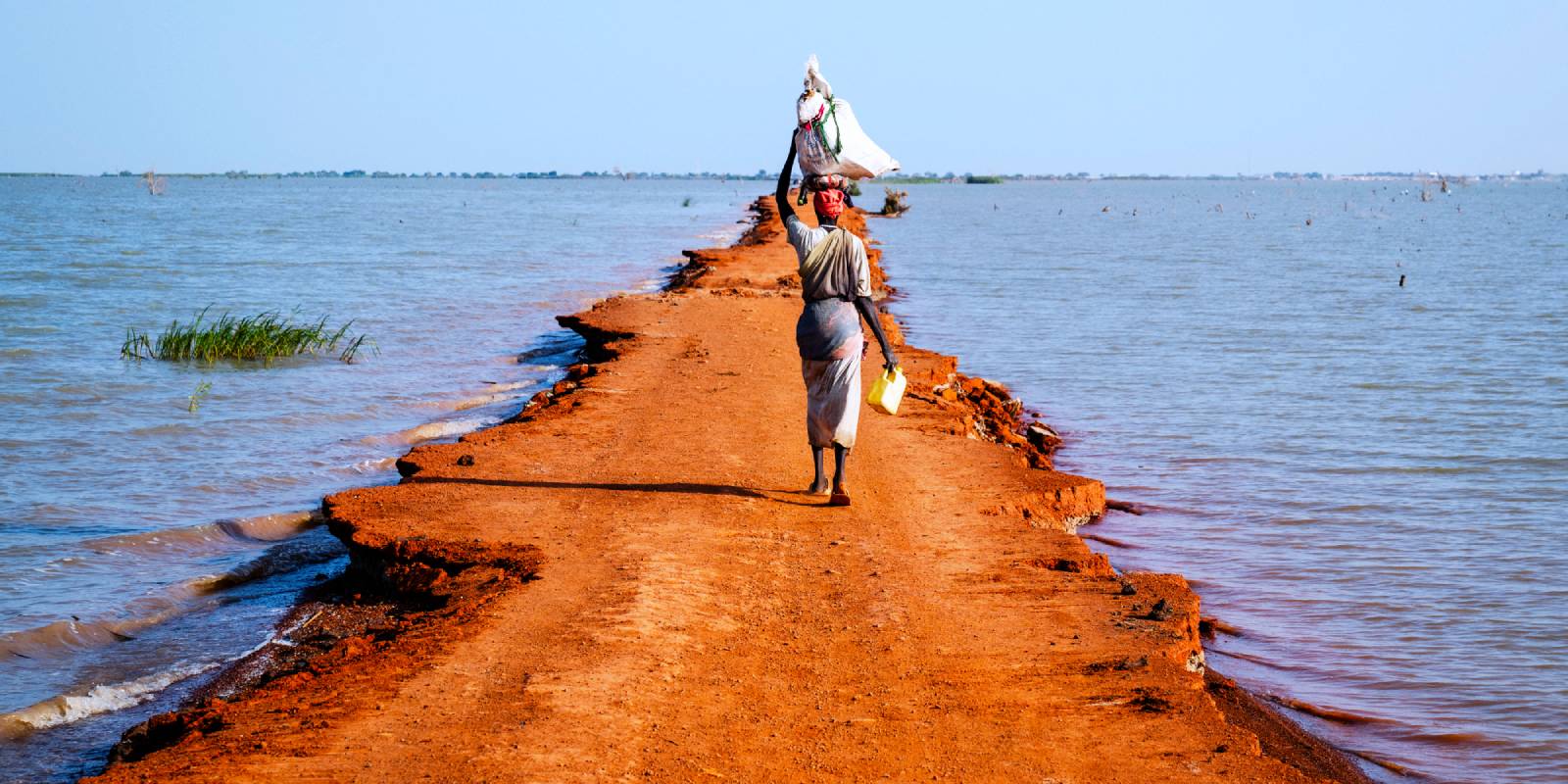
A woman walks along an eroded and flood-affected road near Bentiu in Unity State, South Sudan, on November 6, 2025.
(Photo: AFP/Rian Cope)
These economic strains have been exacerbated by the devastating conflict in neighboring Sudan, through which most of South Sudan’s oil flows. As a result of the Sudan conflict, South Sudan has absorbed an estimated 870,000 South Sudanese returnees who had been seeking refuge in Sudan, as well as 421,000 Sudanese refugees.
The repeated election postponements have occurred within a broader context of the Kiir government making little effort to build democratic institutions or norms, despite self-determination being one of the driving justifications for South Sudan’s secession from Sudan in 2011.
The most basic of these is power sharing. Kiir has regularly limited the space of the political opposition, especially his longtime rival Riak Machar. The two were the leading political and military actors within the Sudan People’s Liberation Movement (SPLM) in South Sudan’s decades-long fight for independence. However, high levels of distrust and unwillingness to compromise between the two led to the outbreak of conflict in 2013 and Machar having to flee the country. As part of the 2018 revitalized peace agreement, Machar became the first vice president (among four others) in 2020. In practice, Kiir has largely governed unilaterally with limited input from opposition parties. Clashes between security forces linked to Machar and the South Sudan People’s Defense Forces (SSPDF) in Upper Nile State in March 2025 resulted in Kiir placing Machar and his senior allies under house arrest, facing charges of treason, murder, and crimes against humanity.
In addition to Machar’s SPLM in Opposition (SPLM-IO) party, there are half a dozen other opposition parties or coalitions, some of which are armed.
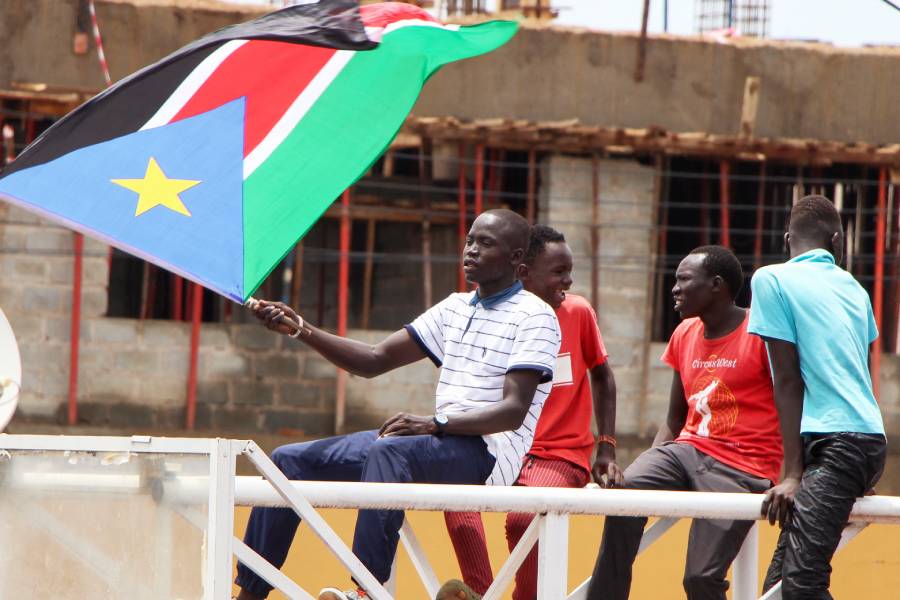
Young South Sudanese wave a flag while cheering the national basketball team. (Photo: AFP)
While a reconstituted bicameral Transitional National Legislative Assembly (TNLA) was stipulated as part of the 2018 peace agreement, the TNLA was only reappointed in 2021. Since then, it has only met periodically, even though this branch of government was conceived as coequal to the executive branch. The composition of its 550 members heavily favors the ruling party as part of a quota system.
The judiciary, by and large, does not operate as an independent body. It is regularly subject to executive influence, faces a shortage of judges, and facilitates the arbitrary targeting and detention of individuals on political grounds. Concerns over South Sudan’s legacy of impunity and the ability of the courts to provide impartial justice led to the provision for a hybrid African Union-South Sudan court in both the 2015 and 2018 peace agreements. However, the hybrid court has never been operationalized due to persistent efforts by South Sudanese authorities to block its creation.
Despite these constraints, the judiciary has taken some tentative steps toward reform. In 2025, it adopted a roadmap for building a more credible, effective, and autonomous judicial system. This includes reforms in court administration, judicial training, ethical standards, transparency, and public access to legal services. The Supreme Court also finalized and validated a new Code of Judicial Conduct, setting clearer ethical rules designed to improve judicial professionalism and strengthen internal accountability. Notably, in April 2025, it partnered with the United Nations to deploy mobile courts to address conflict-related crimes in Unity State, where formal judicial infrastructure is lacking. These courts have delivered judgments on cases that had been pending for years, helping reduce backlogs and demonstrating an expanded judicial presence outside major towns.
The NEC has been perpetually underfunded, which has limited the ability of its members to travel and conduct the necessary pre-election planning steps.
The National Elections Commission (NEC) was reconstituted in December 2023 (ahead of the planned 2024 elections). Comprised of representatives from the main political parties, civil society, the business community, and other stakeholders, the NEC has visited all 10 states in South Sudan, conducted trainings, and engaged in consultative efforts. However, the NEC has been perpetually underfunded, which has limited the ability of its members to travel and conduct the necessary pre-election planning steps.
Reflective of the uncertainty heading into the 2026 elections, the government announced in December 2025 that the 2026 polls would proceed without the prerequisites of a census or permanent constitution. The announcement has been rejected by many civil society actors who are concerned that an election with such loose parameters would be highly prone to abuse. Electing a president and representatives whose authorities are not well defined would also be a recipe for persistent differences in interpretation, an opening to usurpations of power, and inherent institutional crises.
Mirroring the country’s political fragmentation, South Sudan’s security sector more resembles a collection of militias advancing the interests of individual political actors—rather than a unified security force whose mandate is to evenhandedly protect all citizens. South Sudan’s security actors are widely seen as predatory and responsible for persistent attacks on citizens.
There is limited space for independent media to operate in South Sudan. The National Security Service (the country’s intelligence agency) has intimidated, detained, and murdered journalists and civil society leaders. Nonetheless, some South Sudanese journalists continue to report and inform the public on major developments in the country.
South Sudan’s state weakness, the limited legitimacy of its political leadership, hydrocarbon wealth, and strategic location connecting north, central, and east Africa have also made South Sudan a target for foreign influence. The United Arab Emirates (UAE) has provided a $13-billion loan to be repaid over 20 years, during which time the UAE will be able to purchase discounted oil from South Sudan. (The oil sector accounts for 90 percent of government revenue.) The loan amounts to double South Sudan’s gross domestic product and five times its external debt, raising questions over the country’s ability to repay. China, similarly, is a major stakeholder in South Sudan oil companies Dar Petroleum Operating Company and Greater Pioneer Operating Company.
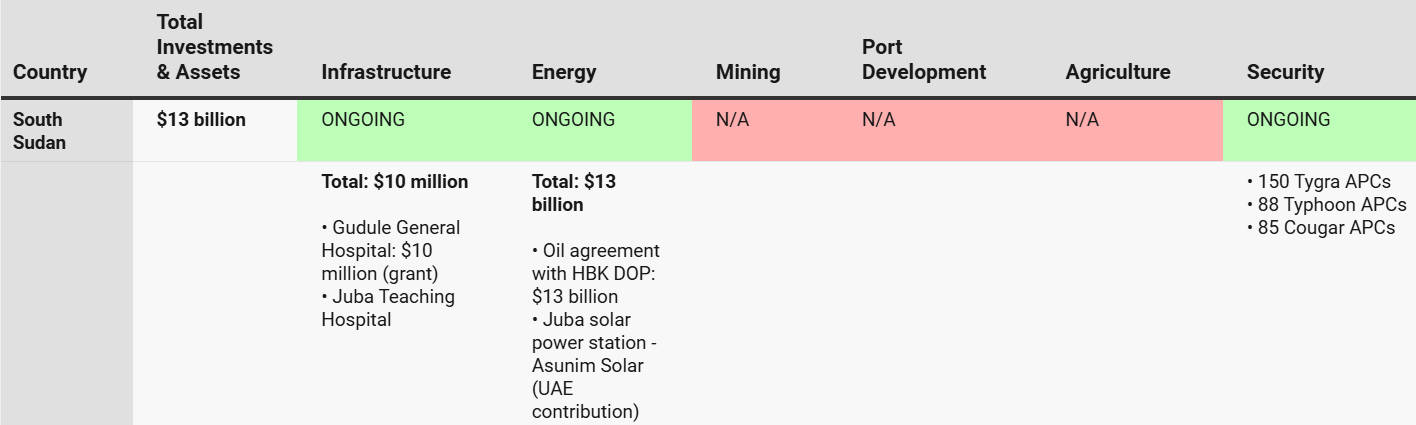
United Arab Emirates Investments in South Sudan.
Click image to go to Spotlight with full interactive table.
South Sudan is also reportedly allowing the UAE to transship weapons through South Sudan as part of the Emirates’ support of the Rapid Support Forces’ military actions in western and southern Sudan.
The primary stakeholders demanding credible elections in South Sudan in 2026 are civil society leaders and ordinary citizens—those most disenfranchised by the repeated postponements and subject to the country’s misgovernance, insecurity, and underdevelopment. Genuine progress will be dependent on these citizen actors gaining more of a say over the electoral process. Faith-based organizations, professional associations, and civic bodies are particularly critical to building nonpartisan rules, public consensus, and collective momentum for such reforms if South Sudan is to break its current downward spiral.
Assessing progress in 2026, then, should be measured not just by whether an election takes place but to the extent that citizen groups are involved and there are advances toward the foundations of credible elections, including an agreed-upon constitution, a fully funded election commission, and a genuinely independent judiciary.
More on: Democracy and Security