

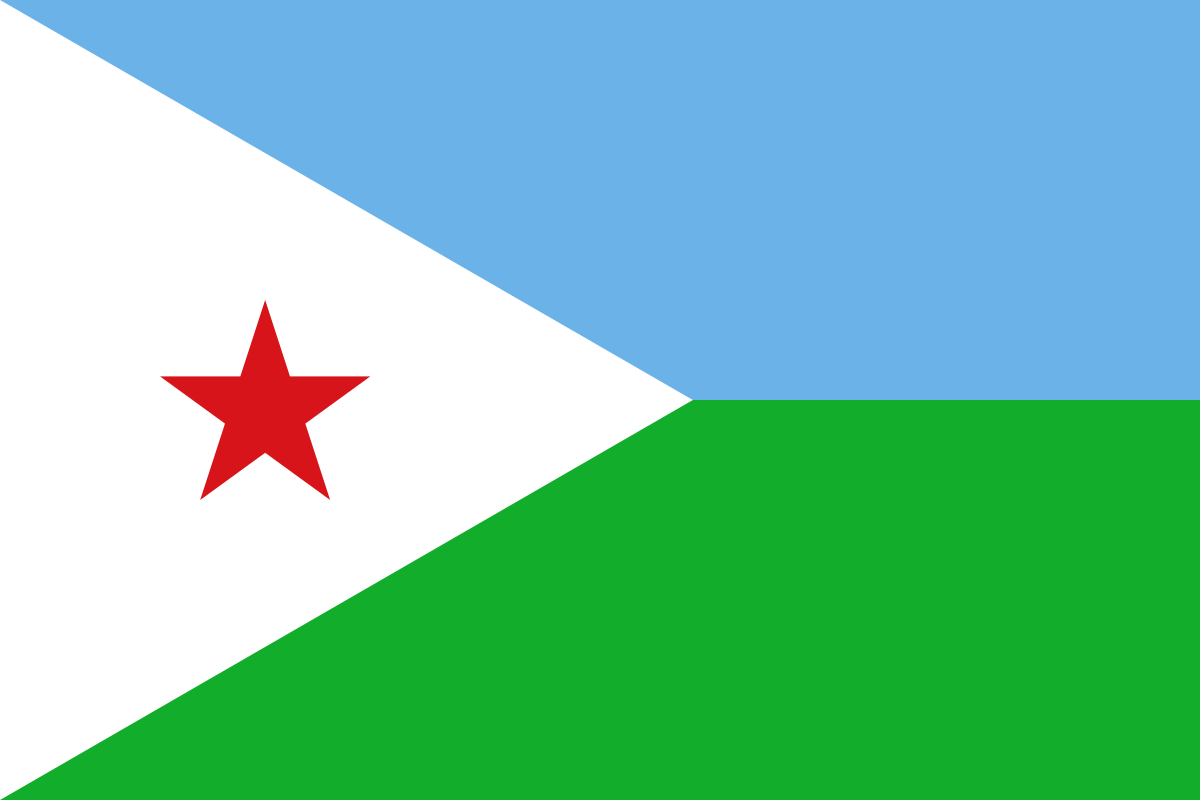
 Djibouti: An Uncontested Election Masks a Sea of Instability
Presidential Elections, April 10
Djibouti’s April 2026 presidential election is unlikely to produce any surprises. In power since 1999, President Ismail Omar Guelleh is pursuing a sixth presidential term in this country of 1.2 million people. Situated along the strategic Bab al Mandab Strait between the Gulf of Aden and the Red Sea, Djibouti sits astride one of the world’s maritime chokeholds through which some 12-15 percent of worldwide trade and 30 percent of container ship traffic passes.
Despite Guelleh’s clear path to holding the presidency, Djibouti must navigate considerable political instability.
The 77-year-old Guelleh’s prolonged tenure has been facilitated by a series of constitutional amendments bypassing presidential term limits. This includes a hastily approved revision pushed through the National Assembly by Guelleh’s Union pour la majorité présidentielle (UMP) coalition in November 2025 that removed the age limit of 75 for presidential candidates.
Guelleh’s continuation in office is also likely assured in that only one lesser-known candidate, Mohamed Farah Samatar, is contesting in the election. Samatar is a former member of the ruling party and heads the Centre Démocratique Unifié (CDU) party, which is not represented in parliament. Other amendments by the National Assembly have increased the institutional hurdles for opposition candidacies. Meanwhile, the ostensible opposition, holding 7 of the 65 seats in the National Assembly, has also endorsed Guelleh.
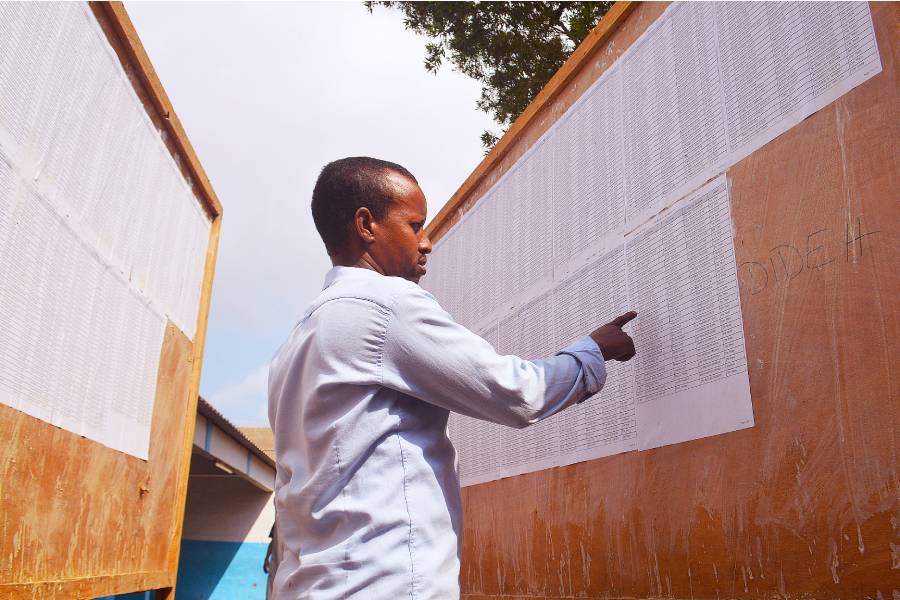
A voter checks for his name on the voter list during a parliamentary election in Djibouti city on February 24, 2023. (Photo: AFP)
The two most vocal opposition parties, the Mouvement pour le renouveau démocratique et le développement (MRD) and the Alliance républicaine pour la démocratie (ARD), have boycotted elections since 2016, citing the lack of impartiality of the Commission électorale nationale indépendante (CENI). The opposition continues to demand that the government respect the terms of a 2014 agreement regarding institutional and democratic reforms. The MRD has described elections in the country as a “charade,” claiming “the people of Djibouti are deprived of their right to freely choose their leaders.”
The electoral playing field, in fact, is heavily tilted. CENI is dominated by Guelleh loyalists. Independent media are unable to operate within the country, and Djibouti is ranked 168th out of 180 countries in Reporters Without Borders’ annual World Press Freedom Index. Journalists who are critical of the government are subject to intimidation and arrest, and freedoms of association, assembly, and speech are largely not upheld.
In the 2021 presidential election, Guelleh was declared the winner with 98 percent of the vote.
Despite Guelleh’s clear path to holding the presidency, Djibouti must navigate considerable political instability in 2026. Guelleh has faced recurring health concerns, which fueled speculation that he may step down prior to the 2026 polls. There are also expectations that Guelleh is preparing to have his 61-year-old stepson, Naguib Abdullah Kamil, succeed him. Kamil is the Secretary General of the Prime Minister’s Office.
The ruling coalition comprises a delicate balance of political, geographic, and ethnic interests.
This has caused strains within the ruling coalition that comprises a delicate balance of political, geographic, and ethnic interests. This includes former opposition parties such as the Front pour la restauration de l’unité et la démocratie (FRUD), which had taken up arms against the government. These tensions were apparently one of the factors in the resignation of one of Guelleh’s senior advisors, Alexis Mohamed, in September 2025. Mohamed attributed his resignation to the country’s “regression in democracy, the lack of transparency in economic and diplomatic agreements, and the marginalization of the republic’s institutions and the nepotistic management of the state.” In his statement, Mohamed also refused to condone a constitutional amendment that would enable Guelleh to again sidestep term limits. Term limits are an “essential foundation of any democracy,” he wrote.
These intraparty tensions follow a pattern of periodic arrests of senior political and security figures in recent years on a variety of alleged charges that are widely considered to be politically motivated.
While buffered from electoral competition, the government faces domestic pressures from substantial disparities in income, access to services, and job opportunities. An estimated 34 percent of the population is in poverty, and 73 percent of youth are unemployed despite Djibouti having the highest annual per capita income levels ($3,276) in East Africa.
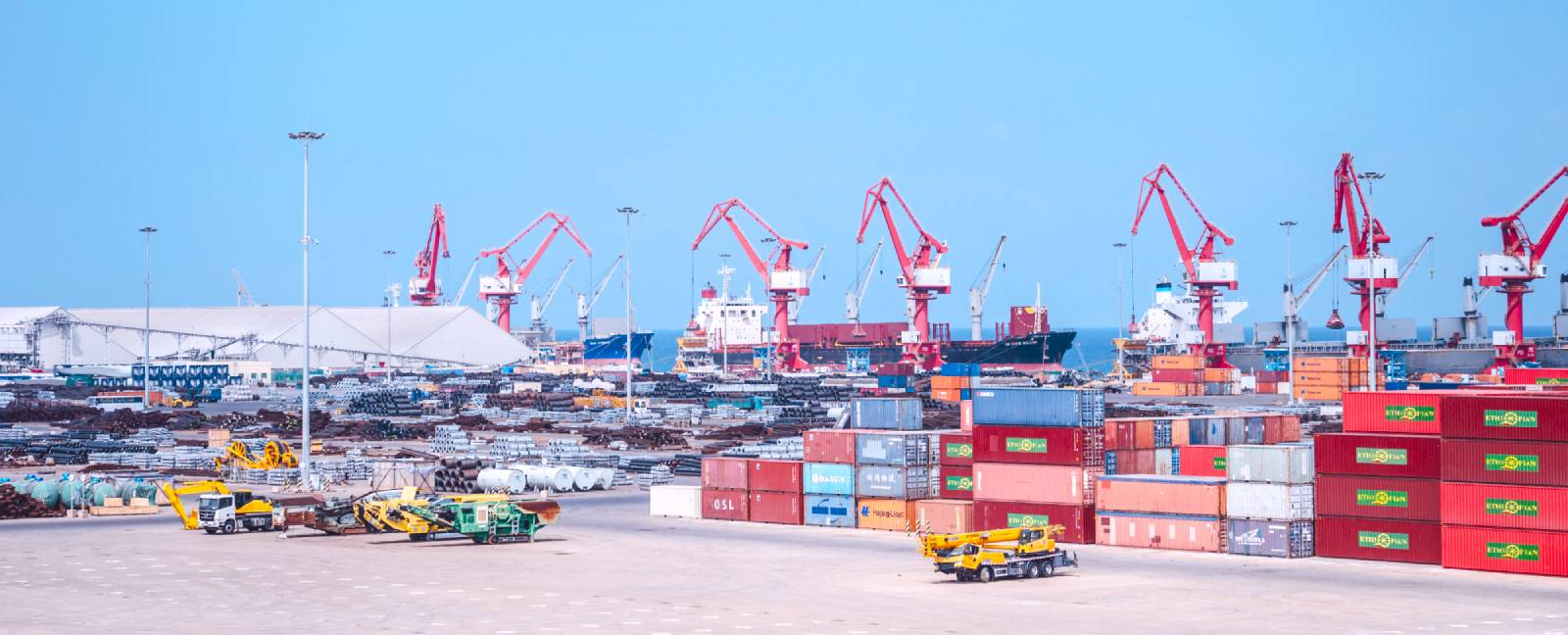
Djibouti City’s Doraleh Multi-Purpose Port, built by Chinese enterprises and officially opened in 2017. (Photo: AFP/Xinhua/Wang Guansen)
Djibouti’s economic prospects are closely tied to regional stability—and the use of its ports. Djibouti still handles over 90 percent of Ethiopia’s trade, despite Addis Ababa’s efforts to diversify. Djibouti’s port revenues earned from Ethiopia, meanwhile, account for roughly 70 percent of Djibouti’s GDP. The upsurge in attacks on vessels in the Gulf of Aden and Red Sea by Houthi militias operating out of Yemen and Somali pirates, therefore, have added to Djibouti’s economic challenges.
In the process of building out its rail and port infrastructure, Djibouti has incurred $3.4 billion of external debt (amounting to 66 percent of its gross domestic product). Around 45 percent of this debt is owed to China, making Djibouti the world’s most exposed borrower of Chinese lending.
Djibouti must also manage expanding Gulf State competition for influence in East Africa, including over control of ports and trade routes. Concerns about the United Arab Emirates’ (UAE) DP World’s control over the port of Doraleh, led Djibouti to revoke this port agreement in 2018—in a case that is still working its way through the courts. Guelleh has characterized the UAE’s growing ambitions in East Africa as “deeply destabilizing for the region.”
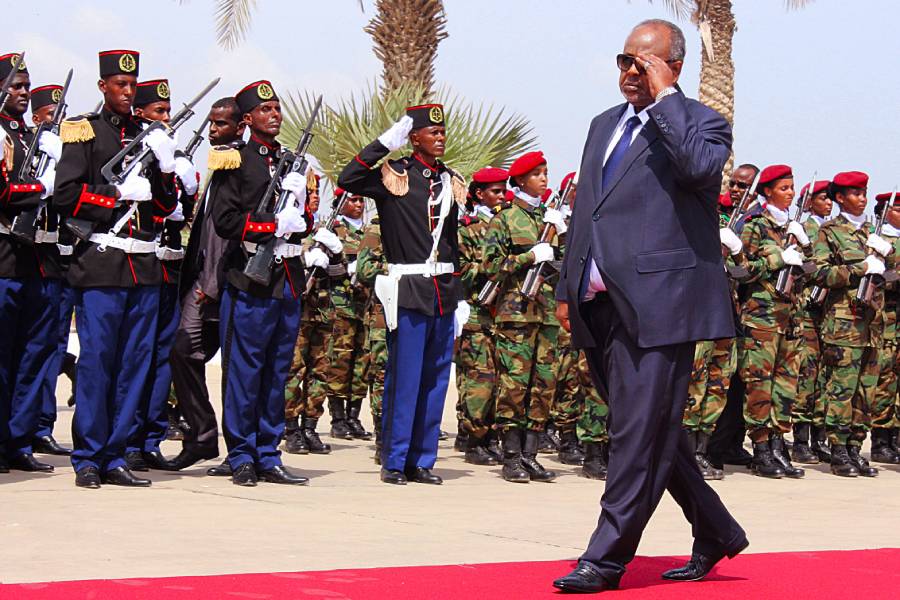
Djibouti President Ismael Guelleh inspects an honour guard at his fourth inauguration on May 8, 2016. (Photo: AFP/Houssein Hersi)
Djibouti, meanwhile, has welcomed increased investments from Saudi Arabia, including a $12.7 billion oil refinery and the creation of a major logistics hub with a 92-year lease in Djibouti’s International Free Trade Zone.
Djibouti has been a steady contributor to regional security efforts in Somalia. Djibouti maintains 1,800 troops in Somalia as part of the African Union’s peace force, helping the government combat al Shabaab. Djibouti also funds a separate 300-strong unit to help secure Somalia’s president and key infrastructure.
While there is unlikely to be much drama over the outcome of Djibouti’s 2026 election, this belies the complex juggling of competing domestic, regional, and international interests that Djibouti must manage to maintain its sovereignty and advance Djiboutian interests. Guelleh has been adept at managing this multilayered chessboard. The persistent erosion of democratic institutions over the years, however, has resulted in a weak political foundation from which Djibouti will eventually be forced to manage the transition from Guelleh, thereby heightening the risks.
More on: Democracy and Security