

 Somalia: Electoral Process Under Construction Amid a Security Crisis
Presidential Elections: Postponed
Somalia’s 2026 elections are framed by its formidable security challenges. A 2025 offensive by al Shabaab reversed previous territorial gains made by the government and put the militant group in a position to potentially take control of Mogadishu. In the northeast of the country, the international terrorist network of the Islamic State retains a base in Puntland State. The threat of attacks in the Gulf of Aden and Red Sea by the Houthi rebels and Somali pirates, meanwhile, continues to dampen maritime traffic through one of the world’s most important shipping chokeholds. The outcome of Somalia’s electoral process, in short, has far-reaching implications for the region and internationally.
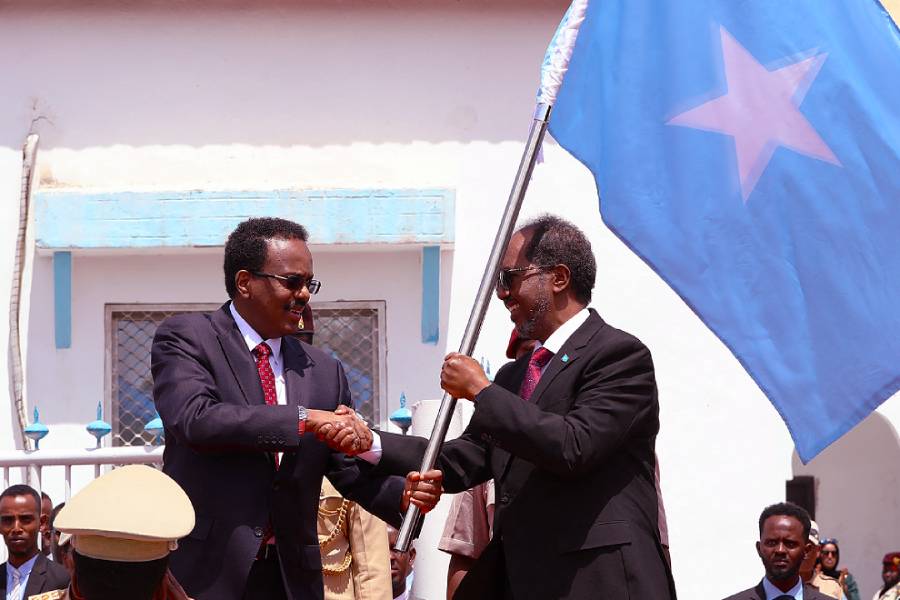
Outgoing President Mohamed Abdullahi Mohamed presents the Somali flag to newly elected President Hassan Sheikh Mohamud in May 2022. (Photo: AFP/Hassan Ali Elmi)
Somalia is heading into its sixth cycle of presidential elections since the reconstitution of a United Nations-backed government, continuing a process launched 25 years ago. While imperfect and indirect, these electoral engagements have facilitated five changes of leaders and parties. Notwithstanding its ongoing fragility, Somalia’s periodic stocktaking of its national leadership is noteworthy, given that the country was long considered a failed state.
President Hassan Sheihk Mohamud, the first leader in Somalia’s political history to secure a second nonconsecutive term, is seeking to extend his time in office. Under Mohamud, Somalia was selected for a term on the United Nations Security Council (after a 50-year absence) and has joined the East African Community. The growing recognition of the progress in Somalia’s state-building process facilitated in 2023 the lifting of the arms embargo on the country in place since 1992. Fiscal policy reform, undertaken as part of an IMF-led debt relief program, saw Somalia’s external debt decline from 64 percent of gross domestic product in 2018 to 6 percent in 2023.
Mohamud’s efforts to amend the country’s provisional constitution, establish a new electoral system, and redraw the federal map, meanwhile, are seen by many as a unilateral push to remake Somalia’s federal system to centralize executive power within the presidency and extend Mohamud’s time in office beyond his May 2026 mandate. This has deepened mistrust between the federal member states (FMS)—especially Puntland and Jubaland—and the Federal Government of Somalia (FGS) at a time when the security threat posed by al Shabaab requires a united front.
The key issue to watch in Somalia’s elections is whether the process is seen as sufficiently inclusive that all federal members states will participate.
In 2021, the security apparatus split along clan lines following the former president’s proposal for a term extension.
The current political crisis in Somalia is the latest iteration highlighting structural challenges in Somalia’s federal system. Somalia’s federal structure was enshrined in the country’s 2012 Provisional Constitution. The document is ambiguous regarding the respective authorities vested in the federal and state governments, however. Successive national leaders have attempted to govern Somalia as a unitary state with a dominant executive. This has resulted in persistent friction between the FGS and FMS.
The self-declared independent State of Somaliland has rejected any role in Somalia’s federal structure since the fall of the dictatorial Siad Barre government in 1991. Somaliland has been self-governing ever since, even though it has received limited international recognition.
Uncertainty over how fundamental aspects of the election will be run (including dates for when preceding local district and parliamentary elections will take place), has amplified tensions surrounding the elections. A key point of contestation revolves around whether the country should adopt a system of universal suffrage for voting or continue its indirect method whereby clan leaders select 101-member electoral colleges for each of the 275 seats in Parliament. Parliamentary members then choose the country’s president.
In an effort to show the feasibility of direct elections, the FGS organized local elections for 390 posts in Mogadishu’s district councils on December 25, 2025. Supported by a 10,000-troop Somali National Army presence, the polls saw a strong voter turnout, reflecting the desire of ordinary Somalis to participate in the voting process.
While universal suffrage is broadly recognized as desirable, holding direct elections has raised multiple concerns. There are genuine risks that al Shabaab would target political candidates, election organizers, and voters in a direct election—as it has in past indirect polls. State leaders also have reservations that the FMS would lose influence in a direct selection process. Critics see the lack of preparations for nationwide direct elections, including an outdated electoral registry, as a pretext for postponing the election and extending Mohamud’s term. Observers, moreover, worry that Mohamud supporters would be overrepresented if direct voting were to take place in 2026, given the relatively higher levels of insecurity in outlying parts of the country relative to the urban areas, such as Mogadishu, from which Mohamud draws considerable support.
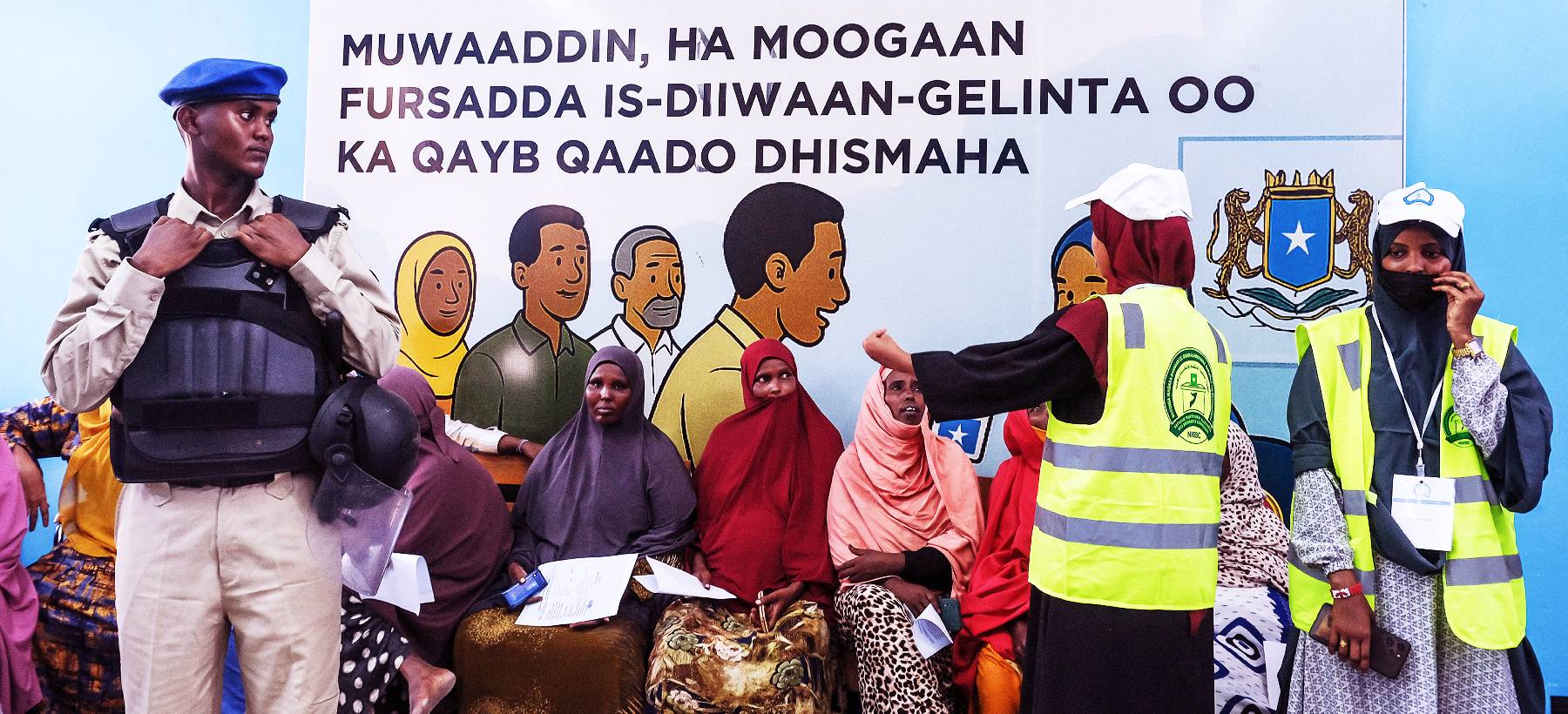
Somali women wait to register during a voter registration event in Mogadishu on April 2025. (Photo: AFP/Hassan Ali Elmi)
Disagreements over the FGS’s proposal for it to administer district-level elections, a function typically managed by the FMS, led to clashes between federal forces and Jubaland troops in December 2024. This resulted in dozens of troop fatalities and the retreat of hundreds of federal forces across the Kenya border.
Some signs of compromise were seen in August 2025 when the FGS and certain opposition parties agreed that members of parliament would be directly elected by voters, though the president would still be elected indirectly by Parliament. This proposal has not been endorsed by all FMS, however.
In total, there are 57 officially recognized political parties in Somalia. Parties that receive 10 percent of parliamentary votes qualify for representation in Parliament.
Somalia is the target of considerable attention from external actors.
Given its strategic location on the Western Indian Ocean and Gulf of Aden, Somalia is the target of considerable attention from external actors and rivalries for regional influence.
Türkiye is Somalia’s most significant regional security partner. Through its TURKSOM military base in Mogadishu, Türkiye trains Somali infantry and paramilitary police forces and supplies military equipment, including attack helicopters, drones, and armored personnel carriers. Under a joint naval force and defense agreement, Türkiye also assists in securing Somalia’s coastline and provides intelligence support.
Türkiye’s oil exploration efforts identified reserves of up to 20 billion barrels of oil in two offshore pilot oil blocks in Somalia in 2025. Turkey’s oil exploration agreement with Mogadishu grants Turkish firms 90 percent of hydrocarbon revenues. Turkish firms also manage the Aden Adde International Airport, in which they retain an 87-percent share as part of a 20-year lease. Both Türkiye and its sometimes partner, Qatar, have ideological affinities with the Muslim Brotherhood in Somalia.
The United Arab Emirates (UAE) has also been an important source of military support to the federal government in Mogadishu, primarily in the form of armored personnel carriers. The UAE—a staunch opponent of the Muslim Brotherhood—has over $600 million of investments in Somalia across a range of port development and infrastructure projects. These are largely focused on the States of Jubaland and Puntland, where the UAE has been helping to develop the Bosaaso Port. In January 2026, however, the FGS announced the cancellation of all bilateral security and defense agreements with the UAE, citing national sovereignty concerns.
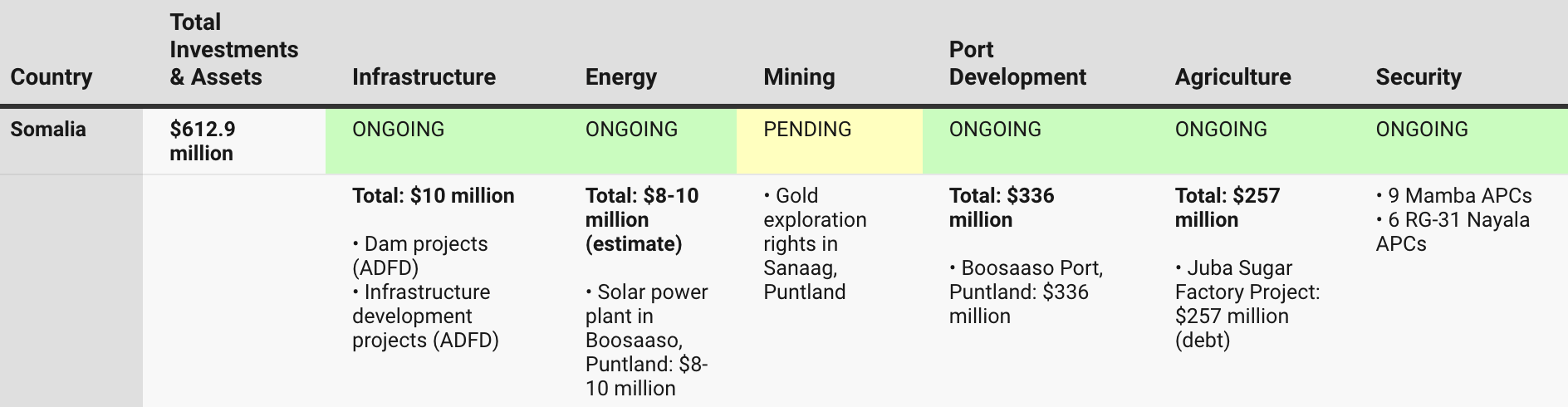
United Arab Emirates investments in Somalia.
Click image for interactive table.
The UAE, meanwhile, has over $500 million of investments in Somaliland, focused on and around the Port of Berbera, for which DP World has negotiated a 30-year concession.
Given the threat of regional spillover from al Shabaab, Somalia’s neighbors—primarily Uganda, Kenya, Ethiopia, and Djibouti–deploy roughly 11,000 troops through the African Union Support and Stabilization Mission in Somalia (AUSSOM).
Egypt has committed to providing up to 10,000 troops in support of AUSSOM and provides Somalia weapons, including anti-aircraft guns and artillery. Egypt’s security engagements in Somalia are widely considered to be a check on Ethiopia, given Cairo’s concerns over Addis’ construction of the Great Ethiopian Renaissance Dam (GERD) on the Nile and interests in establishing access to the Port of Berbera in Somaliland.
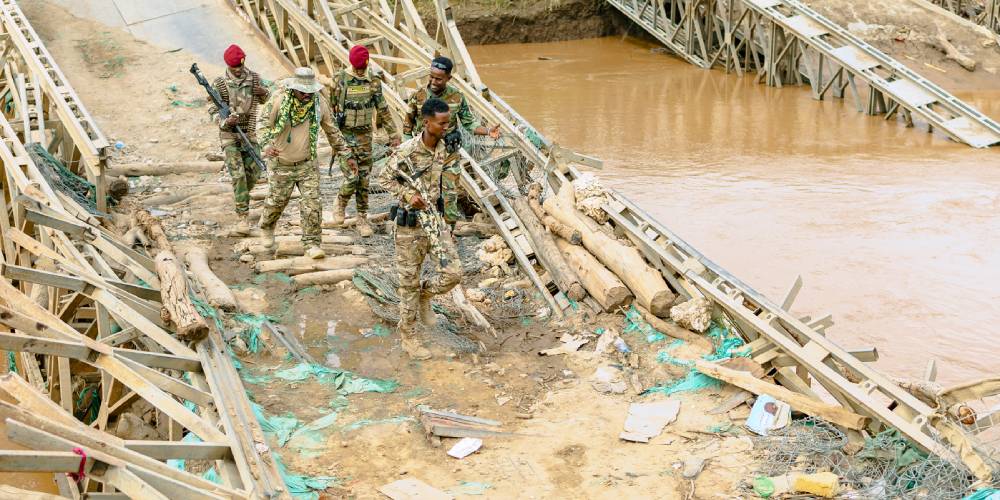
Somali soldiers walk across the Shabelle river on a bridge destroyed by al Shabaab. (Photo: AFP/Tony Karumba)
The United States and other regional and international partners have provided direct military support to Puntland State’s campaign against an Islamic State base in northeastern Somalia. The base is seen as a hub for the terror group’s global financial operations as well as a gateway for funneling foreign jihadists into Somalia and the continent more generally.
Within a fluid and highly complex environment, the key issue to watch in Somalia’s elections is less on the electoral outcome as much as whether the process is seen as sufficiently inclusive that all federal members states will participate. Additional compromise between the FGS and FMS will likely be needed if a potentially violent rupture is to be avoided. Doing so would preserve the country’s federal framework and a basis for cooperation in the fight against al Shabaab and international terrorist networks. Absent this, Somalia is at risk of greater political fragmentation and insecurity over the course of this year.
More on: Democracy and Security