

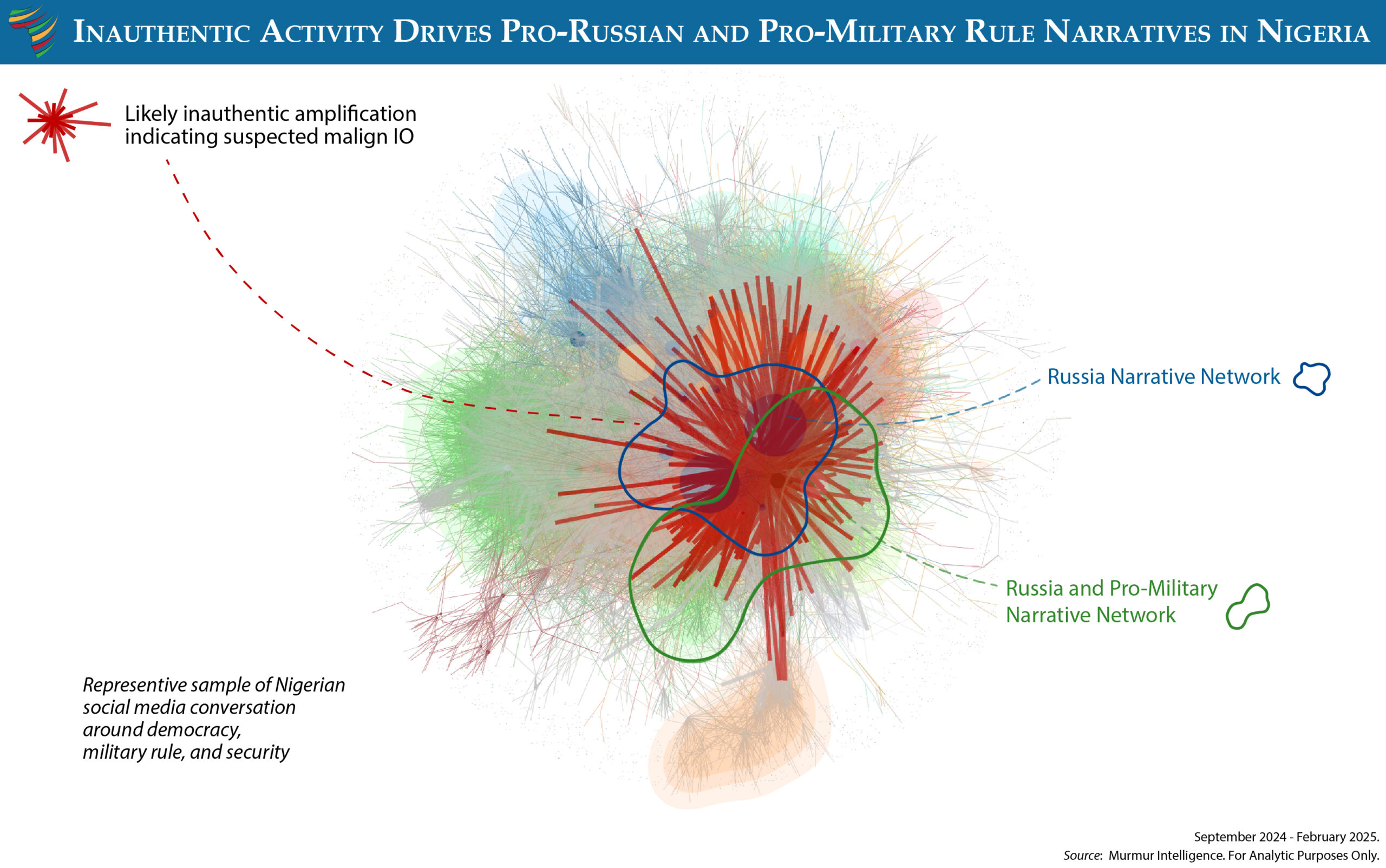
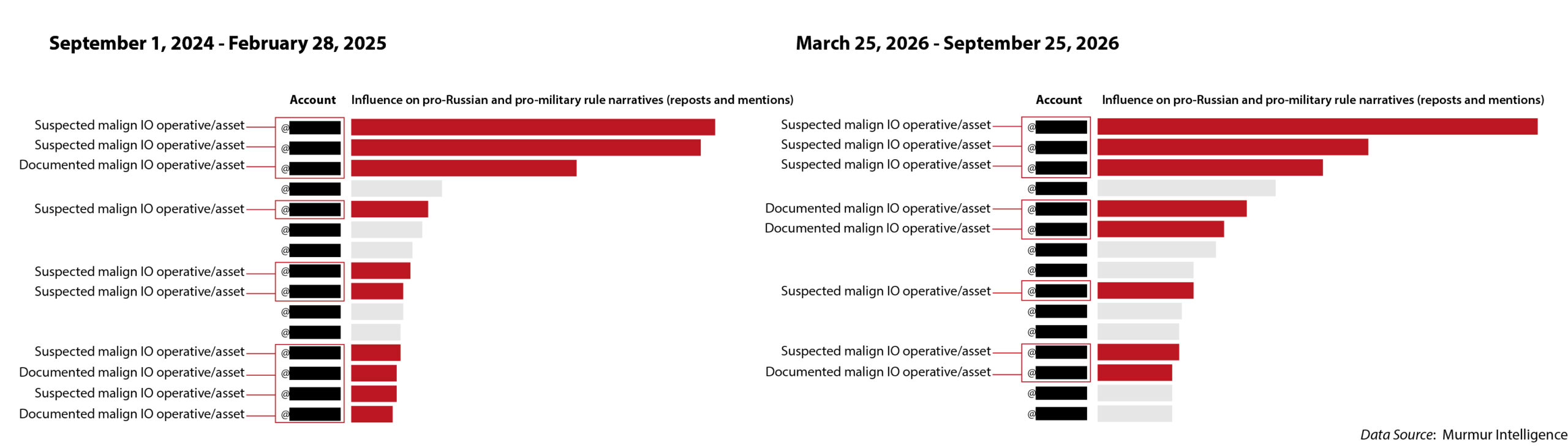
 Network map on Nigerian social media topics shows detected coordinated inauthentic behavior (in red) closely overlaps with accounts spreading pro-Russian narratives and those promoting military-led governance. The accompanying bar charts show the most influential accounts in this conversation across two six-month periods. The leading amplifiers in both periods are documented or suspected malign information-operation assets, illustrating how a relatively small number of coordinated actors can exert disproportionate influence. Over time, however, these narratives are increasingly picked up and shared by authentic accounts. Click the graphics for a full size image.
Nigeria is facing a host of coordinated and deceptive foreign information campaigns intended to shape public perceptions of insecurity, governance, and Nigeria’s regional partnerships.
These trends are particularly rampant across social media platforms in northern Nigeria, where threats from militant Islamist groups and organized criminal gangs are focused. Half of respondents to a survey in Kano State (with a population of 18 million people) believed false claims such as that France was conspiring with the Islamic State and other militant Islamist groups.
Nigeria is facing a host of coordinated and deceptive foreign information campaigns.
Strikingly similar conspiratorial narratives took hold in Mali before its 2020 coup, when nearly 58 percent of survey respondents believed France’s Operation Barkhane was complicit with armed groups. Such narratives were seeded and stoked by pro-Russian networks as Mali’s elected government was deposed by a military junta, opening the door to greater Russian influence.
The barrage of inauthentic content targeting Nigeria frequently portrays the country as chaotic, overrun by violence, and beyond repair through democratic means. An AI-generated Facebook video, for example, falsely depicts Chief of Defence Staff Olufemi Oluyede saying he had “run out of ideas” to combat insecurity. The illustration demonstrates how malign information campaigns can foment distrust in government.
Nigeria may be particularly susceptible to these foreign information-influence campaigns since Nigerians use social media platforms for news more than any other source, and at the highest rate (79 percent) recorded globally. Unsurprisingly, Nigerians also reported the highest global level of concern about fake and misleading information. (By comparison, less than 10 percent of Malians used social media in 2020).
Foreign Actors Actively Subverting Information Integrity in Nigeria
Russia
Russia is the most active foreign actor distorting Nigeria’s information space. This is consistent with the pattern observed across the continent, where Russia has been linked to at least 80 information manipulation campaigns on the continent (70 percent of all identified foreign information influence operations). Often part of a strategy of reflexive control to shape the decision making of a target audience, this information interference takes various forms.
Ghost reporters launder Russian narratives through Nigerian media. A 2026 Graphika–Code for Africa investigation identified 44 ghost reporters and fake experts used to plant Russia-aligned narratives in African media, particularly around terrorism and security, alleged Western support for militants, and praise for Russia, Africa Corps, and the Sahelian military juntas. Nigeria was a significant target: Daily Post Nigeria published 39 articles involving 14 identified ghost authors. Other Nigerian outlets and the Russian Embassy in Nigeria then quoted these fake stories and personas, amplifying their reach. A separate analysis found that in addition to the Sahel and Central African Republic, Russia’s ghost reporters targeted Nigeria, Senegal, and South Africa more than any other African countries.
Generative AI creates local content and fake experts. OpenAI and Meta disrupted a Russia-origin influence network targeting Nigeria and other African countries that used generative AI to create and provide content for fake personas and coordinated social media assets. One such fictitious commentator, “Dr. Manuel Godsin,” was generated from a stolen photograph and fabricated European academic credentials. AI was then used to generate geopolitical commentary for placement in African outlets. Code for Africa subsequently identified 38 pieces attributed to the Dr. Godsin persona that appeared 73 times on at least 27 African websites. Meta removed 37 Facebook accounts and 29 pages posing as local grassroots news sources from the wider Russia-origin network, which also used AI-generated branding and content to appear locally authentic.
OpenAI and Meta disrupted a Russia-origin influence network targeting Nigeria and other African countries that used generative AI to create and provide content for fake personas and coordinated social media assets.
Hijacking the narrative of grievances such as Nigeria’s 2024 cost-of-living protests. Russia-linked actors sought to graft pro-Russian and pro-coup messaging onto the genuine frustrations driving the August 2024 #EndBadGovernance protests. Nigerian investigators found that the Russia-backed “African Initiative” Telegram channel supplied Nigerian influencers with protest content and talking points such as “Putin please come and save Nigeria” and “The army is the answer for Nigeria,” which were then pushed through TikTok and Instagram using Hausa-language hashtags.
Mobilizing domestic influence-for-hire networks to advance geostrategic agenda. Nigerian social media influencers are an attractive target for Russian information operations. Known in Nigeria as “data boys,” these paid influencers can manufacture trends and generate apparent grassroots support.
A Kano influencer with more than 100,000 TikTok followers told investigators that the a Russian-sponsored platform paid him to promote their content. The investigation identified 38 accounts sharing similar pro-Russian and military-takeover narratives during the cost-of-living protests. Russian flags subsequently appeared among protesters in Kano, Kaduna, and Jos. As the investigation’s author Silas Jonathan later explained, the episode illustrates a “chameleonic” information strategy that waits for genuine tension and grievances and then “take[s] the coloration of the situation” to redirect them toward pro-Russian and antidemocratic conclusions.
These Russia-supported influence operations build on earlier campaigns targeting Nigeria.
Establishing an anti-Western bloc across West Africa. Leaked internal documents obtained by The Continent and investigated with Forbidden Stories exposed a Russian influence network operating across 22 countries in Africa. The operation employed nearly 100 political consultants, media specialists, and influence operatives and had a budget of about $7.3 million over 10 months. The internal documents describe an explicit strategy in West Africa to expand the Russia-aligned Alliance of Sahel States into a broader anti-Western bloc. Operatives secretly paid for hundreds of articles, recruited journalists and influencers, cultivated civil-society and youth groups, staged events, and developed country-specific political narratives designed to weaken Western partnerships and normalize closer alignment with Russia.
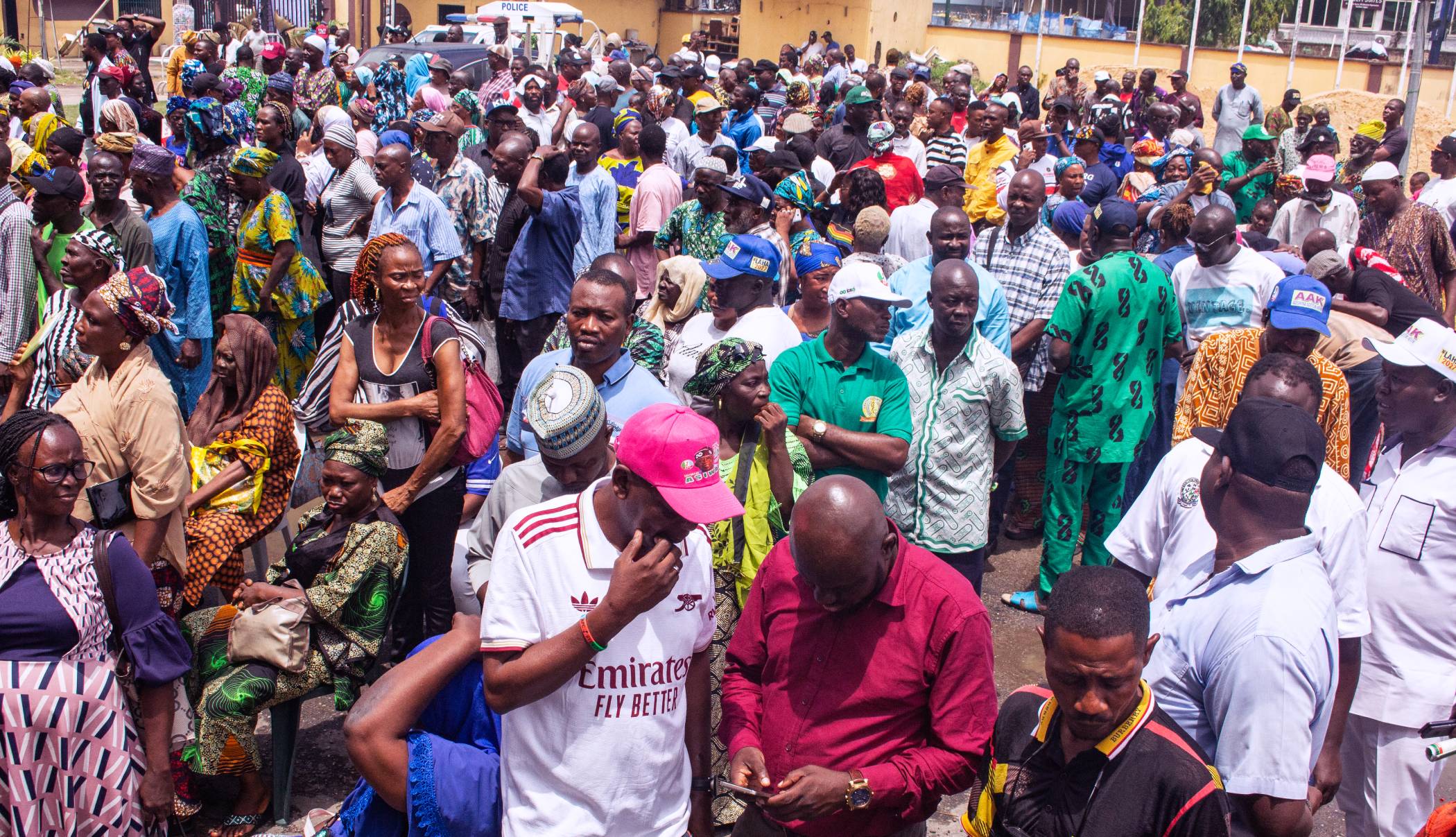
Nigerians wait to vote during a 2026 primary in Lagos State. (Photo: Adekunle Ajayi/NurPhoto via AFP)
Sahelian Military Junta Networks
Targeting Hausa speakers as part of a cross-border influence campaign. The military junta in neighboring Niger has been active in exploiting Hausa-speaking audiences in northern Nigeria. Investigative reporters documented a Nigerien state-media figure touring northern Nigerian newsrooms and radio stations in 2024 to recruit Hausa-speaking journalists into an ostensibly professional network that one participant later described as “a sophisticated plan to form [a cohort of] Hausa journalists who will be promoting the Nigerien junta and anti-Western sentiment across Hausa-speaking countries.”
Nigerian monitors are seeing the same narratives pushed digitally through networks of accounts targeting Hausa speakers with clipped versions of the Nigerien junta leader, General Abdourahamane Tchiani, making unsupported allegations that Nigeria and France are supporting Islamist militants.
Projecting an image of stability and prosperity in the Sahel. AI-generated videos extol military-ruled Burkina Faso as an oasis of stability and prosperity. Meanwhile, across borders, platforms, broadcast media, and local influencers, these Russian-sponsored military junta-themed campaigns seek to conceal the deteriorating security and economic conditions in the Sahel.
China
China has become more aggressive in utilizing inauthentic networks to insert its geopolitical objectives into Nigerian domestic protests and election-related conversations.
Chinese-linked influence systems operate as part of a larger influence ecosystem through state media, paid content, and elite relationships, including China’s United Front. Since 2024, China has become more aggressive in utilizing these networks to insert its geopolitical objectives into Nigerian domestic protests and election-related conversations. These campaigns rely on fake domains, AI-assisted content, and the laundering of official narratives through apparently independent outlets.
Inauthentic digital networks that can rapidly amplify domestic Nigerian controversies. Chinese-linked social media networks with tens of thousands of assets increasingly amplify Chinese government-aligned content, boosting local voices, hashtags, and polarizing opinions to increase their visibility and perceived salience. These networks can rapidly signal-boost organic or fringe content that aligns with Chinese government interests, helping selected narratives appear more prominent and widely shared than they otherwise might be.
China-linked narratives of democratic instability around Nigeria’s protests. Nigeria’s 2024 protests marked a more interventionist Chinese-linked posture in Africa’s domestic information environments. Inauthentic activity targeted protest-related conversations and amplified anti-Western narratives that overlapped with Russian messaging. China-linked networks generally did not champion specific protest demands but instead increased the visibility of unrest and narratives of democratic instability, Western interference, and systemic failure.
The cumulative result of these actors’ malign information operations is an increasingly inauthentic information environment. The sustained manipulation makes it harder for Nigerians to distinguish genuine public debate from manufactured influence, contributing to deepening cynicism, discouraged democratic participation, and increasing receptivity to authoritarian or extremist remedies.
Nigeria’s Information Environment as a Strategic Battleground
Nigeria’s population, economic weight, democratic system, and regional leadership make it an attractive target for foreign authoritarian actors.
Despite obstacles and its flaws, Nigeria has been a constitutional anchor in West Africa since its return to democracy in 1999. Weakening Nigeria—or shifting its orientation toward authoritarian partners—would provide an opening for greater geostrategic influence by Russia and China.
The information operations targeting Nigeria seek to exploit grievances to weaken confidence in elections and democratic institutions, discourage civic participation, intensify social divisions, undermine Nigeria’s regional leadership, and make authoritarian alternatives appear reasonable or inevitable.
The irony is that these actors are promoting the junta-led model of the Sahel in Nigeria—even as security under each of the Sahelian juntas is worsening.
Digital media researcher Maxine Gloria Danso observed, “We’re seeing a deliberate reframing of authoritarianism as modern African resistance … [foreign actors are] channeling [frustrations] into admiration for military regimes.” Another analyst noted that these operations “are creating the conditions under which Nigerian citizens begin to see their own government as the enemy.”
The irony is that these actors are promoting the junta-led model of the Sahel in Nigeria and other coastal West African countries such as Côte d’Ivoire, Ghana, Senegal, and Benin—even as security under each of the Sahelian juntas is worsening.
The stakes for governance, security, and development in Nigeria and West Africa are high. Countries that succumb to coups are subject to years of instability. African countries that avoid coups have made up ground on the United Nations Human Development Index. Those that are coup-prone do not.
Narratives Fostering Disillusionment, Apathy, and Insecurity
Nigeria’s 2027 elections have been a focal point of the broader campaign of foreign information operations. Messages from these campaigns aim to advance the argument that voting is ineffective, while simultaneously hyping fears of instability with the suggestion that only a strongman can solve Nigeria’s problems. Some of the recurring themes include:
- “The election is already rigged.” This election-futility narrative is one of the most consistently identified threats by Nigerian analysts, with voter apathy a central intended effect.
- “Democracy and elections are wasteful.” A common narrative contrasts the financial and institutional costs of elections with low turnout, slow reform, corruption, and insecurity, then presents authoritarian systems as more decisive and less bureaucratic.
- “The Independent National Electoral Commission (INEC) is captured.” Variants observed include claims that “INEC is bought,” “INEC is a Western puppet,” and that the ruling party has the electoral authority “in its pockets.”
- “Civilian democratic institutions cannot protect citizens.” In northern Nigeria especially, analysts are seeing the theme of insecurity used to discredit democratic government and introduce the idea that an alternative political order could better protect communities.
- “Authoritarian rule delivers security and development.” Researchers describe narratives contrasting Nigeria with Burkina Faso, Mali, and Niger and inaccurately claim that the military juntas are delivering roads, schools, hospitals, lower prices, and stronger security—even where observable conditions demonstrate the opposite.
- “Nigeria’s government and ECOWAS are proxies for the West.” Analysts have seen Nigerian officials’ visits to France folded into claims that Nigeria is acting on behalf of Western interests against the Sahelian military juntas. Nigeria is also targeted with anti-ECOWAS messaging that portrays the bloc as an “external actor” rather than a regional African organization.
- “France and Western governments sponsor terrorism.” Journalists have tracked narratives attributing militant attacks to France and that Nigeria is facilitating Western efforts to destabilize the Sahelian military juntas.
This messaging conjures a sense of déjà vu, recalling the same narratives and methods that targeted the democratically oriented governments in Mali, Burkina Faso, and Niger prior to their coups.
Nigeria’s national elections will be a critical stress test of whether Nigeria’s media and fact-checking community can deflect and counter these information distortions while also building resilience for an influence campaign that will likely continue well beyond the election.
How Nigeria is Countering Foreign Information Threats
Nigeria’s greatest advantage against foreign information operations is the breadth and vibrancy of its media and information networks. Like other democracies, its strength lies not in concentrating control over information, but in drawing on independent media, civil society, researchers, technology firms, community voices, and civilian and security institutions with different sources of expertise, audiences, and public trust.
Nigerian government officials, fact-checkers, investigative journalists, election observers, digital-rights groups, researchers, and local leaders are monitoring information manipulation, exposing covert networks, informing audiences, and experimenting with new ways to build resilience. Their response falls broadly into the following categories.
Exposing and Educating. Nigerian journalists, fact-checkers, and researchers are increasingly going beyond debunking false claims to exposing the actors, networks, tactics, and strategic objectives behind foreign manipulation. Illustrations include:
- Code for Africa and partners have mapped covert influence networks and media laundering.
- The Centre for Journalism Innovation and Development (CJID)’s Digital Tech, AI & Information Disorder Analysis Centre (DAIDAC), and Dubawa investigations have exposed Russian-linked recruitment of Nigerian influencers and coordinated pro-coup messaging.
- Africa Check is developing AI-driven narrative mapping, identifying actors targeting northern Nigeria, and sharing findings with newsrooms.
- Several organizations are training journalists in verification, open-source intelligence (OSINT), and detecting AI-enabled manipulation.
- FactCheckAfrica’s “Voices That Count” initiative is equipping social media influencers to recognize manipulated content and share those skills with their own audiences.
The aim of these efforts is both to impose reputational costs on foreign actors purveying false and polarizing messages while inoculating the public by helping Nigerians understand not only what is false, but how and why they are being targeted. This can help puncture false narratives and encourage more grounded, constructive conversations around Nigeria’s real challenges.
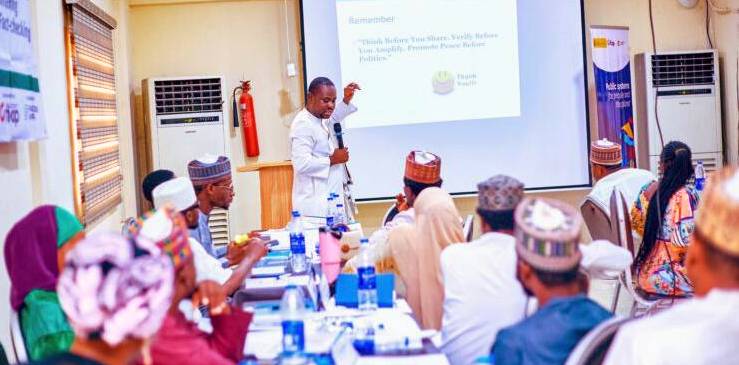
The “Voices That Count” training camp brings together 30 digital creators, content producers, and online communicators from northern Nigeria for training on social media and electoral integrity. (Photo: FakeCheckAfrica)
Fact-Checking and Local Outreach. In Nigeria’s fragmented information space, government officials and professional journalists are increasingly active across formats, languages, and networks. Some examples include:
- Civil-society groups have coordinated the #CheckBeforeYouPost campaign, working with northern Nigerian social media influencers to encourage factchecking and to create election-integrity content.
- DAIDAC and Dubawa are working with northern Nigeria communities on digital literacy and radio stations on programming that addresses democratic participation and election-futility narratives.
Government Information Nerve Centers. Nigeria is also developing stronger government-sponsored nerve centers—centralized analysis, control, and communication points—for detecting and responding to information threats across government ministries and with the public. For example:
- The National Information Technology Development Agency (NITDA) already operates a Situation Room Electoral Accountability Tracker (SEAT) that uses AI-enabled monitoring, incident detection, and escalation channels to share emerging threats with INEC, the Office of the National Security Advisor (ONSA), and other agencies.
- The Centre for Crisis Communication, with backing from NITDA and the Ministry of Information, is developing a broader National Crisis Communication Hub intended to connect government capabilities with journalists, fact-checkers, civil society, and technology partners.
Coordinating and Aligning Across Sectors. A May 2026 “Meeting of Nigerian Regulators on Information Integrity in the Context of the Upcoming Elections” in Lagos brought INEC, NITDA, the National Broadcasting Commission, the National Human Rights Commission, police, cybercrime officials, civil society, and other actors together to develop “joint protocols, rapid-response mechanisms, information-sharing systems, and clearly designated lead agencies … with a shared recognition that no single institution can effectively protect information integrity in isolation.” The work moves Nigeria toward pre-agreed relationships and roles rather than improvised coordination after damaging content spreads.
Nigeria’s security institutions are increasingly treating the information environment as integral to stability and their security obligations to the public.
Raising Security-Sector Awareness and Communication. Nigeria’s security institutions are increasingly treating the information environment as integral to stability and their security obligations to the public. The Army is strengthening engagement with journalists around accurate and professional security reporting, embedding them in selected operations, recognizing that “effective security outcomes should not only be measured by battlefield success but also by public trust and confidence in security institutions.” Military public-affairs offices are also moving quickly to publicly rebut manipulated content, including AI-generated videos attributing false statements to senior commanders.
The role for the security sector in the information space is primarily defensive: to sensitize personnel who are themselves critical targets of pro-coup manipulation, provide strategic threat assessments of foreign actors to senior leaders, close information vacuums through faster credible communication, and cooperate with civilian defenders without subsuming their independent role. Performing threat assessments of the degree to which foreign narratives are penetrating the armed forces will continue be an important priority indicator for Nigeria’s military.
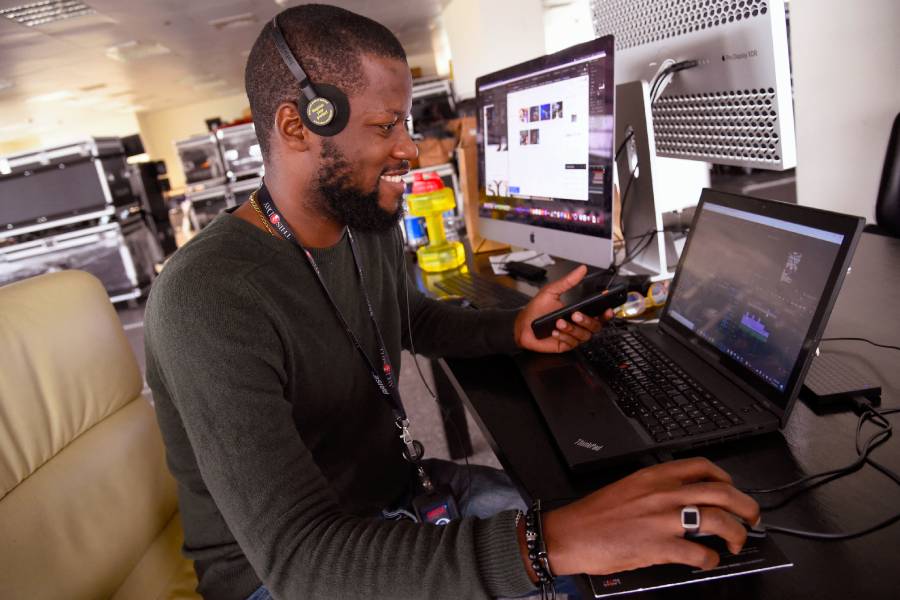
A Nigerian journalist sources for information on the internet in Lagos. (Photo: Pius Ekpei/AFP)
Collaborating, Through Information Networks. Fact-checkers and civic groups are building relationships that allow them to divide the labor requirements, share verification and early-warning information, and amplify one another’s findings rather than respond in silos. The Nigerian Fact-Checking Coalition (NFC) provides one key network. For the August 2026 Osun State election, NFC operated joint situation rooms in Abuja and Lagos, with partners conducting field monitoring in Osun and feeding real-time information back to the coalition.
Building Technical Hubs. Like the NFC situation room, several organizations and public institutions are building monitoring centers that can turn a sprawling information environment into actionable early warning. DAIDAC’s election-monitoring hub is collecting hundreds of narratives through monitors across northern Nigeria, combining online analysis with grassroots listening.
Applying Principles for Protecting an Open Information Environment. Nigeria’s emerging response to foreign information manipulation is being anchored in African-developed principles for protecting information integrity without sacrificing an open information environment. The Praia Model Policy Framework on Information Integrity emphasizes transparency, proportionality, human rights, media and information literacy, and multi-stakeholder cooperation. Nigeria became the first West African country to work through the Praia Policy Framework’s national implementation in detail at the 2026 Lagos Meeting of Nigerian Regulators.
Scaling the Counterpunch of Nigeria’s Resilience Ecosystem
Nigeria’s information space has undergone a revolution, creating arguably one of the world’s most highly digitalized and social-media-driven news environments. The rapid shift in citizens’ information sources toward social media, combined with the emergence of generative AI, enables foreign information operations to produce articles, posts, images, audio, and video at near-zero marginal cost while reaching millions of users in seconds.
This has fostered an asymmetric environment in which credible institutions continue to work carefully and sequentially, while malign actors operate continuously, subversively, experimentally, and at scale. Building on ongoing governmental, media, fact-checking, and civil society efforts to counter foreign information operations, the priority is to harmonize and reinforce these complementary institutional capabilities, to scale up and force multiply—while preserving the independence and trust that make them effective. Several overarching guidelines can amplify the dividends from these efforts.
Nigeria’s information defenders will need to become better connected while remaining decentralized. A dispersed information integrity ecosystem is a strength but requires faster information sharing, clearer coordination mechanisms, and a stronger ethos of collaboration to avoid gaps and allow complementary capabilities to reinforce one another. Regular in-person convenings can help build the trust needed for durable information-integrity communities, partnerships, and joint initiatives.
Draw from Ghana and Côte d’Ivoire’s models. Ghana’s coalition-based approach shows the value of linking fact-checkers, media, election observers, researchers, and civic organizations around shared goals. Côte d’Ivoire’s preparations for its 2025 election, including efforts by government and civil society, demonstrate how well-prepared organizations can monitor emerging narratives, produce timely analysis, and connect that analysis to public communication and institutional response. Both underscore that effective coalitions need more than membership lists: they require trust, clear roles, and a practical link between analysis and action.
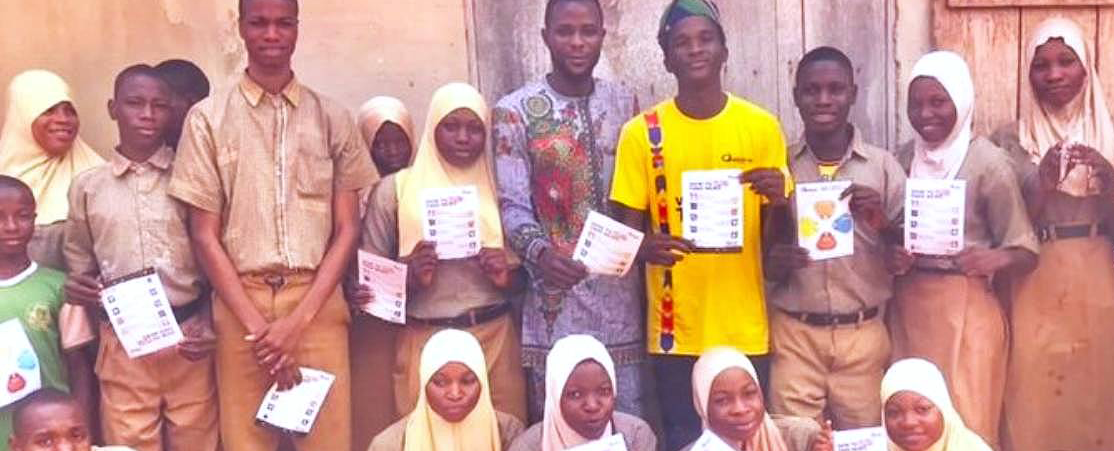
A social media literacy training in Osun State teaches participants how to identify manipulated images and verify visual content online. (Photo: Dubawa)
Information integrity defenders will need bigger and better calibrated megaphones. Foreign information manipulation operations can reach millions of Nigerians, while fact-checks, investigations, and policy reports often reach much narrower audiences. Closing that gap will require investing in new media—particularly video creators, who “perform a public service comparable to traditional journalism.” Conducting audience research can deepen understanding of which communities are most exposed to foreign influence and what actually persuades them. This can improve the efficiency and reach of efforts to counter foreign influence operations. The objective is not simply to correct individual falsehoods, but to compete more effectively over the larger narratives and information norms shaping how Nigerians interpret governance, democracy, security, and the country’s direction.
Foreign efforts to covertly manipulate Nigerian audiences have become more than a communications nuisance but have evolved into a form of political subversion.
Increase the reputational cost for foreign sponsors of information manipulation. Foreign efforts to covertly manipulate Nigerian audiences have become more than a communications nuisance but have evolved into a form of political subversion. Research on responses to Russian influence operations suggests that the strongest results are generated when governments credibly expose the foreign actor with evidence, state what was at stake, and demonstrate that covert interference would carry reputational and political costs.
Additional Resources
- Graphika, “Umbrae Ex Machina: Mapping Russian Ghostwriting Operations Across African News Outlets,” Graphika, August 25, 2026.
- Joseph Siegle, “Russia’s New Frontier in Africa,” Spotlight, Africa Center for Strategic Studies, July 8, 2026.
- Aliyu Dahiru, “Nigeria Is Facing an Information War in Its Own Language,” HumAngle, May 25, 2026.
- Forbidden Stories, “Propaganda Machine: Secret Documents Reveal Russia’s Foreign Influence Strategy across Three Continents,” February 14, 2026.
- Africa Center for Strategic Studies, “A Growing Divergence of Security Narratives in Burkina Faso,” Spotlight, August 26, 2025.
- Silas Jonathan, “‘Sexyfying’ Strongmen: How TikTok Influencers Are Using AI Disinformation and Propaganda to Undermine Democracy and Glorify Authoritarianism,” DAIDAC, May 5, 2025.
- Africa Center for Strategic Studies, “Mapping a Surge of Disinformation in Africa,” Infographic, March 13, 2024.
- Paul Nantulya, “China’s United Front Strategy in Africa,” Spotlight, Africa Center for Strategic Studies, September 5, 2023.
- Africa Center for Strategic Studies, “China’s Influence on African Media,” Spotlight, May 12, 2023.