

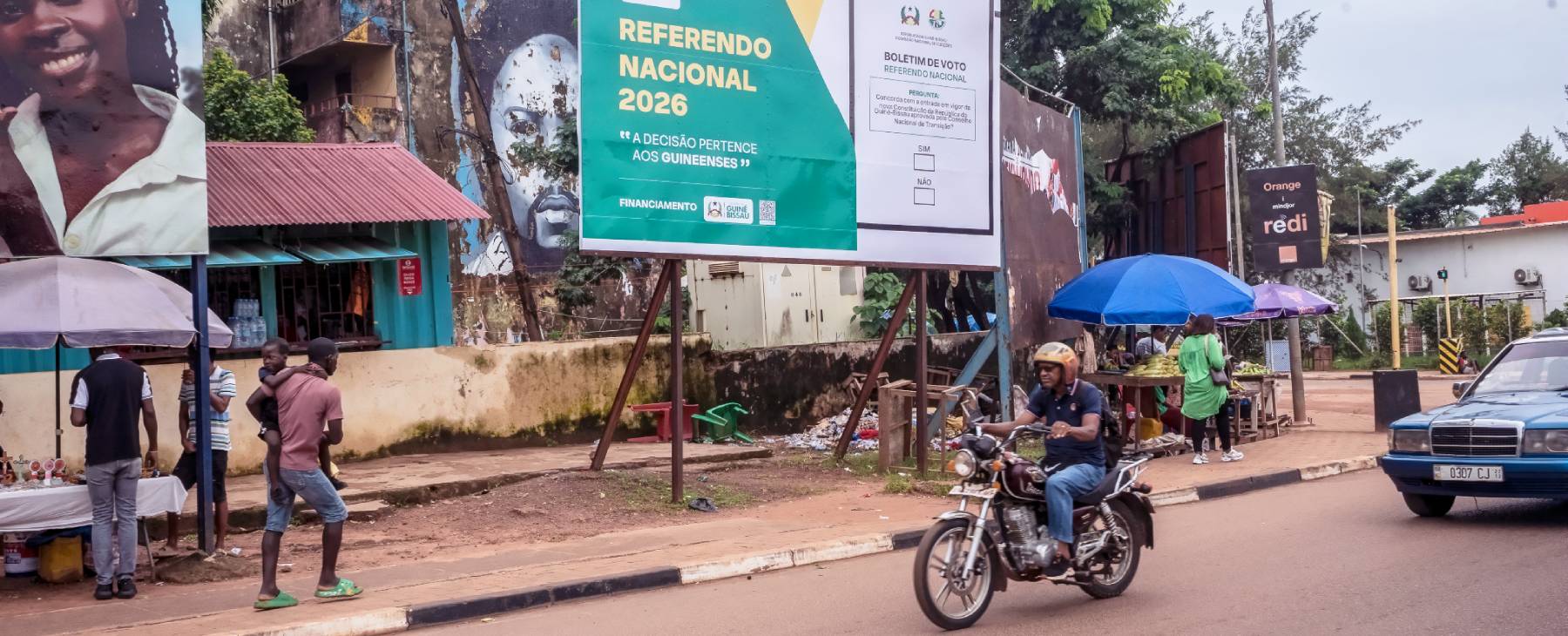
A campaign billboard calling to vote in a referendum in Antula, near Bissau. (Photo: AFP/Samba Balde)
Guinea-Bissau’s military junta is organizing a constitutional referendum on August 30, 2026, intended to lay the legal framework for planned elections in December. Guinea-Bissau’s political trajectory has been shrouded in confusion following a military coup led by Defense Chief of Staff, General Horta Inta-A Na Man, on November 26, 2025. The coup, the country’s fifth since 1980, perpetuates the country’s long history of political instability.
This instability overshadows persistent reform efforts by civil society and some political leaders in previous years to enhance greater power sharing, transparency, and the separation of civil and military authorities. The following highlights the significance and longer-term implications of the referendum.
Why is this constitutional referendum being held now?
The referendum is being held to validate a new constitution created by the military junta following the November 2025 coup that occurred as the National Electoral Commission was counting ballots from the country’s last presidential election. The military subsequently destroyed ballots and detained opposition political leaders. The referendum is part of a transition process outlined by the junta leading to planned elections in December 2026.
What changes are proposed under the constitutional referendum?
The proposed constitution aims to consolidate power within the office of the president.
The proposed constitution aims to consolidate power within the office of the president. This would replace Guinea-Bissau’s semi-presidential system where power is shared by the president, who serves as head of state, and the prime minister, who is the head of government leading the cabinet and administering the country’s day-to-day affairs. Under the semi-presidential system, the prime minister is elected by the national parliament.
The proposed constitution includes a decrease in the number of parliamentary seats and districts from 102 to 65 and 29 to 12, respectively.
The new constitution also increases the hurdle for contesting elections. Presidential candidates would need to make a financial deposit of 50 million CFA francs (approximately $90,000). Parties sponsoring candidates would need to secure 5,000 members, with a minimum of 300 members per region.
Why is this significant?
Guinea-Bissau has long tried to move away from the overconcentration of power in the presidency. This led to the adoption of the semi-presidential system in the 1993 constitution. This power-sharing arrangement was in response to the 19-year rule of President João Bernardo Vieira, who concentrated authority within the executive, facilitating abuses of power and impunity. This concentration of power included the politicization of the military, which has contributed to the military’s frequent interventions into Guinea-Bissau’s politics.
Guinea-Bissau has long tried to move away from the overconcentration of power in the presidency.
A central feature of the 2023 parliamentary elections was a series of constitutional reforms intended to further clarify the powers between the president and prime minister and limit turf rivalries between the two offices. The proponents of these reforms won a 54-48 majority in parliament, validating the power-sharing arrangement. However, then-President Umaro Sissoco Embaló, a former brigadier general in the national army, resisted recognizing this separation of powers.
Instead, Embaló dissolved parliament multiple times, selected his own prime minister, and created a shadow cabinet of presidential advisors, comprised of former ministers and security officials with close ties to the military and police. Embaló subsequently postponed planned presidential elections for December 2024 until the following year.
Given the close relationship between General Na Man and Embaló, many independent observers are concerned that the referendum and new elections may be an attempt to restore Embaló to the presidency. At the least, it will further perpetuate the blurry lines of authority between the presidency and the military.
Institutionalizing oversight of political power and civil-military relations are central issues in Guinea-Bissau given the long legacy of coups, state corruption, narcotics trafficking linked to senior government and military officials, and political violence.
Who is administering the referendum?
The military junta replaced the National Electoral Commission (NEC) leadership responsible for overseeing elections in February 2026 and created a new secretariat. The Commission is now under the leadership of Supreme Court Judge Carmen Isaura Lobo. Critics deem the selection of a new NEC leadership and the establishment of a new secretariat illegal and view it as an effort to undermine the electoral process.
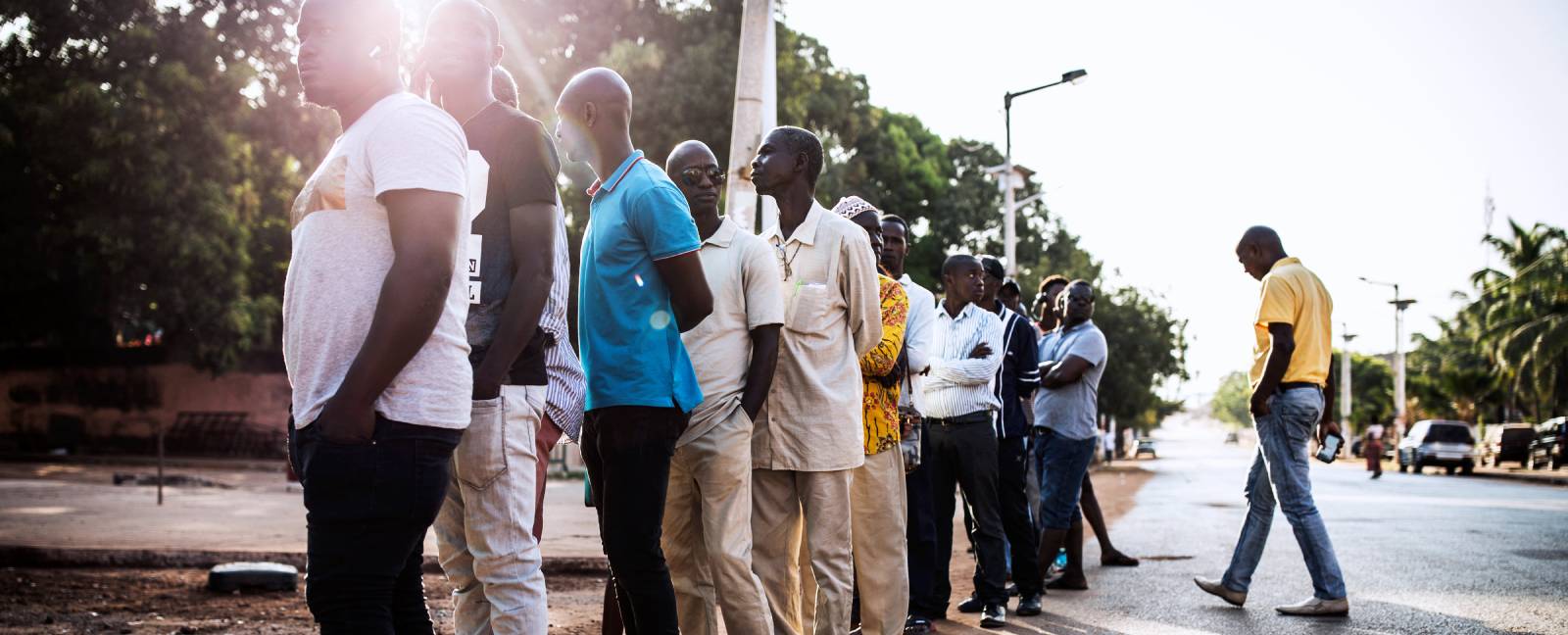
People wait outside a polling station as part of presidential elections in Guinea-Bissau. (Photo: AFP)
The military government has also replaced the leadership of the Superior Military Court due to their opposition to criminalizing the leadership of the largest opposition party.
Despite its long legacy of political instability, Guinea-Bissau has a track record of relatively competitive elections and alternations of power. This has been largely due to the professional composition of the NEC. The NEC executive secretariat was comprised of magistrates nominated from the Superior Council of the Judiciary and elected by two-thirds of parliament for a 4-year term. The dissolutions of parliament, however, have prevented the filling of vacant posts, which was used as a justification by the junta for its dismissal of the NEC.
What space exists for opposition political parties?
Political space remains limited since the coup, with demonstrations and strikes prohibited. Political activities are banned, opposition party headquarters are closed, and the Constitutional Court is suspended. Independent media have been restricted since the coup and journalists have faced increased intimidation.
A nationwide demonstration in December 2025 calling for the restoration of constitutional government was blocked by the military. The leader of the demonstration, Vigário Luís Balanta, president of the revolutionary movement “Pó di Terra,” was kidnapped and found dead 4 months later.
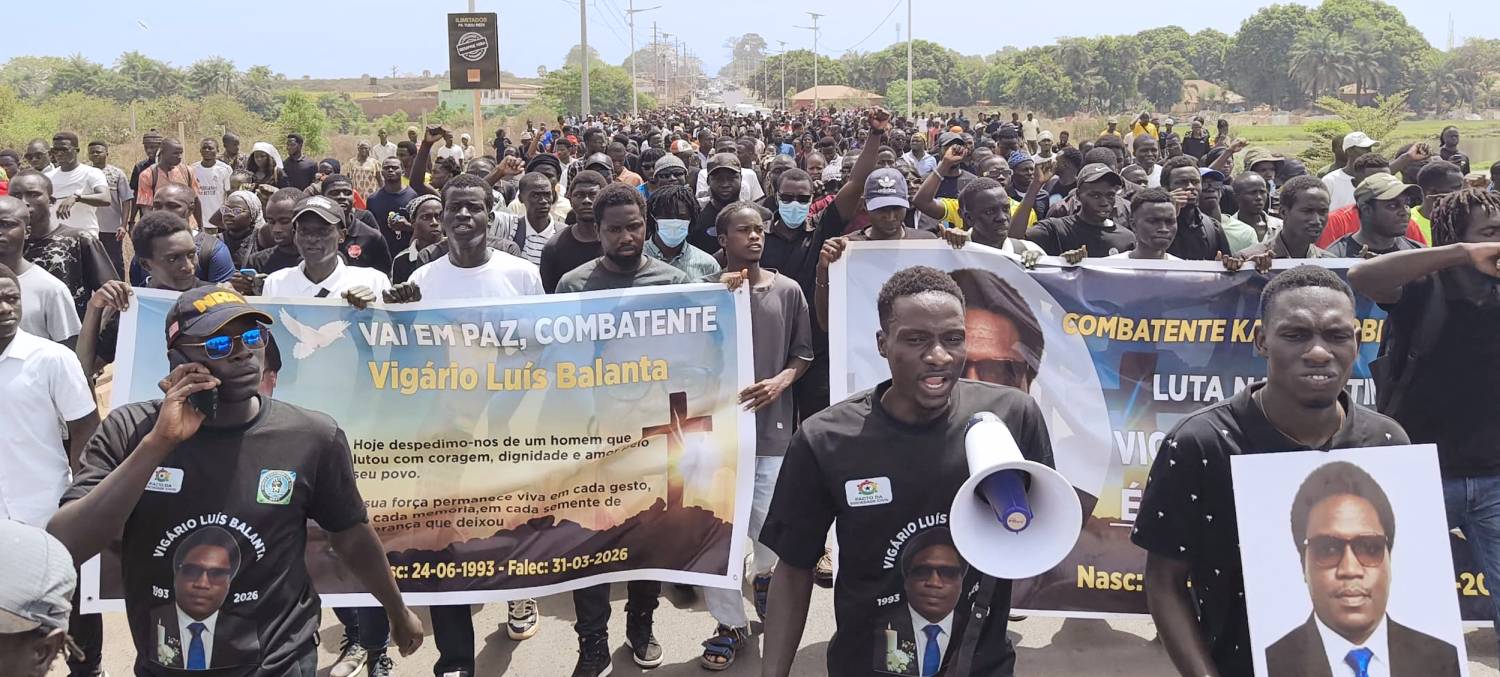
Demonstrators march in Bissau, April 2, 2026, to demand justice after civil society activist Vigario Luis Balanta was found dead. (Photo: Mussa Djassi)
The most prominent opposition figure is Domingos Simões Pereira, the prime minister before the dissolution of parliament and the leader of the Partido Africano para a Independência da Guiné e Cabo Verde (PAIGC). He was put in pre-trial detention in July 2026 by a military court and is charged with allegedly financially aiding ostensible coup attempts in 2023 and October 2025. Pereira was prevented from contending in the elections in November 2025.
Civil society organizations issued an open letter condemning the creation of a new constitution under the military junta.
Members of a coalition of opposition parties, Plataforma Aliança Inclusiva–Terra Ranka (PAI-TR), have criticized the Economic Community of West African States (ECOWAS) and other regional bodies for failing to impose sanctions on the junta and others who have interfered in the process of restoring constitutional norms.
A group of civil society organizations issued an open letter rejecting and condemning the creation of a new constitution under the military junta. The letter called for any revisions to the constitution to take place through normal political processes.
What are the referendum’s potential geostrategic implications?
Speculation largely revolves around Russia. Moscow increased its engagement in Guinea-Bissau under Embaló’s leadership from 2020 to 2025, and he was one of the handful of African leaders who attended the 2023 Russia-Africa Summit. This follows a pattern of Russia gaining more influence in Francophone and Lusophone West Africa by supporting coups and other unconstitutional claims on power.
In February 2025, Russian President Vladimir Putin and Embaló signed an agreement to expand exploration of Guinea-Bissau’s natural resources. The Russian aluminum company Rusal has a significant bauxite concession in Guinea-Bissau. Russia has also promised to expand its military cooperation and training of military officers.
Additional Resources
- Mehdi Ba and Claire Rainfroy, “Guinée-Bissau : comment la junte verrouille les élections de décembre 2026,” Jeune Afrique, July 9, 2026.
- DW, “Guinea-Bissau sets constitutional referendum for August,” July 6, 2026.
- Antonio Cascais, “Guinea-Bissau on Edge after Activist’s Killing,” DW, April 9, 2026.
- Joseph Siegle and Hany Wahila, “Africa’s Elections 2025: A Test of Credibility to Uphold Democratic Norms,” Spotlight, Africa Center for Strategic Studies, January 13, 2025 (updated on December 22, 2025).
More on: Africa’s Crisis of Coups