

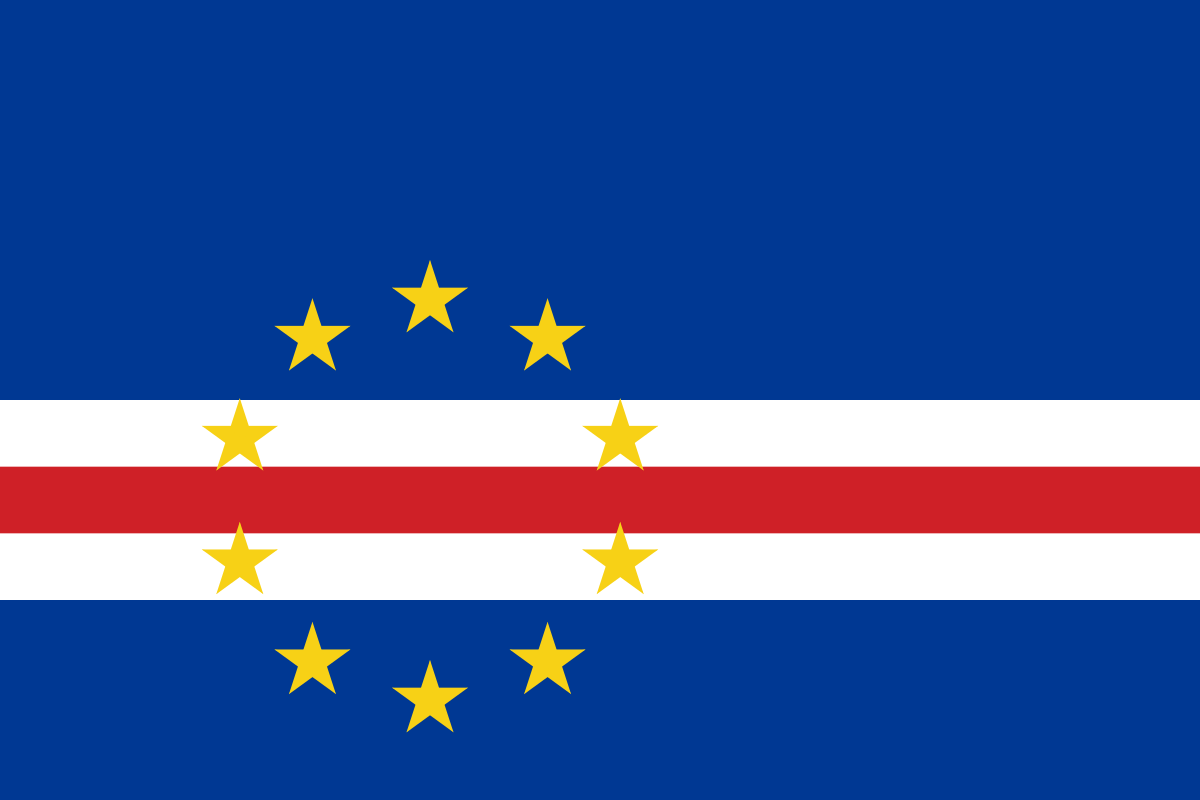
 Cabo Verde: Power Sharing that Delivers Stability and Prosperity
Presidential & Legislative Elections, May 17 & November 15
Elections in the 10-island archipelago of half a million people are expected to maintain a high standard of transparency and electoral integrity. With a history of free and fair elections, Cabo Verde consistently ranks as Africa’s most democratic country in Freedom House’s annual Freedom in the World survey. It has alternated power between the two leading and evenly balanced political parties: the Movimento para a Democracia (MpD) and the Partido Africano da Independência de Cabo Verde (PAICV) since it transitioned to a multiparty system in 1991.
The country’s legacy of independent institutions provides a solid foundation from which to conduct elections.
Cabo Verde’s hybrid presidential and parliamentary model shares executive responsibilities. The directly elected president serves as commander-in-chief, oversees legislative process with veto authority, and serves as a mediator in reaching consensus. The prime minister, who is selected by the National Assembly, acts as the head of government, implementing policy and leading the country’s day-to-day functions. The power-sharing model depends on cooperative relations between the respective executive authorities. Currently, these positions are held by different parties, reflecting the political balance within Cabo Verde’s polity. President José Maria Neves is from the PAICV, and Prime Minister Ulisses Correia e Silva is with the MpD.
Neither party has yet put forward its candidate for the October presidential polls. In 2021, Neves won with 52 percent of the vote. The MpD has confirmed that Prime Minister Silva will again lead their legislative slate of candidates into the parliamentary elections in April. The MpD controls 36 of the National Assembly’s 72 seats, while the PAICV holds 29. The results of the respective elections will determine whether the country will continue the shared governance arrangement or if one party will control both executive roles.
The country’s legacy of independent institutions provides a solid foundation from which to conduct elections. The Comissão Nacional de Eleições has proactively employed measures to ensure the accuracy of information and counter false claims ahead of the elections via a social media-focused electoral information verification unit. The judiciary is widely viewed as independent, facilitating the unbiased consideration of any electoral appeals by candidates. Judges to the nine-member Supreme Court are selected by three separate mechanisms—the president of the country, the National Assembly, and the Supreme Council of Magistrates—fostering judicial autonomy. Journalists can cover the candidates and issues without intimidation ahead of the elections.
Cabo Verde’s economy has grown robustly in recent years, with annual economic growth of 7.2 percent in the past year. Annual per capita incomes of $4,475 are among the highest on the continent, with tourism accounting for roughly 20 percent of the country’s gross domestic product.
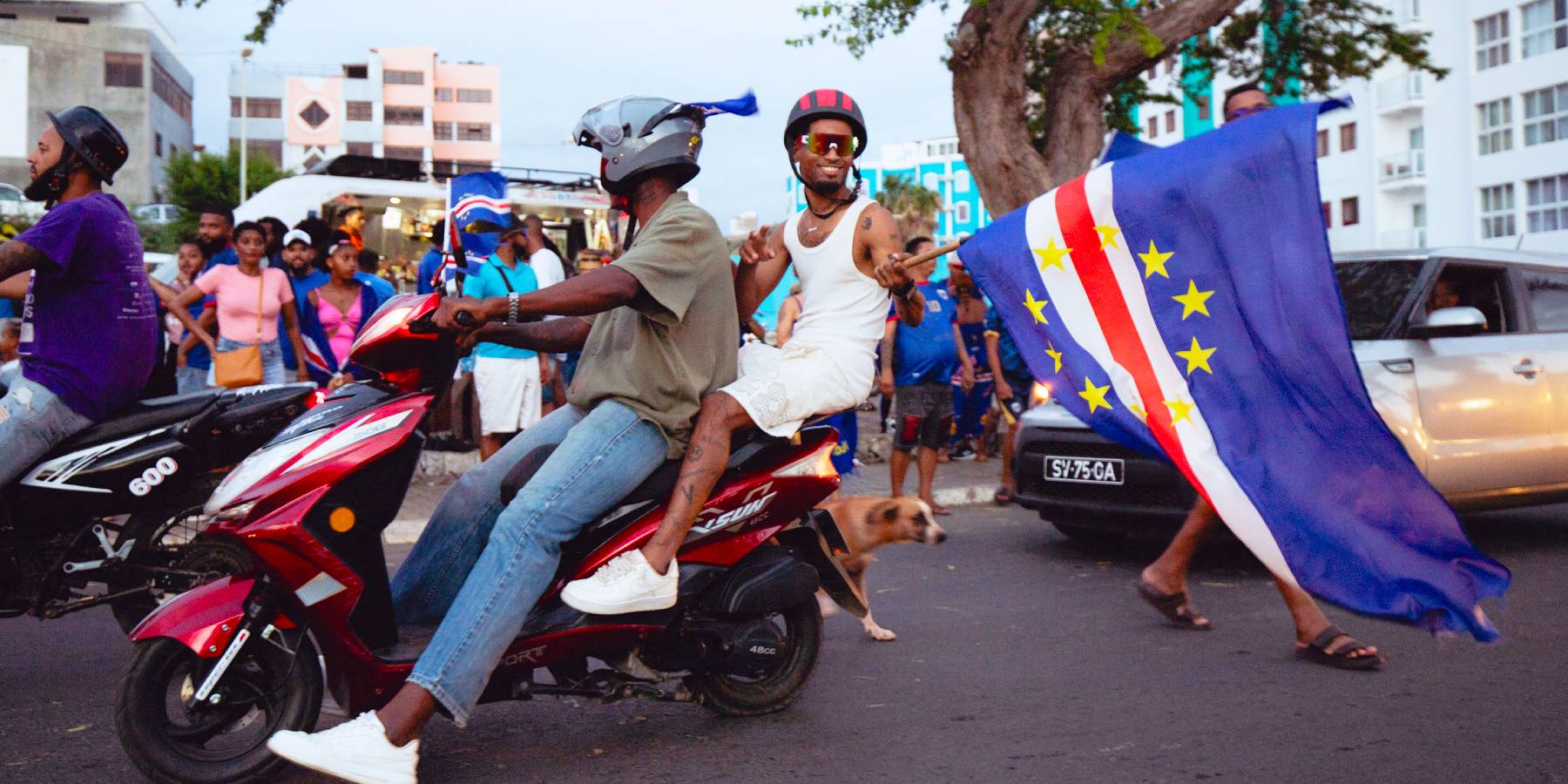
A citizen waves a Cabo Verde flag in São Vicente, October 2025. (Photo: AFP/Queila Fernandes)
Sitting off the coast of West Africa on a major maritime trade route between Latin America and Europe, Cabo Verde faces a variety of maritime security challenges, however. It is exposed to transnational organized crime, with its ports used for the illicit entry of arms, finances, and drugs. The archipelago is also a target destination for African migrants seeking to transit to Europe.
Cabo Verde is an active member of the Yaoundé Protocol, the maritime security mechanism coordinating 25 Central and West African governments’ efforts to combat illicit trafficking and piracy in the Gulf of Guinea. It hosts the Multinational Maritime Coordination Center for Zone G (including The Gambia, Guinea-Bissau, and Senegal) and conducts joint patrols in its zone.
Cabo Verde’s election is on track to extend its stable, power-sharing model of governance, which blends transparency, competitiveness, and accountability—pillars that have contributed to its economic prosperity and security.
More on: Democracy and Security