

 Benin: Rebuilding Democratic Norms Has Far Reaching Regional Implications
Presidential and Legislative Elections: April 12
The 2026 presidential election in this coastal West African country of 14.5 million people holds significance not only for its democratic trajectory but also for its governance and security implications for all of West Africa.
President Patrice Talon is stepping down following the completion of his second, and constitutionally limited, term. This is significant given the growing propensity for African incumbents to extend their tenures in office. Talon’s decision to step down was not assured, as he had regularly pursued constitutional amendments to circumvent legal restrictions barring a third term. That he feels compelled to pass the torch speaks to a measure of enduring restraints on the head of state within Benin’s political space.
Talon’s legacy of consolidating power in the executive will be a challenge to democratic checks and balances in Benin for some time to come.
Nonetheless, the election will be a further test of Benin’s democratic resiliency. During his tenure, Benin’s most wealthy man turned politician has systematically restricted political participation in this country that had championed West Africa’s shift toward democracy in the early 1990s. Restrictions include exorbitant party registration fees, a “certificate of conformity” that allows the ruling party to exclude selective parties, the use of a special court to prosecute terrorism crimes to try political opponents and journalists, and requirements that political candidates gain the endorsement of members of the National Assembly (dominated by Talon supporters due to such barriers). These measures have severely curtailed opposition representation in the National Assembly since 2019 and handicapped aspiring national political contenders.
Further restrictions enacted under the December 2025 constitution required opposition parties to secure at least 20 percent of the vote in every electoral district. This resulted in the largest opposition party, Les Democrats, forfeiting its 28 seats in the 109-member parliament following the January 2026 parliamentary elections.
Given these barriers to opposition party participation, the 2026 contest begins with a tilted playing field. The Constitutional Court has approved only two candidates to contest the April presidential election. Romuald Wadagni will be representing the ruling coalition of the Bloc républicain (BR) and the Union progressiste le renouveau (UPR). The 49-year-old former Minister of Economy and Finance has been a leading actor in the Talon administration. With a background in the private sector, Wadagni is credited with contributing to government policies that have helped Benin realize steady economic growth while maintaining the country’s sovereign credit rating. Real per capita incomes in Benin have increased by 27 percent over the past 10 years, and infant mortality rates have declined by 25 percent, to 46 per 1,000 births.
Paul Hounkpè, who leads the Forces cauris pour un Bénin émergent (FCBE) party, is slated to be the sole opposition candidate. Hounkpè was the Minister of Culture under former President Boni Yayi. He was his party’s vice-presidential candidate during the tightly restricted 2021 presidential elections. He is also the former mayor of Bopa.
The most notable electoral storyline, however, is of a candidate who will not be on the ballot.
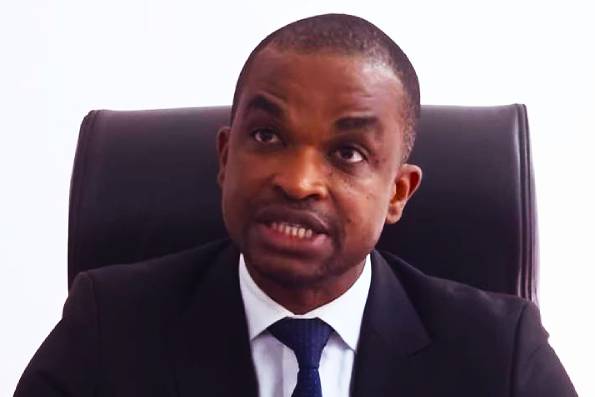
Renaud Agbodjo (Image: screen capture)
The most notable electoral storyline, however, is of a candidate who will not be on the ballot. Renaud Agbodjo, the leader of Benin’s largest opposition party, Les Démocrates, was barred from competing by the Constitutional Court on one of the Talon-era technicalities that he did not obtain a sufficient number of endorsements from members of parliament. Agbodjo was seen as a formidable opponent with considerable name recognition from having defended high-profile opposition politicians, including the former party leader Thomas Boni Yayi, who faced arrests on what are widely seen as politically motivated charges.
While 2026 will see the inauguration of a new president, Talon’s legacy of consolidating power in the executive will be a challenge to democratic checks and balances in Benin for some time to come. As part of a package of constitutional amendments and revisions to the electoral code, presidential terms have been extended from 5 to 7 years, a senate will be established of which some members will be appointed by the president, and the minimum threshold for party participation in the National Assembly has been increased to 20 percent—making it even harder for opposition parties to gain representation.
The stakes of Benin’s 2026 election were soberly punctuated by an attempted coup by a group of mid-level military officers led by Lieutenant Colonel Pascal Tigri on December 7, 2025. Several people were killed in the attempt, and the coup plotters temporarily gained control of the national television and radio stations before being apprehended or chased away by loyalist troops with support from Economic Community of West African States (ECOWAS) forces, including the Nigerian Air Force and special forces from Côte d’Ivoire. The prospect of a return to military government in Benin recalls the 18-year repressive and economically stagnant era of Mathieu Kérékou, which spawned Benin’s democracy movement in the early 1990s.
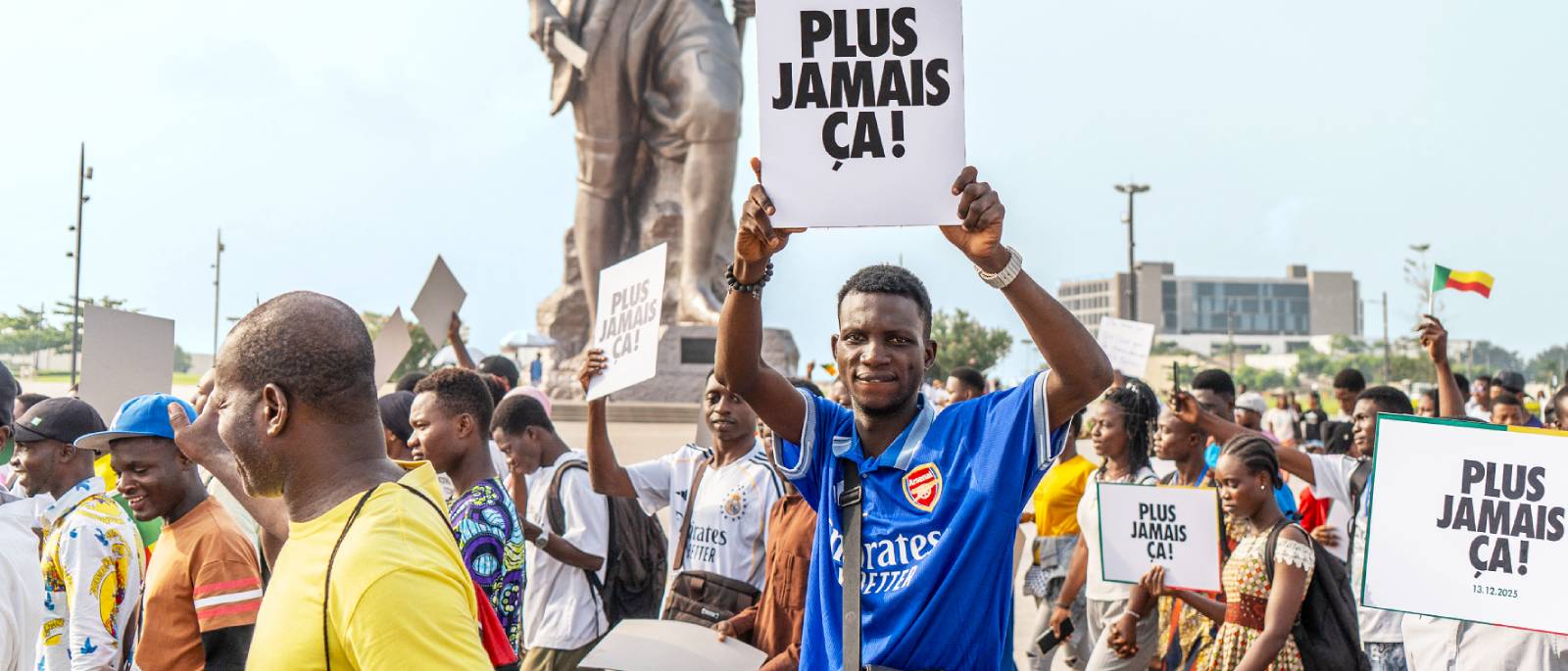
Young people hold placards with slogans such as “Never Again” at a rally decrying the country’s abortive coup and call for the preservation of democracy on December 13, 2025. (Photo: AFP)
The coup attempt has far-reaching regional implications. The rollback of the attempted putsch was a welcome respite for ECOWAS, given that 5 of the West African regional bloc’s 15 member states have succumbed to coups since 2020. At the same time, the revelation that the coup plotters may have been aided by the military juntas in neighboring Niger and Burkina Faso reflects an apparent effort on the part of the Sahelian juntas to normalize military takeovers within the West African region.
The attempted coup in Benin follows a sustained, Russian-sponsored information operation that disseminates baseless claims of progress by the Sahelian military juntas to foster disillusionment within the coastal West African democracies. The messaging campaigns are paradoxical, given the deteriorating security, economic, and political environment in each of the three junta-led countries—and the tangible risk that Bamako and Ouagadougou could fall to jihadists. The cult-of-personality surrounding Burkina Faso’s junta leader, Ibrahim Traoré, is the exemplar of these campaigns.
Installing a military government in Benin would also provide the military juntas in landlocked Niger and Burkina Faso greater access and control of key transport arteries to the coast.
Another threat emanating from Benin’s Sahelian neighbors is the spillover of militant Islamist groups into northern Benin in recent years. There have been an estimated 375 fatalities linked to these groups in northern Benin over the past year. The most active of these militant groups is believed to be the Katiba Hanifa faction of the JNIM coalition, which has attempted to gain a foothold by promoting divisive intercommunal messages, extortion, and illicit trafficking of wildlife and forest products from the W and Pendjari National Parks along Benin’s northern borders.
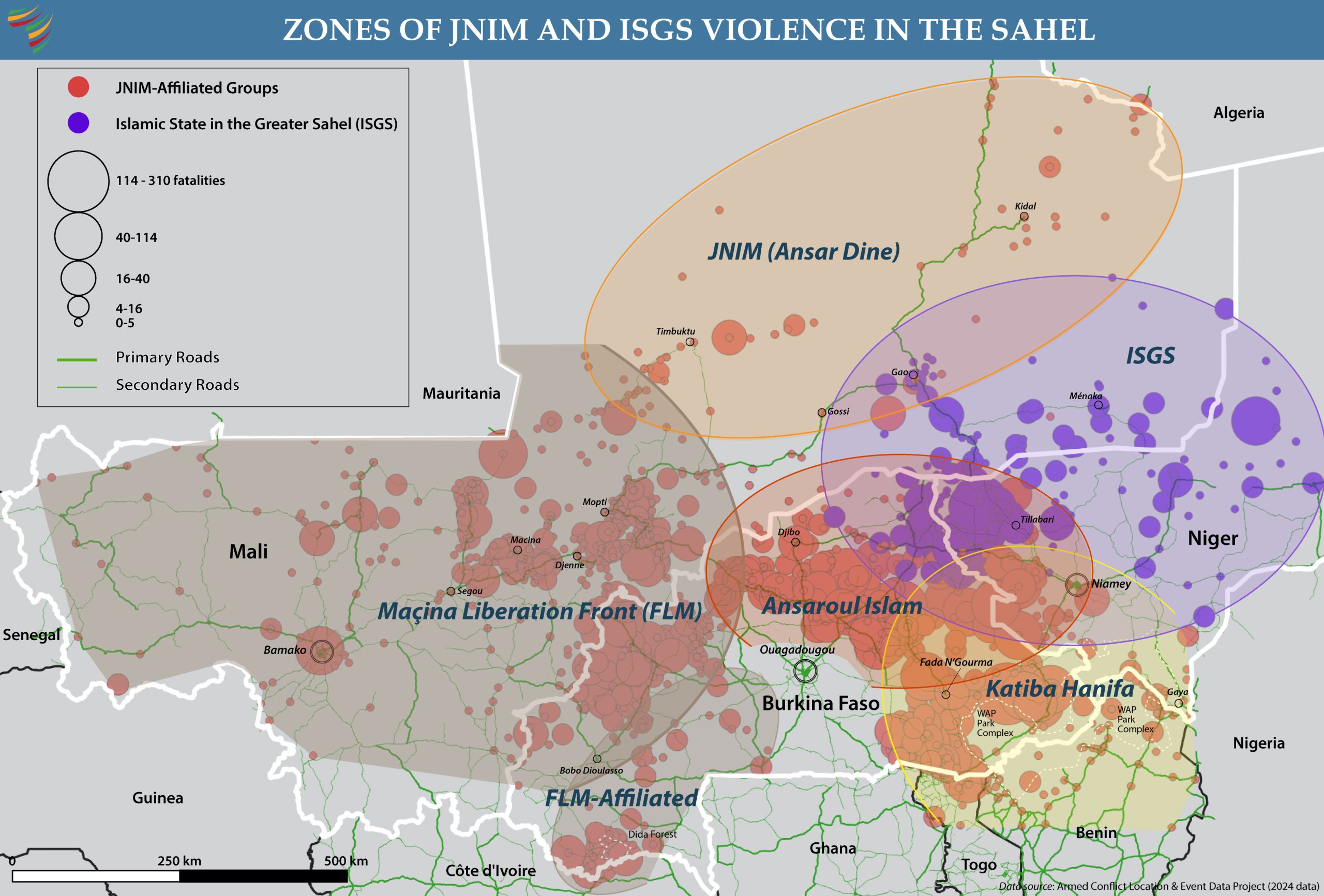
Zones of militant Islamist violence in the Sahel.
Click on image for expanded view.
Mobilizing to respond to this violence has been a major focus of the Benin government and military. Preventing the spread of this security threat further south and stabilizing northern Benin will be a central priority for whoever wins the 2026 presidential contest. The credibility of the electoral process and the degree of legitimacy it garners the winning candidate will be integral to mobilizing and sustaining popular support needed to effectively combat the militant threat.
Despite Benin being one of the smallest countries in ECOWAS, its 2026 presidential election will be a bellwether for the region—shaping not only Benin’s democratic trajectory but also the reach of politicized militaries in coastal West Africa, the momentum of the militant Islamist threat, and the influence of Russia in further undermining the region’s democratic governments to enhance its influence on the continent.
More on: Democracy and Security