


Radar and automatic identification system (AIS) in Madagascar enable operators to monitor the nautical and tactical situation of the marine environment in the region. (Photo: Themys)
With its expansive territory and 1.5 billion people, Africa’s security landscape is characterized by great diversity and complexity. Violent extremist groups are spreading across the Sahel, with Burkina Faso, Mali, and Niger accounting for over 40 percent of the nearly 24,000 annual terrorism-related deaths in Africa. Similar threats persist in the Lake Chad Basin, Somalia, and northern Mozambique. The escalating speed with which these violent extremist actors can access and deploy new technology, including weaponized drones, is reshaping Africa’s security environment.
Africa also plays an increasingly critical role in the international security architecture. Threats to African maritime shipping lanes, including the Bab al Mandab Strait connecting the Red Sea with the Indian Ocean, have strained international supply chains. The continent, similarly, faces a host of transnational threats including organized crime, cyberattacks, and arms trafficking that imperil government authority and regional stability.
Security threats evolve faster than traditional acquisition cycles.
Responding effectively to this diverse and evolving threat environment requires African armed forces that are agile, technologically enabled, and adaptable to rapidly changing operational demands. Yet, Africa’s procurement systems are often misaligned to generate the weapons, logistical, and communications systems needed to defeat these evolving and often irregular security threats. Slow procurement processes, moreover, inhibit the rapid resupply of forces and equipment maintenance needed to sustain pressure on these threat actors.
These procurement challenges are reinforced by persistent fiscal pressures. Many African governments are often grappling with high public debt, limited domestic revenue, sluggish economic growth, inflation, currency depreciation, and recurring external shocks. These constraints significantly limit fiscal space for defense modernization. Consequently, many armed forces continue to operate with aging equipment, fragmented logistics systems, inadequate maintenance capacity, and heavy reliance on imported defense equipment.
These converging trends shape the parameters for defense planning across the continent. Substantially increasing defense budgets is neither fiscally sustainable nor politically feasible for many African governments. A central challenge, therefore, is how to achieve greater military capability within a highly constrained resource environment. Strengthening defense procurement is central to addressing this challenge and is a strategic imperative to improve military readiness, enhance resilience, and maximize the return on limited defense resources.
African Procurement Models are Under Pressure
Defense procurement has traditionally been viewed as an administrative function focused on acquiring military equipment. Moreover, procurement approaches for many African governments prioritize the acquisition of high-value conventional platforms like fighter aircraft, armored vehicles, naval vessels, and heavy weapon systems. Nigeria’s ongoing acquisition of 12 AH-1Z attack helicopters and related equipment, for example, is valued at approximately $997 million.
Sustainment costs for big-ticket capital acquisitions compete directly with investments in intelligence, surveillance, mobility, logistics, cyber defense, and force readiness.
This pattern reflects broader regional trends. In West Africa, arms imports doubled between 2015–2019 and 2020–2024. Big-ticket items constitute a significant share of these limited defense budgets. In Ghana, illustratively, 30 percent of the $926 million defense allocation for 2026 was designated for Air Force retooling and armored personnel carriers. In Nigeria, three-fourths of a $1.8 billion supplementary military budget approved in 2021 was directed toward capital expenditure, including combat aircraft and offshore patrol vessels.
Such capital acquisitions create substantial long-term obligations for maintenance, spare parts, ammunition, infrastructure, software upgrades, and specialized training. These sustainment costs compete directly with investments in intelligence, surveillance, mobility, logistics, cyber defense, and force readiness, which, in many African countries, are more relevant to addressing contemporary security challenges.
Most African countries depend on external partners for the acquisition, maintenance, and modernization of military equipment, which can further compound these pressures. In addition to the higher costs frequently required, relying on foreign suppliers exposes procurement systems to exchange-rate volatility, supply-chain disruptions, export controls, delivery delays, and geopolitical uncertainty. The ongoing reliance on these external supply chains also limits opportunities for technology transfer, local manufacturing, and the development of domestic maintenance and repair capabilities.

A demonstration of a BlueBird Aerosystems Spylite Mini-UAS in service with the Senegalese military.
Sustaining imported equipment often proves as significant a financial challenge as acquiring it. In South Africa, shortages of spare parts, lengthy procurement lead times, funding constraints, and maintenance backlogs have reduced the availability of critical military equipment. Some military helicopters have been in deep-level maintenance for more than 4 years, while inadequate funding for spare parts acquisition have delayed the delivery of aircraft components and their return to service. The strategic procurement challenge, therefore, is not just about procuring assets but ensuring that defense establishments have the financial, technical, and institutional capacity to sustain acquired capabilities throughout their operational life.
Persistent fiscal constraints further complicate procurement decisions. In many African countries, personnel costs account for more than 60 percent of defense spending, leaving little funding for capital investment, research and development, maintenance, or capability enhancement.
Institutional weaknesses also undermine the effectiveness of defense procurement. Insufficiently professional and empowered procurement bodies are more prone to political pressures to pursue prestige projects that may contribute little to advancing national security priorities. Fragmented planning, weak acquisition management institutions, insufficient life-cycle cost analysis, limited contract oversight, and inadequate integration among procurement, logistics, and force planning, moreover, frequently reduce the return on defense investment. Procurement systems often prioritize equipment acquisition without adequately considering interoperability and infrastructure requirements. These shortcomings can lead to capability gaps, reduced equipment availability, and higher ownership costs over time.

A Nigerian Air Force helicopter is parked on the tarmac of the Maiduguri Air Force Base. (Photo: AFP)
In Botswana, illustratively, constrained acquisition budgets have led to the purchase of less expensive, older aircraft. However, these require higher sustainment costs, which are becoming harder to source. Of three C-130Bs acquired by Botswana, one was eventually placed in storage and another was grounded in 2024, leaving only one of the original three in active service. Botswana subsequently received a C-130H valued at approximately $30 million and a package of 12,000 spare parts worth nearly $1 million. While donated, the experience shows how seemingly affordable acquisition decisions can generate substantial downstream costs if life-cycle requirements are not adequately anticipated and resourced.
The Evolution of Ukraine’s Agile Defense Procurement Process
Ukraine’s defense procurement system has undergone one of the most significant transformations in Europe in recent decades. Following independence in 1991, Ukraine inherited a large Soviet-era defense industrial base and a procurement system that was highly centralized, bureaucratic, and dominated by state-owned enterprises. Although the country possessed considerable manufacturing capacity, decades of underinvestment, fragmented governance, corruption, and weak institutional oversight limited its ability to modernize its armed forces efficiently. Procurement was often slow, opaque, and poorly coordinated. Limited investment in research, innovation, and industrial competitiveness reduced the sector’s responsiveness to evolving security threats.
These weaknesses were exposed in 2014 when Russia annexed parts of eastern Ukraine. Ukraine’s outdated procurement institutions could not rapidly equip military forces or sustain prolonged operations. This began a process of Ukraine fundamentally restructuring its defense procurement architecture—a process that was accelerated after Russia’s full-scale attack on Ukraine in 2022. The aims of the reforms were to improve transparency, speed, accountability, and operational effectiveness.
Ukraine’s experience demonstrates that defense procurement is not merely an administrative function but a strategic capability that directly influences military readiness, operational resilience, and national security.
The establishment of the Defense Procurement Agency (DPA) and the State Operator for Non-Lethal Acquisition (DOT) professionalized procurement management by separating weapons acquisition from logistics and sustainment. In practical terms, the reforms differentiated procurement policy and oversight from procurement execution. The Ministry of Defence retained responsibility for setting policy, defining requirements, allocating resources, and exercising oversight. Meanwhile, specialized agencies like the DOT assumed responsibility for contracting and supplier engagement. DPA was focused primarily on identifying the weapons, ammunition, and military equipment that Ukraine needed, while DOT managed food, clothing, fuel, and other non-lethal requirements.
This division clarified institutional responsibilities, reduced the Ministry’s direct involvement in individual procurement transactions, and allowed specialized acquisition organizations to develop dedicated contracting, market analysis, and supplier-management expertise. Direct contracting with manufacturers reduced reliance on intermediaries. As procurement regulations were progressively aligned with NATO standards, the adoption of international best practices and oversight were prioritized.
Digital procurement systems increased transparency and accelerated contracting with manufacturers. By simplifying the weapons codification procedures and digitizing the process, redundancies were eliminated. The codification timeline was reduced to 10 days, and manufacturers were able to submit and track their applications online. The effect was to significantly accelerate the timeline for bringing new weapons into military service.
At the same time, Ukraine expanded domestic defense production through the Brave1 defense technology platform, which links government, industry, universities, and private innovators to rapidly develop drones, electronic warfare systems, robotics, and other emerging technologies. These reforms have enabled Ukraine to shorten procurement timelines, strengthen domestic production, improve accountability, and respond more rapidly to changing operational requirements.

Press conference of representatives of the Ministry of Defence and the Armed Forces of Ukraine. (Photo: MDU)
The effects are visible in the number of systems entering service. In 2023, the Ministry of Defence codified 405 models of weapons, including 244 produced domestically (46 percent of the total). The following year, more than 900 models were approved, with two-thirds allocated to Ukrainian manufacturers.
Specialized procurement agencies simultaneously expanded competition and strengthened financial discipline. During its first year, DOT concluded 719 contracts worth $1.6 billion—a savings of $362 million. These changes created a shorter pathway from battlefield requirement to testing, codification, contracting, production, and fielding.
Ukraine’s experience demonstrates that defense procurement is not merely an administrative function but a strategic capability that directly influences military readiness, operational resilience, and national security. Countries that can rapidly acquire, produce, maintain, and adapt military capabilities are better positioned to respond to evolving threats, even when financial resources are constrained. Conversely, inefficient procurement institutions increase costs, delay modernization, and reduce military effectiveness regardless of the size of the defense budget.
For African governments, this lesson is especially important. They contend with persistent threats from terrorism, violent extremism, organized crime, piracy, cyberattacks, and border insecurity, all while operating under severe fiscal constraints. These conditions require procurement systems that maximize operational capability from limited resources rather than pursuing expensive, platform-centric modernization programs.
Practical Lessons from Ukraine’s Procurement Reforms
Ukraine’s reforms offer several practical lessons. First, procurement institutions should be modernized before procurement budgets are markedly expanded. Strengthening governance, professionalizing acquisition agencies, adopting digital procurement systems, and improving oversight can significantly improve the efficiency of existing defense spending without requiring substantial additional resources. During its first year, DOT realized substantial savings while its DOT-Chain digital system accelerated the supply cycle fourfold.
Second, procurement should be driven by operational capability rather than prestige acquisitions. Investments in intelligence, surveillance, reconnaissance (ISR), unmanned systems, secure communications, cyber defense, and logistics are often more relevant to Africa’s contemporary security environment than acquiring a limited number of expensive conventional platforms.
Procurement reform is a force multiplier.
Third, Ukraine shows that a robust domestic defense-industrial base is a strategic asset, not merely an economic objective. African governments should promote technology transfer, licensed production, public-private partnerships, and collaboration among defense institutions, universities, and local industry. Even where countries cannot manufacture complete weapon systems, building domestic capacity for maintenance, repair, ammunition production, software development, and unmanned technologies can reduce dependence on foreign suppliers, strengthen supply chain resilience, and create skilled jobs.
Finally, Ukraine illustrates that procurement resilience depends on institutional agility. Security threats evolve faster than traditional acquisition cycles. Procurement systems must therefore quickly incorporate new technologies, respond to changing operational requirements, and support continuous innovation.
A central lesson from Ukraine is that procurement reform is a force multiplier. By strengthening the efficiency of procurement institutions, investing in innovation, supporting domestic industry, and aligning acquisitions with operational requirements, African governments can achieve greater military effectiveness even with constrained defense budgets.
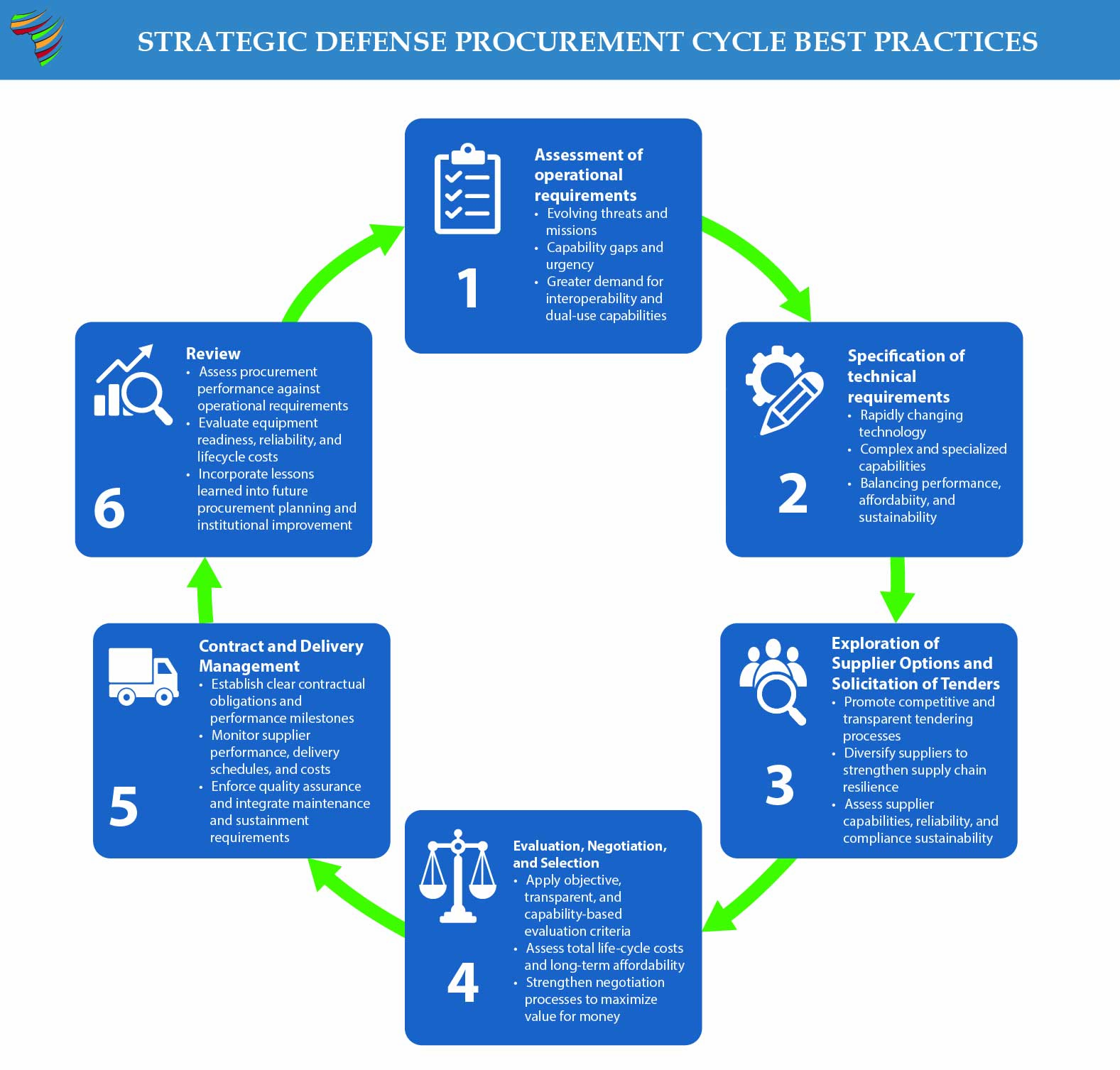
Click here for a printable PDF
Priorities for African Governments
The experience of Ukraine demonstrates that procurement reform, procurement agility, domestic defense industrial development, and rapid technological innovation can significantly enhance military readiness without a proportional increase in defense spending. For African governments, the challenge is therefore not simply to spend more on defense but to spend more strategically. As fiscal pressures continue to constrain military budgets, procurement systems must become more agile, accountable, and aligned with national security priorities.
Anchor procurement decisions in clearly defined national security strategies. Governments must make difficult choices about which capabilities are most urgent. By conducting threat assessments and integrating them into broader fiscal sustainability and debt management frameworks, governments are better able to prioritize strategically and integrate modernization requirements within available resources. In this way, they can balance investments in major platforms with operational requirements, including ISR, cyber defense, unmanned systems, communications, logistics, training, ammunition, and sustainment.
This requires a shift from reactive, platform-driven acquisitions to long-term capability development that is supported by multiyear budgeting that provides predictability for modernization programs while ensuring affordability. Procurement decisions should also incorporate life-cycle costs to ensure that new capabilities remain affordable and operational over time.
Countries that can rapidly acquire, produce, maintain, and adapt military capabilities are better positioned to respond to evolving threats, even when financial resources are constrained.
Strengthen procurement institutions. Establishing professional acquisition management, transparent oversight, and digital system institutions can improve efficiency and reduce delays. Strengthening the expertise of procurement personnel and contracting procedures enables translating strategic requirements into realistic capability specifications, assessing alternative systems, evaluating suppliers, negotiating contracts, and managing equipment throughout its life cycle.
These procurement organizations, in turn, need to be linked to operational commands, finance authorities, logistics organizations, and national security institutions to ensure that acquisition decisions reflect both operational requirements and available resources. Professionalizing procurement institutions can also help safeguard acquisition processes from political pressures for prestige purchases that may not align with the defined national security priorities.
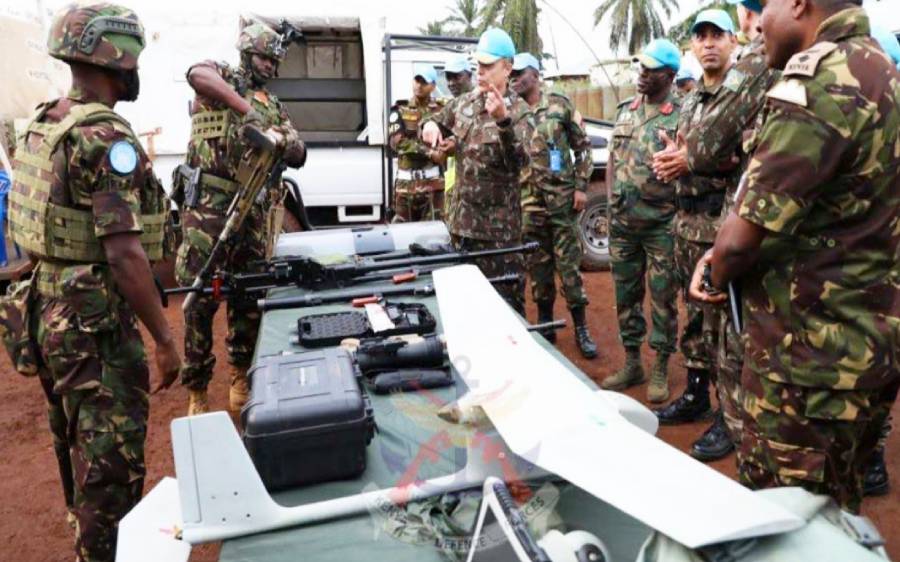
Kenyan soldiers demonstrate the AeroVironment RQ-11 Raven micro-UAS.
Optimize domestic procurement. Defense procurement is part of a broader national resilience strategy rather than a stand-alone acquisition function. Developing domestic industrial capacity, expanding research and innovation partnerships, and strengthening maintenance and logistics systems can reduce reliance on external sources while improving operational readiness. For many African governments, broad defense industrial self-sufficiency may be neither financially sustainable nor operationally necessary, however, and should be approached selectively. Prioritization should be given to eliminating procurement dependencies that create unacceptable operational or strategic vulnerabilities.
Maintenance and repair, ammunition, selected spare parts, logistics support, technical training, and certain unmanned and dual-use technologies may offer attainable initial opportunities for developing local capacity. Sequencing procurement sourcing allows governments to build industrial and technical capacity over time while avoiding capability gaps that could result from attempting to replace established foreign supply chains too quickly. In some cases, technology transfer, licensed production, joint ventures, and local maintenance arrangements may provide a gradual pathway toward greater domestic capability.
Pursue strategic diversification. Acquiring systems from multiple international partners can provide governments with a more affordable and flexible solution to reducing dependence on a single supplier. Diversifying inventories can create additional requirements for training, maintenance, ammunition, spare parts, infrastructure, and technical support, however. Procurement decisions should therefore consider interoperability, fleet standardization, and sustainability alongside acquisition price and access to suppliers.
Expand regional cooperation. Joint procurement, shared maintenance facilities, standardized equipment, and collaborative industrial initiatives can increase purchasing leverage, improve interoperability, and strengthen collective security while easing the fiscal burden on individual countries. The African Union (AU) and regional economic communities (RECs) can provide frameworks for expanding cooperation in areas where individual national markets or defense budgets may be too limited to sustain capabilities independently. The AU offers procurement principles to which African defense procurement agencies can align their practices while progressively incorporating relevant international defense-specific standards for quality assurance and life-cycle management. Regional approaches may be particularly valuable for specialized capabilities that are expensive to acquire and maintain but do not necessarily need to be replicated by every country.
Construct a regional defense industrial base. Rather than each country attempting to establish a comprehensive national defense industrial base, governments could identify areas of comparative advantage and develop complementary regional capabilities. One country may specialize in maintenance and repair, another in ammunition or selected components, and another in training, communications, or unmanned technologies. Such specialization could expand regional markets, improve economies of scale, and strengthen collective resilience while allowing governments to concentrate scarce resources in areas where they possess technological advantages.
Procurement Reform as a Strategic Capability
A robust domestic defense-industrial base is a strategic asset, not merely an economic objective.
Contemporary experience shows that procurement is a strategic capability that directly affects operational readiness, force sustainability, industrial resilience, technological innovation, and strategic autonomy. Transparent, adaptive, and professionally managed procurement systems can enable African governments to maximize limited financial resources into effective military capability.
A transition to capability-based procurement, supported by stronger governance, regional cooperation, and domestic industrial development, offers the most credible path to strengthening Africa’s defense readiness while preserving long-term fiscal sustainability.
Additional Resources
- Richmond Commodore and George Baffour Awuah, “Africa’s New Debt Era: Structural Risks, Institutional Reform, and the Path to Fiscal Resilience,” African Center for Economic Transformation, May 2026.
- Netta Goussac and Vincent Boulanin, “Responsible Procurement of Military Artificial Intelligence,” Stockholm International Peace Research Institute (SIPRI), February 2026.
- Fatai Alli, “Revitalizing Integrated Tactical Units,” Africa Security Brief, 47, Africa Center for Strategic Studies, February 9, 2026.
- Africa Center for Strategic Studies, “Mounting Fatalities Linked to Militant Islamist Violence amid Shifting Tactics,” Infographic, August 12, 2026.
- African Union, African Union Procurement Manual, (Addis Ababa: African Union, April 2024).
- Stephen Watts, Kimberly Jackson, Sean Mann, and Stephen Dalzell, “A Developmental Approach to Sustainable Security-Sector Capacity in Africa,” RAND Corporation, September 2018.