

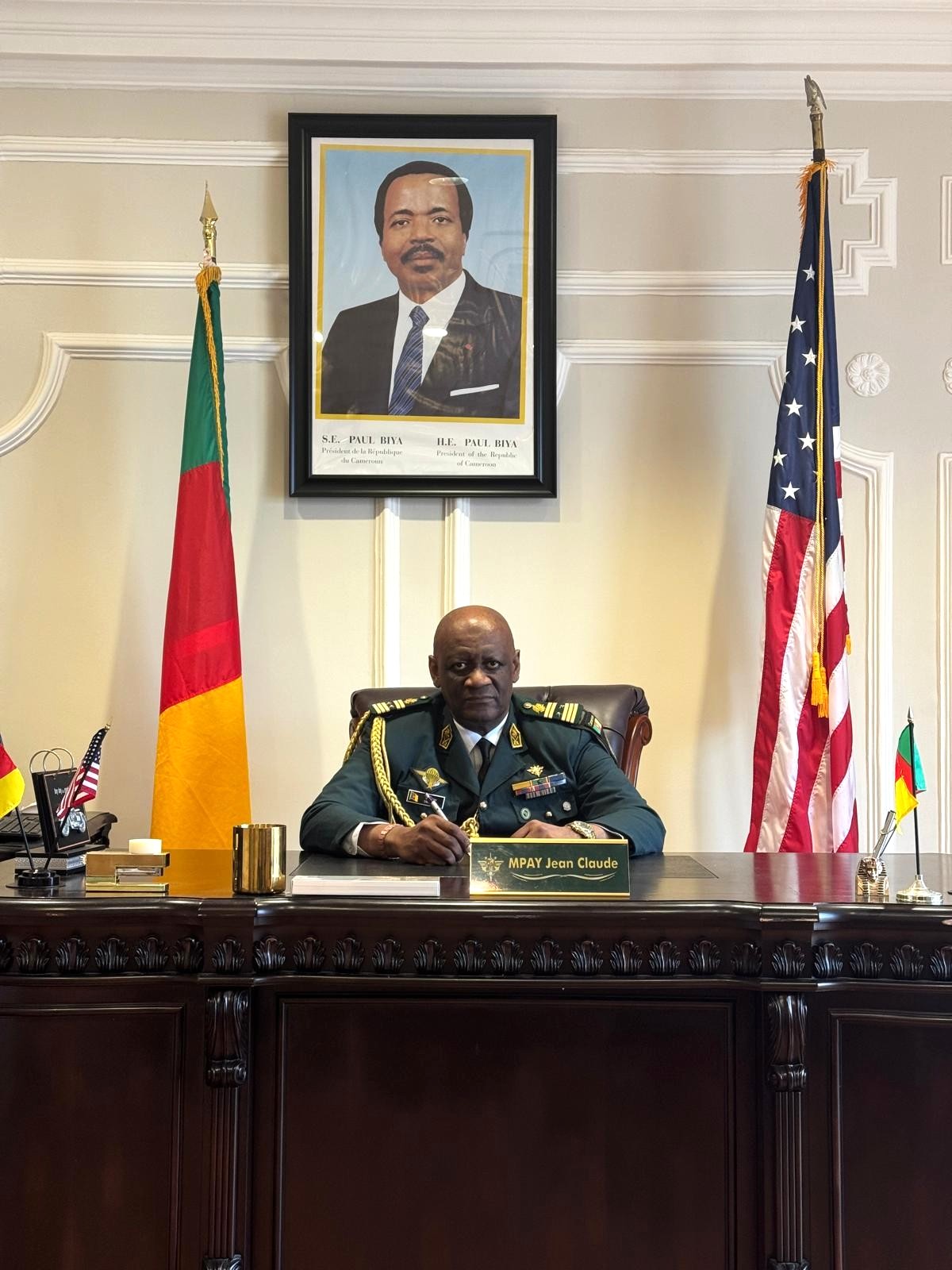
 Currently serving as Defense Attaché at the Embassy of Cameroon in Washington, DC, Colonel Jean-Claude Mpay has been part of the Africa Center for Strategic Studies community since 2015. During this period, he has participated in Africa Center programs both as a participant and as a speaker. He has generously shared his expertise and knowledge at thematic security seminars in Cameroon, within the framework of the African Defense Attachés program on national security strategy in Washington, and more recently by delivering a presentation on U.S.–Africa security cooperation during the Africa Center’s seminar on contemporary security challenges for United States government officials.
Please introduce yourself.
Colonel Jean-Claude Mpay (JCM): I am Colonel Jean-Claude Mpay, currently serving as Defense Attaché at the Embassy of Cameroon to the United States of America. I spent a large part of my career as an education officer within the Cameroonian Armed Forces. I hold a master’s degree in Strategy, Defense, Security, Conflicts, and Disaster Management from the University of Yaoundé II Soa; a master’s degree in International Relations and Diplomacy from the Diplomatic Academy of Cairo; as well as a master’s degree and a bachelor’s degree in Public Law from the University of Yaoundé.
Over the years as an infantry officer, I acquired extensive experience delivering training within military educational institutions. I spent nine years at the Cameroon War College, first as an instructor, then as Head of General Education, and later as Deputy Commandant and Director of Education. There, I had the opportunity to train approximately 500 officers from about 25 countries in Africa, as well as from France and the United States. I also trained soldiers, non-commissioned officers, and cadets, and taught basic, advanced, and staff officers’ courses.
During my career in defense and security, I served as Chief of the Operations Cell (J3) of the Multinational Joint Task Force (MNJTF), tasked with combating the terrorist group Boko Haram, affiliated with the Islamic State, in the Lake Chad Basin. The Islamic State and its affiliates are among the deadliest terrorist groups in the world. The MNJTF brought together five countries—Benin, Cameroon, Chad, Niger, and Nigeria—with support from the United States, the United Kingdom, and France, collectively referred to as the P3. I was responsible for training, preparation, command, and coordination of operations, and I also took part in the planning of Operations Yancin Tafki and Lake Sanity 1.
The MNJTF Headquarters is located in N’Djamena, but I spent most of my time at the MNJTF Tactical Headquarters in Diffa, Niger. From there, I coordinated land, air, and naval operations in Cameroon, Chad, Niger, and Nigeria. The nongovernmental organization International Crisis Group assessed the period I spent there as the most successful, based on MNJTF achievements between late 2018 and 2020 in protecting civilian populations, increasing the number of defecting terrorists, reducing friendly-force casualties, and conducting both kinetic and non-kinetic operations against Boko Haram.
In terms of honors and decorations, I have received several awards, including the French National Defense Medal in Gold and Silver, the Multinational Joint Task Force Medal, the Yancin Tafki Operation Medal (MNJTF), the Knight and Officer Medals of the Order of Merit of Cameroon, the Cameroon Public Force Medal, and the German Military Sports Medal in Gold.
What have been your recent interactions with the Africa Center for Strategic Studies?
JCM: On September 18, 2025, the Africa Center invited me to speak at its Africa’s Contemporary Security Challenges seminar, intended for U.S. government officials whose portfolios focus on African countries. Asked to address security cooperation partnerships, I delivered a presentation on ways to strengthen and consolidate the U.S.–Africa strategic partnership, drawing in particular on examples from Cameroon. I discussed U.S. interests in Africa, examined the current status and capabilities of U.S.–Cameroon security cooperation, analyzed the importance of adopting a regional and subregional approach rather than a single-country focus, and shared reflections on the recent impact of U.S. funding cuts in a context of geopolitical competition.
How has the Africa Center alumni network been useful in your career?
JCM: Let me give an example at the operational level. While serving with the MNJTF, I received a request from an Africa Center alumnus from the Democratic Republic of the Congo. His country, together with members of the International Conference on the Great Lakes Region and the East African Community, was setting up operations to combat armed groups and illicit trafficking, inspired by the MNJTF model and its results in the Lake Chad Basin. In response, I shared our Concept of Operations, which helped guide their efforts very successfully.
At the tactical level as well, the alumni network proved valuable. At one point, I used the network to inform colleagues in Niger and Chad about how Fulani herders were transporting weapons concealed and tied under the bellies of cattle moving within herds. A few days later, many weapons were seized by the armed forces of their respective countries.
There was also a tactic used by terrorists who would position themselves at the rear of friendly convoys using vehicle-borne suicide bombs in order to gain access to military bases and detonate inside, causing heavy losses. To counter this, convoy vehicle counts were established and communicated in advance to friendly forces to prevent unauthorized vehicles from joining convoys. This measure helped prevent casualties.
Did you establish contacts through Africa Center programs that you would not otherwise have made?
JCM: Yes, absolutely. I had the pleasure of meeting the Deputy Minister of Defense of Liberia, former and current United Nations and African Union peacekeeping force commanders, Chiefs and former Chiefs of Defense Staff of Niger, Guinea, and Gabon, as well as senior leaders of professional military education institutions.
Do you remain in contact with alumni you met at Africa Center events?
JCM: I regularly meet Cameroonian participants who travel to Washington, DC for the Africa Center’s annual Emerging Security Sector Leaders Seminar. I also remain in frequent contact with other African defense attachés in Washington who are affiliated with the Africa Center. In addition, I have invited certain alumni to serve as resource persons at the Cameroon International War College.
What is your connection to the Africa Center’s mission of strengthening African security?
JCM: As a former instructor and focal point for the Economic Community of Central African States (ECCAS) at the Cameroon War College, we continue to use WhatsApp groups to share best practices and exchange ideas aimed at strengthening African security. I represented our institution at the African Peace Support Training Association (APSTA) based in Yaoundé. I participated in meetings bringing together former and current peacekeeping force commanders, as well as directors of peacekeeping training institutions in Africa and worldwide. I taught at the International School of Security Forces of Cameroon (EIFORCES), the National Defence College of Nigeria, and the Higher Defense Studies Course of Côte d’Ivoire.
The Africa Center works to strengthen African security by deepening understanding, providing a trusted platform for dialogue, building enduring partnerships, and catalyzing strategic solutions. This mission aligns fully with that of the Cameroon War College, which seeks to provide training, education, and research for military, police, and civilian personnel engaged in peace support operations at the strategic, operational, and tactical levels in order to improve responses to complex crises through multidimensional operations.
Would you like to share a message or reflection addressed to the Africa Center?
JCM: I thank the Center for its continued partnership with my country and commend its commitment to training African and American defense and security professionals. I express my sincere appreciation for the exceptional results achieved by the Africa Center in identifying security challenges and proposing solutions, as well as for its dedication to maintaining high training standards through professionalism. These results may be difficult to quantify, but they are real.
How do you view the strengthening of the partnership between the United States and Cameroon?
JCM: In Africa, Cameroon stands out as a partner of major strategic importance—often underestimated—for achieving U.S. objectives in security, stability, and development. Located at the crossroads of West and Central Africa, Cameroon constitutes a critical anchor whose stability radiates across regions as vital as the Lake Chad Basin and the Gulf of Guinea. Its central geographic position, combined with the presence of the high-capacity Port of Douala and an international airport, has led to Cameroon hosting the headquarters of the African Standby Force Logistics Base of the African Union.
Cameroon plays a multifaceted role. It acts as a bulwark against regional instability and terrorism, confronting persistent threats and complex security challenges such as Boko Haram in the Far North region and the Anglophone crisis in the North-West and South-West regions, which, although internal, have regional implications in terms of refugee flows and border stability. Understanding these dynamics is essential to appreciating the value of a strengthened U.S.–Cameroon partnership.
Tailoring the U.S.–Cameroon security partnership requires a flexible, context-sensitive approach that takes into account variations in partner capacity, political will, and institutional structures. Effective cooperation should be designed to align U.S. strategic objectives with local priorities. A key variable lies in the operational capacity of partner armed forces, which requires advanced capabilities such as counterterrorism intelligence and specialized equipment.
The U.S.–Cameroon security partnership is rooted in a long history of collaboration, with the U.S. government serving as a major strategic partner in strengthening Cameroonian security capabilities. This cooperation has translated into several key initiatives aimed at countering regional threats and promoting stability.
Historically, U.S. programs have made decisive contributions to Cameroon’s ability to contain insurgent threats, particularly in the Far North region. A notable example is the support provided to the Rapid Intervention Battalion (BIR), an elite unit that benefited from U.S. training and equipment to combat Boko Haram terrorists and maritime piracy effectively. This assistance enabled Cameroon to play a critical role within the MNJTF, demonstrating its commitment and effectiveness in regional counterterrorism operations.
Maritime security constitutes another fundamental pillar of this cooperation. The Gulf of Guinea is one of the world’s most dangerous maritime areas due to piracy and illegal fishing, threatening international trade routes and energy security. U.S. cooperation has strengthened Cameroon’s naval capabilities, particularly through the Yaoundé Architecture for Maritime Security, a key regional coordination framework. Cameroon’s participation in joint exercises such as Obangame Express (led by the U.S. Sixth Fleet) and Flintlock (under AFRICOM) has also improved operational readiness and interoperability among participating armed forces. In this context, the Cameroonian Navy will participate in the 250th anniversary of the U.S. Navy (FLEETEX250) in New York in June 2026.
Military education and training are essential components of the partnership. The International Military Education and Training (IMET) program funds the education of Cameroonian military personnel, fostering durable professional relationships between U.S. and Cameroonian officers. These exchanges are essential for strengthening mutual understanding and promoting military doctrines consistent with international standards. Despite resource constraints, the Cameroonian Armed Forces have demonstrated notable professionalism and effectiveness in multiple operations, making Cameroon a reliable and capable partner on the continent. In this regard, the Cameroon International War College previously hosted one U.S. senior officer per year for approximately four years, although the United States has recently stopped sending students. Nonetheless, a valuable opportunity remains to connect African and U.S. officers, many of whom continue to hold senior politico-military positions in Africa.
Equipment support represents another important dimension. U.S. assistance—though sometimes limited—has provided advanced surveillance, communications, and protective equipment, often surpassing contributions from other partners. Follow-on support distinguishes U.S. programs: unlike some external actors that provide one-time deliveries, U.S. initiatives frequently include mentoring, monitoring, and continuous advisory support, strengthening sustainability. This long-term engagement builds trust and enhances Cameroon’s capacity to confront evolving threats, particularly those posed by Boko Haram and transnational extremist networks. The United States should increase the number of training slots offered to Cameroon, which also remains open to expanded partnerships with other countries offering additional training opportunities, such as Russia, France, China, India, Brazil, and Morocco.
It is important, however, to note that this cooperation is not without challenges. Concerns related to human rights and governance have at times led the U.S. Congress to impose restrictions on military assistance, limiting the scope and effectiveness of certain programs. Although motivated by legitimate concerns, these restrictions have also created gaps in cooperation that could, over time, undermine security objectives and human rights protection. The complexity of these issues calls for a nuanced approach that balances support for security imperatives with the promotion of democratic values and fundamental rights.