
English | Français | Português
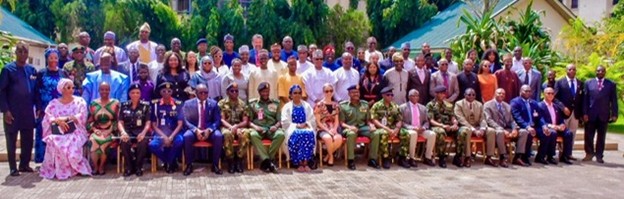
On the margins of the African Defense College Forum that the Africa Center for Strategic Studies convened in partnership with the National Defence College-Nigeria (NDC-N), the Africa Center’s Nigerian alumni and chapter leaders hosted a high-level symposium in Abuja on July 14, 2025. The half-day gathering drew more than 80 participants from Nigeria’s security sector, government, academia, and civil society, alongside representatives from the U.S. Embassy and alumni of other U.S. professional military education institutions.
Themed “The Nexus Between Rural Insecurity, Banditry, and the Spread of Violent Extremism in Northwest and North-Central Nigeria” the event examined how gaps in rural security create openings for armed groups to thrive.
In his opening remarks, Senator Abdulaziz Yar’Adua, Chairman of Senate Committee on Army and Chairman Northern Senators Forum, underscored the urgency of addressing persistent insecurity in rural regions, setting the stage for two in-depth presentations that unpacked the drivers of rural violence and violent extremist recruitment.
Dr. Anouar Boukhars, Professor of Counterterrorism and Countering Violent Extremism at the Africa Center, emphasized that Nigeria’s crisis stems less from the rise of bandits and violent extremists than from systemic challenges that the state faces in the domains of intelligence, community protection, and justice. Communities often report threats, he noted, but state responses are delayed, piecemeal, or absent—leaving armed groups free to act with impunity. This problematic cycle of incomplete security provision fosters mistrust in state institutions and pushes communities toward relying more extensively than they otherwise might on self-defense groups to ensure security, which sometimes escalates violence rather than curbs it.
Dr. Boukhars also warned of broader regional implications. Banditry has hardened into both a criminal economy and a survival mechanism for marginalized groups in the northwest, while in the northeast, the Islamic State in West Africa Province (ISWAP) has resurged dramatically. In 2025 alone, ISWAP overran fifteen military bases, expanded operations into Cameroon, and deployed new tactics—night operations, motorbike mobility, and drone weaponization. To counter these threats, he called for a three-pronged strategy: local peacebuilding to resolve farmer–herder conflicts, reforms to strengthen border security and adapt counterterrorism to emerging technologies, and development investments in agriculture, infrastructure, and education.
Complementing this analysis, Professor Chris Kwaja, Senior Lecturer and Researcher at the Centre for Conflict Management and Peace Studies at Modibbo Adama University of Technology, highlighted the socioeconomic grievances fueling banditry. Poverty, unemployment, and feelings of state neglect, he argued, drive communities into bandits’ orbit, while heavy-handed state responses deepen alienation and inadvertently bolster armed actors.
These insights fed into a dynamic panel discussion moderated by Ambassador Hadiza Mustapha, former African Union Advisor for Peace, Security, and Governance. Participants debated practical solutions to strengthen Nigeria’s rural security architecture, focusing on community-based initiatives, seasonal security planning, and mechanisms for accountability. A lively plenary session followed, where alumni shared experiences from across Nigeria and beyond, enriching the exchange with cross-regional perspectives.
The symposium concluded with an action-planning session, during which alumni identified concrete recommendations and opportunities for collaboration. Chapter Vice President Mohammed Bello Tukur closed by emphasizing the importance of sustained alumni engagement and collective responsibility in advancing solutions.
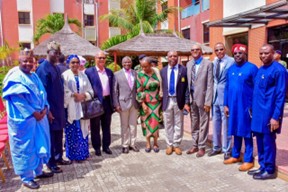
On the sidelines of the symposium, the Director of the Africa Center, Ms. Amanda Dory, met with the Nigeria Chapter’s executive committee. She also welcomed recently returned alumni from the June 2025 Emerging Security Sector Leaders (ESSL) program in Washington, D.C., reinforcing the chapter’s connection to the next generation of Nigerian security leaders.
Founded in 2005, the Nigeria alumni chapter now counts over 450 members. True to its mission, the chapter continues to serve as a trusted platform for dialogue, networking, and partnership-building in support of national and regional security.