


 São Tomé and Príncipe
Presidential & Parliamentary Elections: July 19 & September 26
São Tomé and Príncipe will be heading to the polls for its eighth cycle of presidential elections since the introduction of multiparty politics in 1991.
Africa’s smallest nation by population size, roughly 240,000 people, will be heading to the polls for its eighth cycle of presidential elections since the introduction of multiparty politics in 1991. The 2-island archipelago in the Atlantic Ocean that lies on the Equator, roughly 250 kilometers off the coast of Gabon, has a history of competitive elections.
São Tomé and Príncipe operates under a hybrid presidential and parliamentary model. The president is directly elected for a five-year term, limited to two terms. The president serves as commander-in-chief, directs foreign policy, approves legislation passed by the National Assembly, and acts as an impartial arbiter to ensure the smooth functioning of state institutions. This role is currently held by Carlos Vila Nova from the Acção Democrática Independente (ADI) party. Nova won 57 percent of the second round of presidential elections in 2021.
The 55 members of the National Assembly are elected to 4-year terms. The National Assembly selects the prime minister who serves as the head of government, implementing policy, and leading the country’s day-to-day functions. The ADI secured 30 seats in the 2022 parliamentary elections and selected Patrice Trovoada as prime minister. In January 2025, however, President Nova dismissed Trovoada for prolonged absences and selected Américo dos Ramos, also from ADI, as the new prime minister.
Both presidential and parliamentary elections will be held in 2026.
The ADI and the Movimento de Libertação de São Tomé e Príncipe – Partido Social Democrata (MLSTP-PSD) have historically been the two major parties that have dominated elections in São Tomé and Príncipe. There have been multiple transitions of power between the parties and they have, at times, “cohabitated” with the president represented by one party and the prime minister from the other.
This year’s presidential election is testing that script, however.
ADI has opted to support the 43-year-old Nito D’Abreu as their presidential candidate. The bypassing of Nova reflects the ongoing intraparty fallout of Nova’s dismissal of Trovoada. Nova, consequently, will be running for re-election as an independent.
Elsa Pinto, a former Minister of Foreign Affairs, will represent the MLSTP-PSD. If elected, she would become the country’s first woman president. The MLSTP-PD also faces intraparty divisions, however, as former prime minister, Jorge Bom Jesus, a party stalwart, is running as an independent.
Nino Monteiro, a businessman and president of the national football federation, turned politician, is also contending in the election with the support of the Movimento Independente dos Cidadãos/Partido Socialista. Miques João Bonfim, a flamboyant figure with a reputation for denouncing political and judicial figures, rounds out the roster of presidential candidates in what is expected to be a competitive election.
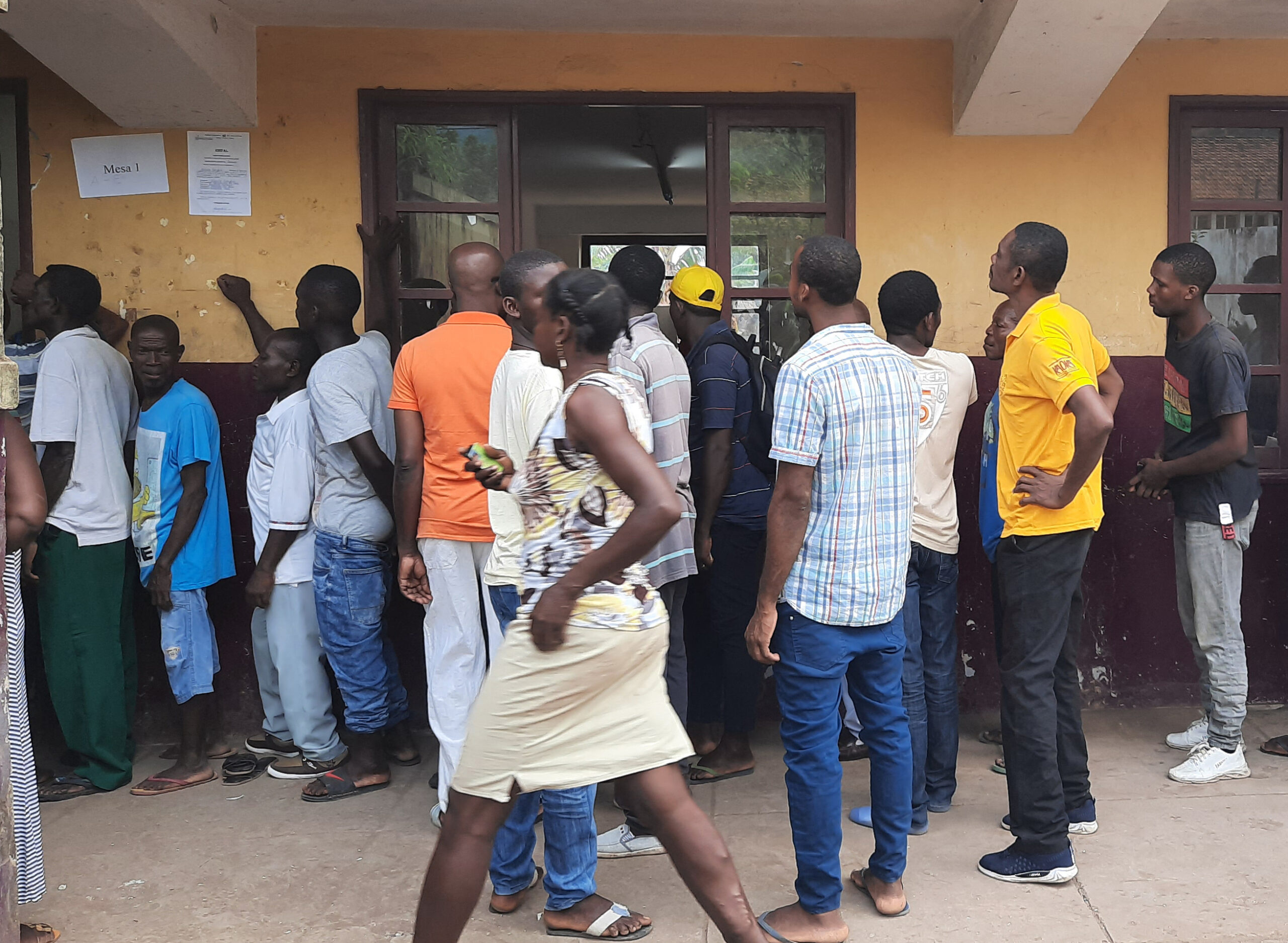
São Tomé and Príncipe citizens wait in line to vote. (Photo by AFP)
Elections in São Tomé and Príncipe are widely seen as free and fair. The Comissão Eleitoral Nacional (CEN) operates independently with members selected from the National Assembly. Independent media are able to cover elections and candidates without fear of reprisals, and São Tomé and Príncipe is regularly recognized for having one of the most open environments for journalists and civil society leaders in Africa.
São Tomé and Príncipe’s tranquility was roiled in November 2022, however, when four people were killed in an assault on a military barracks in an apparent coup attempt. While details remain murky, the coup plotters were evidently part of a disbanded South African/Angolan apartheid-era militia known as the Buffalo Battalion. While there was no evidence that the attack was linked to any political party, a key issue for the 2026 elections will be to demonstrate that this violence was an isolated aberration rather than an ongoing feature of national politics.
Because of São Tomé and Príncipe’s strategic location in the Gulf of Guinea—near valuable offshore hydrocarbon reserves, illicit trafficking routes from Latin America to Europe, and periodic pirate attacks—São Tomé and Príncipe’s 1,300-strong security forces have maintained ongoing security partnerships with neighboring African coastal countries, the European Union, Portugal, and the United States. São Tomé and Príncipe is also a party to the Yaoundé Protocol, an effort by 25 West and Central African countries to improve cooperation to curb illicit trafficking and piracy in the Gulf of Guinea. As part of Zone D (along with Cameroon, Equatorial Guinea, and Gabon), it conducts joint patrols with neighboring countries.
Despite a track record of solid elections, recent years have provided political, security, and geostrategic disruptions in the tiny archipelago.
Russia has attempted to forge closer ties to São Tomé and Príncipe in recent years—part of a wider effort to expand Russia’s naval presence in the Gulf of Guinea. The overtures led to the signing of a military cooperation agreement in 2024, covering training, arms supply, logistics, and joint exercises in exchange for Russian naval and air force visits. Russia has also proposed helping São Tomé and Príncipe monitor its 160,000-square-kilometre territorial waters using radars and drones.
Despite a track record of solid elections, recent years have provided political, security, and geostrategic disruptions in the tiny archipelago. The 2026 elections will be a test for São Tomé and Príncipe to reassert its democratic credentials and reputation for stability.
More on: Democracy and Security