

 The Gambia: Challenges of Exiting the Gravitational Pull of Autocracy
Presidential Elections: December 5
The country is struggling to exit the gravitational pull of consolidated executive power.
President Adama Barrow is seeking a third term in The Gambia’s 2026 election. The move has created considerable turmoil in this tiny coastal West African country of 2.6 million people, given that Barrow had galvanized popular support for his candidacy against longtime autocrat Yahya Jammeh in 2016 on pledges of democratic reform. Among these pledges was the promise that Barrow would only serve a single term and that he would seek a constitutional reform to institute presidential term limits as a corrective to Jammeh’s repressive 22-year rule.
Instead, Barrow sought and gained a second term in 2021. Proposed constitutional amendments to institutionalize term limits in 2020 and 2025, moreover, have not garnered the requisite three-quarters of National Assembly votes, due to a lack of support from Barrow’s party. Critics contend that without explicit term limits and other institutionalized checks and balances, power could again become entrenched—enabling the 61-year-old Barrow to extend his rule indefinitely.
Upon taking office, Barrow embarked on security sector reforms to redress the abuses of the Jammeh government, including the alleged deaths of 240 regime opponents by security forces under Jammeh’s rule. This led to the development of a national security strategy and a security sector reform strategy in 2020 that, collectively, institutionalize norms of military professionalism. These reforms have been stymied, however, by the failure to adopt a new constitution, which is necessary to create the authorities to undertake the reforms.
The challenges of prosecuting former Jammeh officials linked to abuses led the Economic Community of West African States (ECOWAS) to set up a special court in December 2024 to try crimes committed during Jammeh’s reign. A 500-troop strong ECOWAS Mission in The Gambia, ECOMIG, has remained in the country since 2017 with a mandate to support security provision and security sector reform.
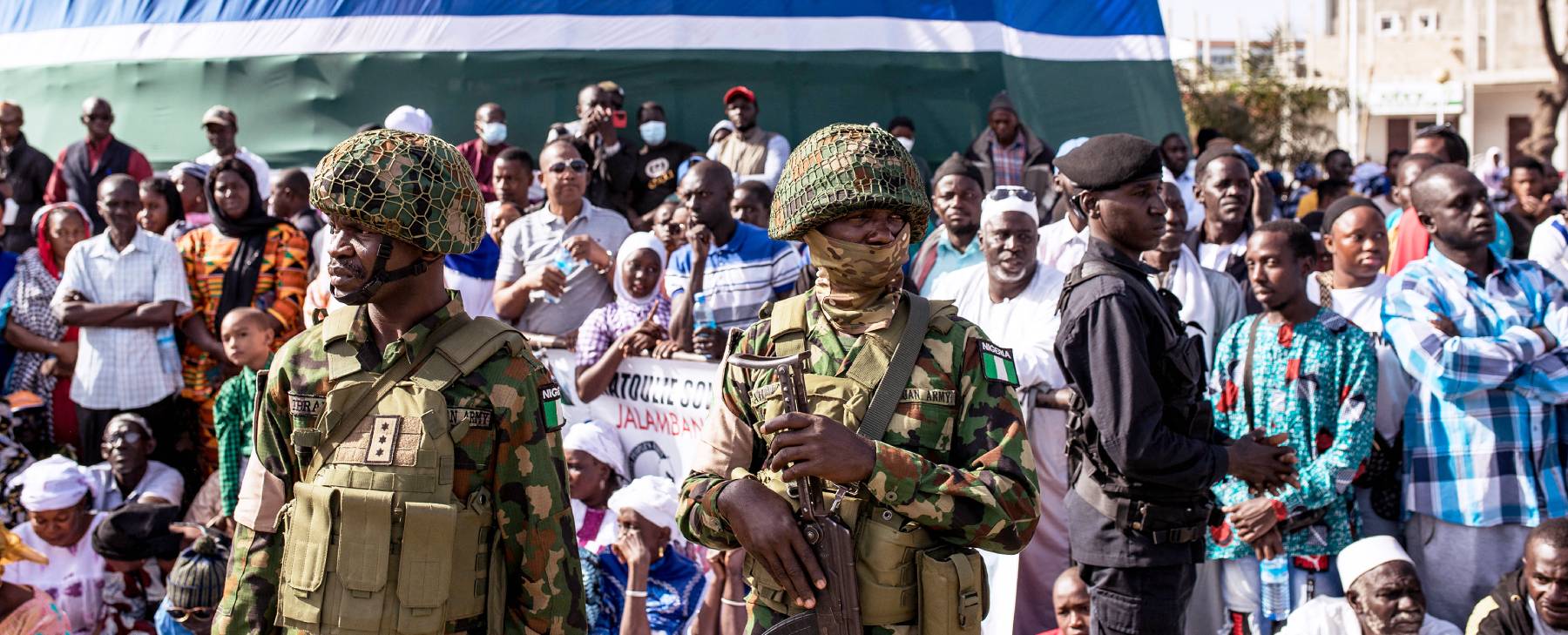
Nigerian ECOMIG officers stand guard at The Gambia’s 60th Independence Day in Banjul on February 18, 2025.
(Photo: AFP/Muhamadou Bittaye)
Barrow is credited with restoring space for civil society and independent media. Since Barrow came into office, The Gambia’s ranking on Reporters Without Borders’ annual Press Freedom Index has improved nearly 90 places (from 145th in 2016 to 58th out of 180 countries). The country’s ranking on Transparency International’s Corruption Perception Index has similarly progressed from 145th to 96th (out of 180 countries).
Nonetheless, there have been several instances in recent years when journalists have faced intimidation and detention on charges of defamation for their critical coverage. Civil society requests to protest on issues criticizing the government, similarly, are at times rejected by the Inspector General of the Police.
Barrow’s government has endeavored to recover state assets of $362 million believed to have been stolen during the Jammeh era. In the process of liquidating some of these assets—including expensive cars, aircraft, and real estate—critics have accused the government of lacking transparency and selling the assets at below-market prices to government officials.
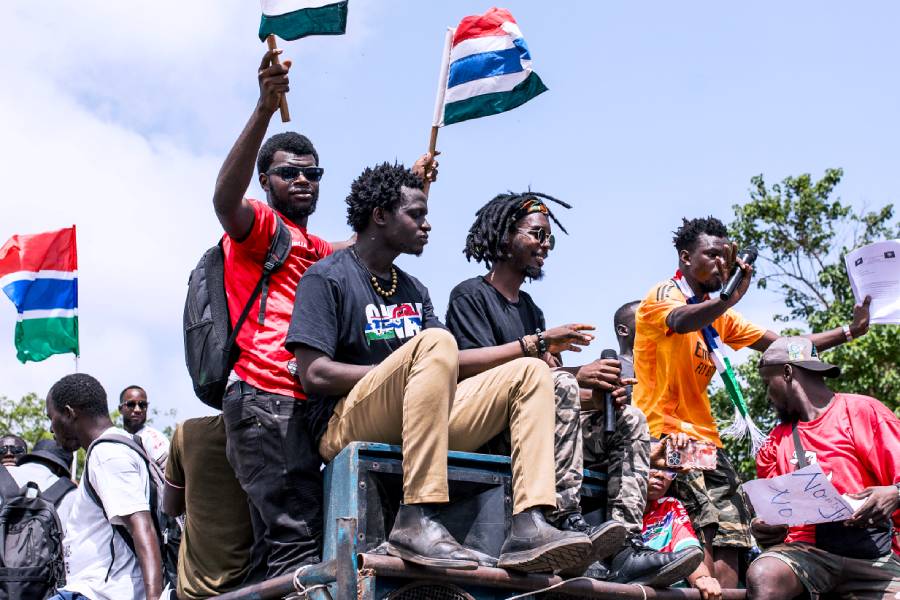
Gambians at a demonstration demanding transparency from government leaders, July 2025. (Photo: AFP/Muhamadou Bittaye)
The Barrow government has also faced strong criticism for removing Auditor General Modou Ceesay from his post in September 2025, only 3 years into his 9-year term. The action sparked angry protests and arrests on the streets of Banjul. The government has been accused of enabling preferential access to foreign exchange and government-backed loans to those with close ties to the government.
The allegations are especially sensitive since an estimated 53 percent of Gambians live below the poverty line—a legacy, in part, of Jammeh’s coup and extended military rule that caused the economy to stagnate for more than two decades. While annual per capita incomes have risen by 24 percent since 2016, they remain around $750.
Barrow faces a fragmented opposition. There are 19 registered political parties, and presidential candidates must secure at least 50 percent of the vote or face a second round against the runner-up. The most prominent opposition figure is the 77-year-old Ousainou Darboe from Barrow’s old United Democratic Party (UDP). (Barrow was forced to leave the party after breaking his promise to only serve one term and institute term limits.) Darboe came in second to Barrow in the 2021 elections, garnering 28 percent of the vote.
The selection of Darboe as the standard-bearer of the UDP triggered a pushback from the party’s younger members, who are demanding more rapid change in a country where 60 percent of the population is under the age of 25. This led to the creation of a new political platform, Unite Movement for Change, under the 40-year-old Talib Ahmed Bensouda, Mayor of Kanifing (west of Banjul). Bensouda has emphasized improving access to basic services such as water, electricity, education, and health care, noting that an estimated 12,000 young Gambians attempt to migrate to Europe every year due to limited opportunities.
Other declared candidacies include Mama Kandeh of the Gambia Democratic Congress, who received 12 percent of the vote in the 2021 election, and Bakary Badjie, leader of the United Gambian Front.
Often forgotten, The Gambia had a nearly 30-year era of democratic governance from 1965 until 1994, during which time the principles of rule of law and respect for civil liberties were readily enjoyed.
The Gambia’s 2026 election will be a norm-setter for the country as it attempts to navigate between two distinct governance eras since independence. The country is struggling to exit the gravitational pull of consolidated executive power exerted during Jammeh’s coup and ironfisted governance from 1994 to 2016. Often forgotten, The Gambia also had a nearly 30-year era of democratic governance from 1965 until 1994, during which time the principles of rule of law and respect for civil liberties were readily enjoyed. Given the tensions over these competing governance models within West Africa, the path taken by The Gambia will likely have larger ripple effects.
More on: Democracy and Security