

 Ethiopia: Expanding Representation While Managing Centrifugal Forces
Parliamentary Elections: June 1
The practices employed during these polls will shape Ethiopia’s electoral norms for years.
Ongoing frictions surrounding Tigray and clashes between federal forces and other armed, ethnically based separatist groups in Amhara and Oromia make the electoral environment even more fraught. A central priority for the elections, therefore, will be how to ensure security to enable voting (and enfranchisement) in as much of the country as possible.
With roughly 500,000 troops with the Ethiopian National Defense Force and 30,000 officers under the Federal Police, the government has considerable capacity to provide this security. However, opportunities for spoilers abound.
A key flashpoint is the contested jurisdictional boundary of western Tigray (also known as Welkait). The National Electoral Board of Ethiopia (NEBE) has instructed these districts to hold elections outside of either regional authority claiming jurisdiction (Tigray or Amhara), with regional council elections scheduled for a later date. The dominant party within Tigray, the Tigray Liberation Peoples Front (TPLF), has challenged this guidance and called for the reinstatement of the pre-war elected regional council and leadership, fueling uncertainty around the elections.
Drawing on experience from the 2021 election conducted during the Tigray conflict, the NEBE has developed a classification system of the feasibility of conducting elections subject to security conditions. This classification projects that elections will be held in all but 46 parliamentary constituencies in 2026, including all 38 in Tigray. As a benchmark, voting took place in 436 of the 547 parliamentary constituencies in the past election.
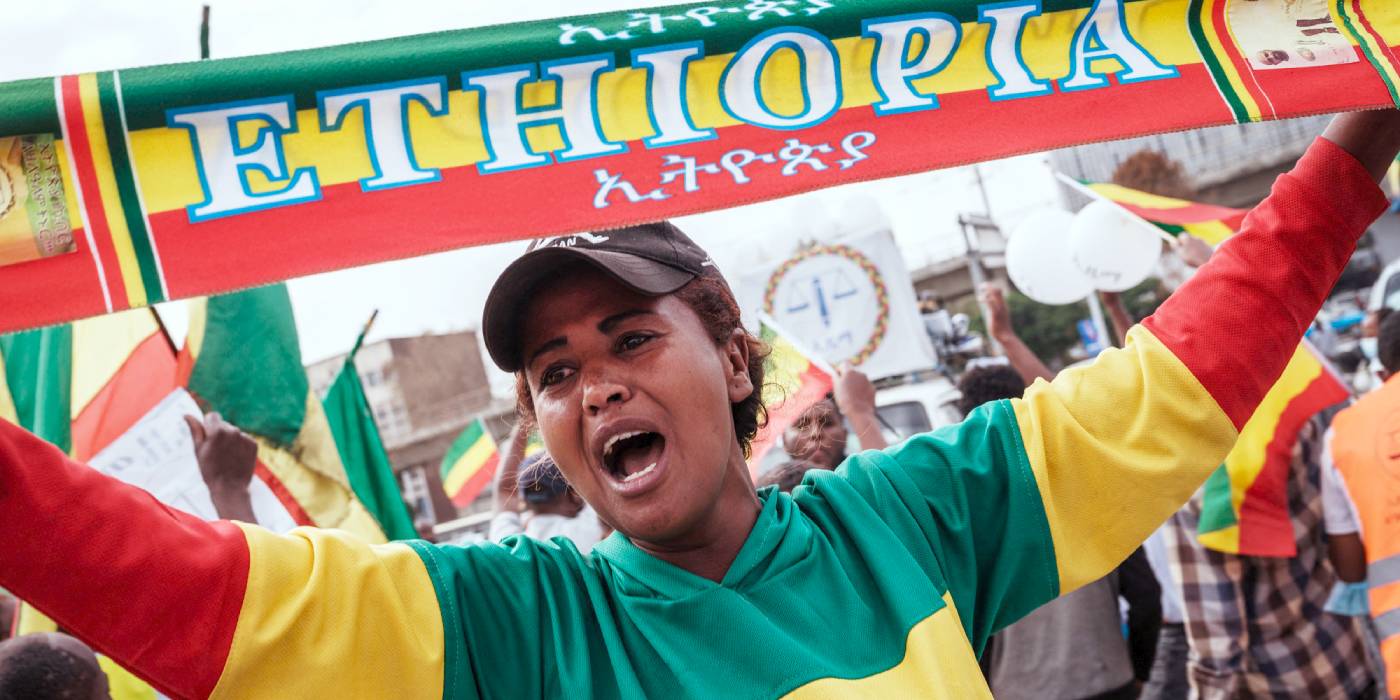
Supporters at a campaign rally in Addis Ababa. (Photo: AFP/Yasuyoshi Chiba)
The persistent security tensions are, in part, symptomatic of a fundamental flaw in Ethiopia’s constitution. Established in 1991 under the minority Tigrayan-dominated Ethiopian People’s Revolutionary Democratic Front (EPRDF), the constitution enshrines an ethnic federal model for the country. Despite the advantages of devolving power closer to local communities in a populous and diverse population, by overlaying ethnic, regional, and political jurisdictions (including the right to secede), the ethnic federal model creates centrifugal pressures on the state incentivizing fragmentation. History has repeatedly shown such models to be inherently unstable. A central feature of the fighting in Tigray, Amhara, and Oromia is the unwillingness of ethnic militias in these regions to lay down their arms and integrate under a unified military chain of command.
Prime Minister Abiy Ahmed Ali is seeking to extend his leadership through these elections by maintaining a parliamentary majority with his Prosperity Party. Ethiopia’s Federal Parliamentary Assembly is a bicameral body with a 547-member House of People’s Representatives (HPR), which is directly elected and selects the prime minister. The 112 members of the House of the Federation (HoF), Parliament’s upper house, are indirectly elected by regional councils.
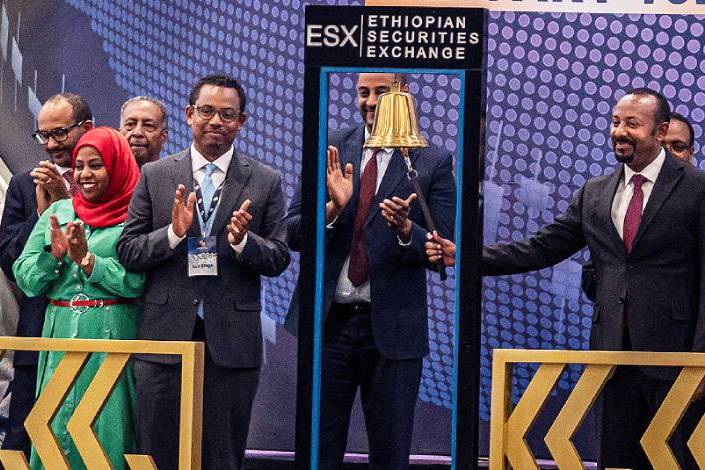
Prime Minister Abiy Ahmed rings the bell at the launch of the Ethiopian Securities Exchange in Addis Ababa, January 10, 2025.
(Photo: AFP/Amanuel Sileshi)
Abiy has fashioned an image as a reformer and modernizer to his supporters. At the same time, he is criticized for consolidating power and being intolerant of dissent.
Upon taking office in 2018, Abiy facilitated the release of thousands of political prisoners and opened political and civic space in a country that has only known various versions of authoritarian government. The Ethiopian Human Rights Commission was established to provide independent oversight of government actions and has issued reports critical of the Abiy administration, including during the Tigray conflict. The Ethiopian National Dialogue Commission, similarly, was created in 2021 to facilitate a broader dialogue toward finding consensus on challenging national issues such as identity, state formation, and the federal system.
Abiy has championed the privatization of state-owned enterprises in the telecommunications, aviation, and energy sectors. This includes the completion of the 6,450 MW Grand Ethiopian Renaissance Dam (GERD) in 2025 that dramatically expands energy capacity in the country. Macroeconomic reforms, including freeing the exchange rate, have helped stimulate exports and attract foreign direct investment. Per capita incomes in Ethiopia have grown by 22 percent since 2018, though remain under $1,000 per year.
Critics, meanwhile, contend that political space under Abiy has diminished in recent years. Journalists regularly face intimidation or arrest for critical reporting. The Ethiopian Media Authority revoked the license of a prominent media house, Addis Standard ahead of the elections. An estimated 43 journalists were detained over the past year, mostly when reporting from the conflict-affected regions of Tigray, Amhara, and Oromia. Several international media outlets have been prevented from reporting on conflict-related matters. In April 2025, the Prosperity Party-dominated Parliament passed legislation that increased journalists’ liability for inaccuracies in their reports. The legislation also increases the scope for government interference in reporting by shifting responsibilities for media oversight from a semi-autonomous regulatory body to a political appointee of the prime minister. The World Press Freedom Index ranks Ethiopia 148th out of 180 countries in its level of press freedom.
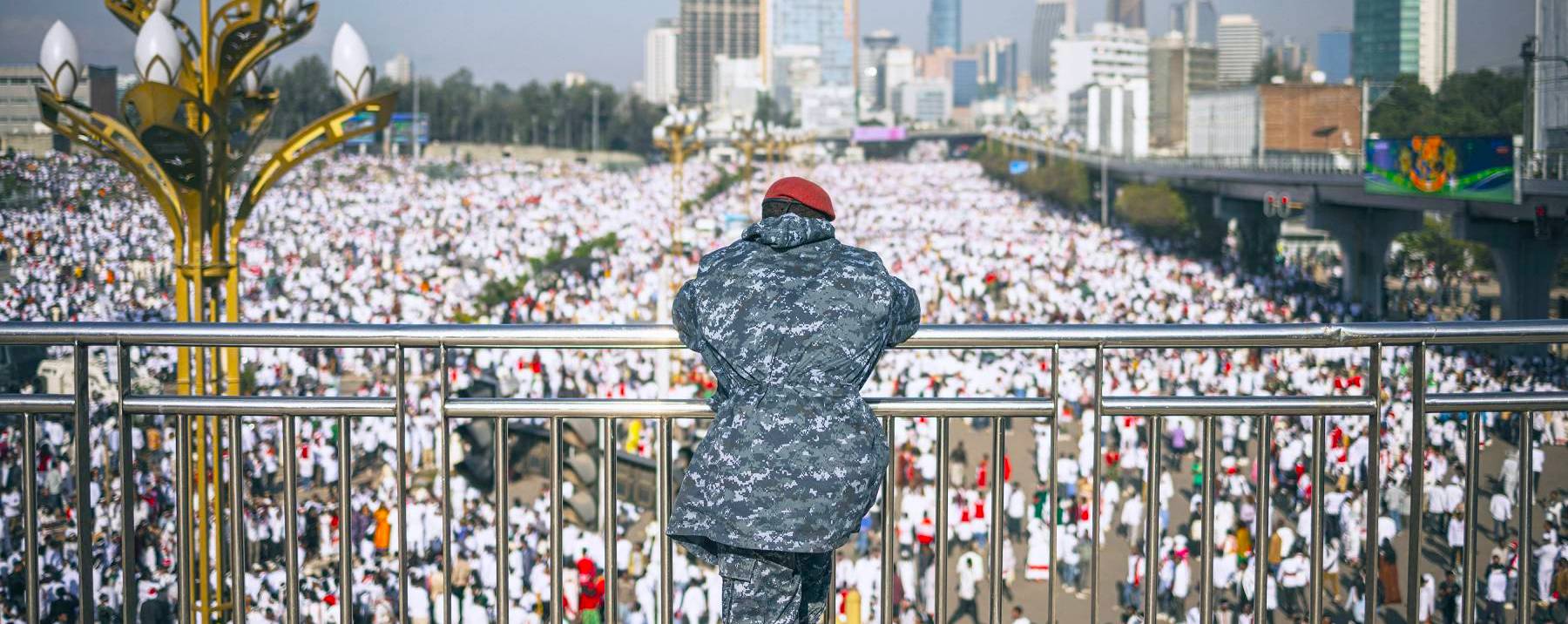
A federal police officer watches as people gather for an Oromo festival in Addis Ababa. (Photo: AFP/Michele Spatari)
Parliament also adopted draft legislation in June 2025 for a Civil Society and Media Act that would grant the government sweeping powers to limit civil society organizations, especially those focused on governance oversight—paralleling the restrictive conditions of the EPRDF. Over the past year, Ethiopian authorities have suspended five prominent human rights groups. At times, even the work of the Ethiopian Human Rights Commission has been sidelined.
Despite these challenges, there are 48 opposition parties accredited for the 2026 elections. A revision to the Ethiopian Electoral, Political Parties Registration and Electoral Code of Conduct law passed by the HPR in July 2025 lowered the threshold for party participation in parliament from 15 percent to 10 percent, creating more opportunity for opposition parties. Numerous opposition parties have formed coalitions to enhance their national reach as they attempt to expand their representation from just 55 seats in the HPR. These coalitions have adopted a range of platforms, including strengthening democratic processes, elevating peacebuilding initiatives across the country, and deepening national unity, among others. The ruling party has also opted not to nominate candidates in three localities with strong opposition support (Tigray and some localities in the Amhara and Addis Ababa), creating more space for opposition representation.
The election must balance the quest for greater enfranchisement within an ethnic federalism model that accentuates polarization.
Some regionally based ethnonational parties remain skeptical of contesting the elections or are calling for a postponement pending further reforms or improved security. Others have attempted to prevent voter registration to undercut the legitimacy of the electoral process. The most prominent regional party is the Tigray People’s Liberation Front (TPLF). The NEBE revoked the TPLF’s legal status as a political party in May 2025 for failing to hold a general assembly as required for its re-registration. This has deepened perceptions of disenfranchisement by some within the region. At the same time, the revocation of the TPLF’s legal status has created opportunities for other less prominent political parties in Tigray to merge forces to enhance their representation.
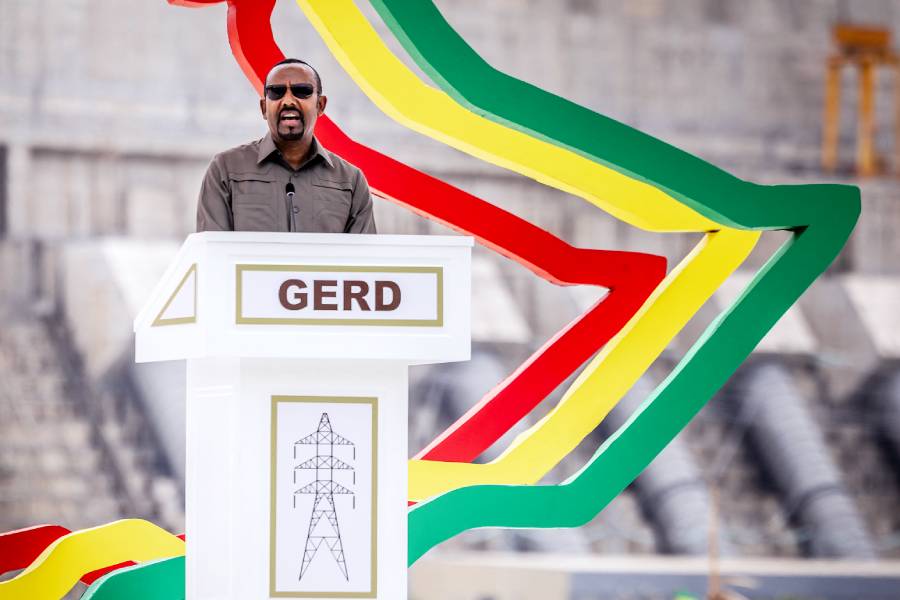
Prime Minister Abiy Ahmed at the inauguration ceremony of the Grand Ethiopian Renaissance Dam. (Photo: AFP/Luis Tato)
Ethiopia’s 2026 elections are also shaped by increasingly complex regional dynamics. With East Africa’s largest economy at roughly $150 billion and an expanding trade portfolio, Ethiopia has been seeking to diversify its reliance on the ports of Djibouti, through which 90 percent of landlocked Ethiopia’s imports and exports flow. Concerns that Ethiopia may establish a port in Berbera, Somaliland, or attempt to seize Assab in Eritrea have ratcheted up tensions in the region. Eritrea, which still has troops in Tigray, has made overtures to the TPLF. Egypt, unhappy about the construction of the GERD on the Nile, has simultaneously elevated its support to Somalia.
Ethiopia is also a target of Gulf State rivalries, though Addis has a long tradition of balancing its regional and international partnerships. The United Arab Emirates (UAE) has developed especially close ties with Ethiopia, having committed $2.3 billion in financial support, renewable energy, and infrastructure projects. This includes a $400-million project to construct the road network to the Port of Berbera in Somaliland. Addis’ closer ties to the UAE are also linked to reports that Ethiopia has become a staging ground for the Rapid Support Forces in Sudan—and, inversely, for deeper ties between the Sudan Armed Forces and Eritrea. Saudia Arabia, meanwhile, has been increasing its presence in neighboring Djibouti.
Ethiopia’s 2026 elections, therefore, represent a multitiered balancing act of storylines. Given its limited experience with competitive elections, the practices employed during these polls will shape Ethiopia’s electoral norms for years to come. This will be the case despite persistent fighting in certain regions of the country, which creates opportunities for spoilers and could inhibit voting. The election must simultaneously balance the quest for greater enfranchisement within Ethiopia’s ethnic federalism model that simultaneously accentuates polarization. Ethiopia is navigating each of these domestic concerns within increasingly choppy regional crosscurrents. How the country manages its elections while juggling these contending interests will reveal much about Ethiopia’s political maturation—and its enduring stature in the region.
More on: Democracy and Security