

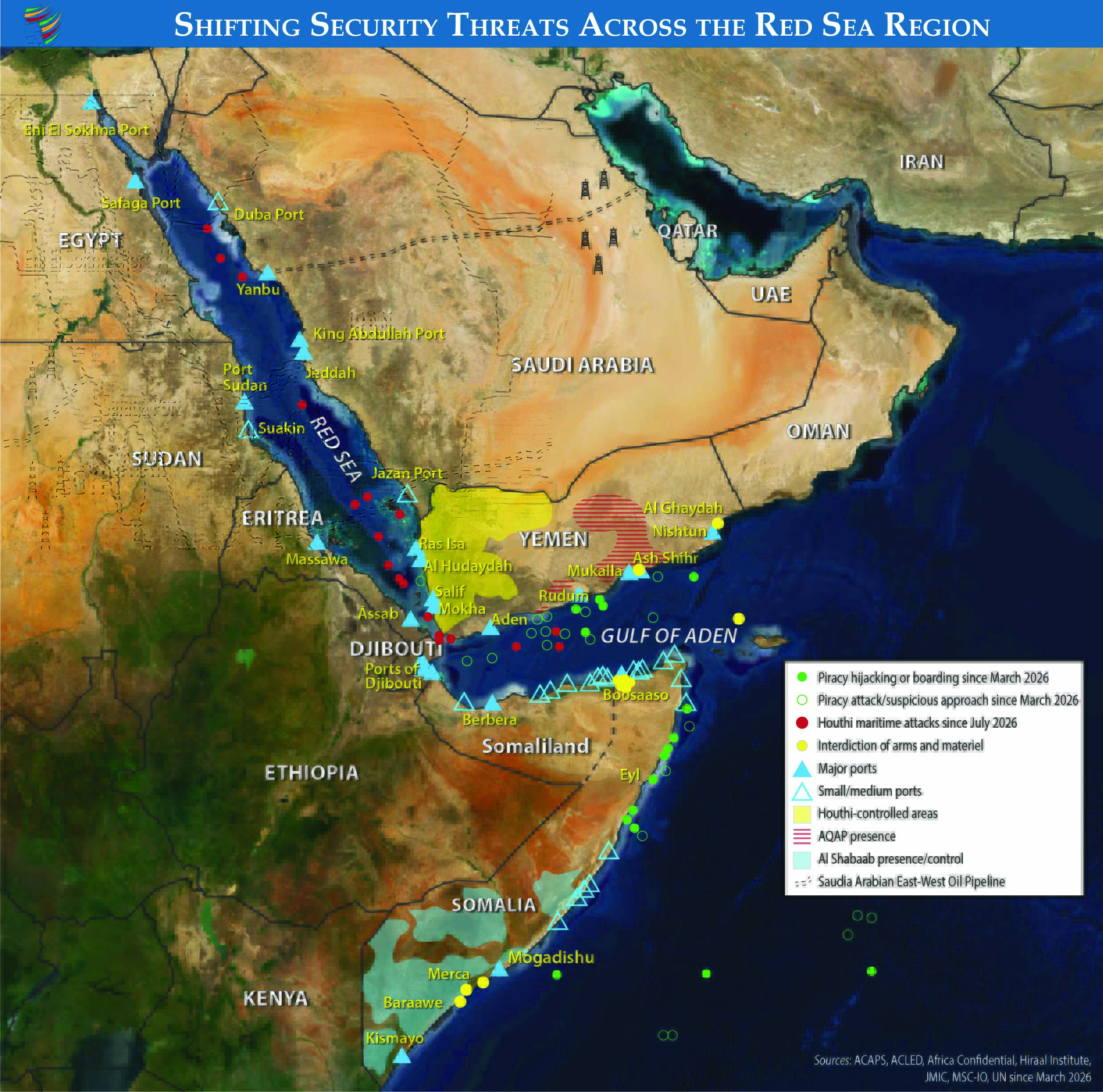
Renewed missile attacks by Yemen’s Houthi militants on maritime vessels in the Red Sea have roiled international shipping and altered the security landscape for this vital waterway connecting Africa and the Arabian Peninsula. By capturing the port town of Mokha, Perim Island in the middle of the Strait, and other strategic border territory, the Houthis have solidified their leverage over the 32-km (20-mile) wide Bab al Mandeb Strait linking the Red Sea and the Indian Ocean.
The Red Sea maritime corridor has typically accounted for roughly 30 percent of global container traffic, 15 percent of global oil and shipping transits, and 12 percent of global annual trade—valued at $1 trillion. The Red Sea maritime corridor has historically managed 95 percent of maritime traffic between Europe and Asia.
Launched in July 2026, the latest Houthi attacks on shipping in the Red Sea and Gulf of Aden are intensifying pressure on global supply chains already strained by Iran’s efforts to close the Strait of Hormuz.
Renewed Houthi attacks on Red Sea shipping and increased leverage to disrupt maritime passage through the Bab al Mandeb Strait fundamentally alter the regional maritime security challenge.
Underscoring the Houthis’ efforts to leverage geostrategic advantage over the Bab al Mandab, the Iranian-backed militant group attacked Saudi Arabia’s key East-West crude pipeline in September 2026, further constricting the movement of oil from the Gulf countries to global markets. In response to Iran’s earlier restrictions on the Strait of Hormuz, Saudi Arabia had increased its shipment of oil via the Red Sea port of Yanbu from roughly 1 million to 4.9 million barrels of oil per day.
While African countries are not a party to either the Yemen or Iran conflicts, the continent’s strategic location bordering three of the world’s seven major maritime chokeholds—the Bab al Mandeb Strait, the Suez Canal, and the Strait of Gibraltar—has direct security and economic implications for Africa.
Attacks on Maritime Traffic in the Red Sea
There have been 12 Houthi attacks or attempted attacks on commercial vessels in the southern Red Sea since July of 2026. This includes ballistic missile attacks on Saudi oil tankers the Amzan (August 24) and the Ghazal (targeted but unhit, July 28). The Encelia and Layla (July 22) were targeted with a combination of drones, cruise missiles, and ballistic missiles. The Houthis also used two ballistic missiles on the Egyptian cargo ship Tihamah in the Bab al Mandeb Strait on August 11, in which four sailors were killed. They subsequently launched a ballistic missile attack on a Yemeni Coast Guard rescue vessel, killing two of the rescuers.
These attacks mark a resumption of Houthi attacks on maritime traffic in the Red Sea and Gulf of Aden following a roughly half-year hiatus. The Houthis initially struck vessels transiting the Red Sea in November 2023, following the outbreak of the Hamas-Israel conflict. Over the subsequent 2-year period, the Houthis launched an estimated 530 attacks on maritime shipping, entailing roughly a 2:1 ratio of drones and missiles.
The resumption of Houthi attacks in the Red Sea has been accompanied by a spike in piracy events in the Gulf of Aden. Since April 2026, there have been at least 23 piracy attacks in the region. Aside from a brief surge in November 2025, the piracy threat had largely abated between June 2024 and April 2026.
While the patrons behind the pirate activity off the Horn of Africa are murky, it is known to be lucrative. The hijacking of a Chinese-flagged vessel in 2026 generated a ransom payment of at least $1.2 million. The militant Islamist group, al Shabaab, has been linked to earlier episodes of Somali piracy. Piracy provides Africa’s best-resourced violent extremist group—with estimated annual revenues of $200 million—an additional funding stream as well as a tool to shape the regional security environment. The proximity to the Yemen coast of some of the piracy incidents has also raised speculation of Houthi involvement.
There have been growing ties between the Houthis and al Shabaab since early 2025.
There have been growing ties between the Houthis and al Shabaab since early 2025. This has largely involved significant arms shipments and training by Houthi operatives of al Shabaab fighters, which has contributed to the growing sophistication of al Shabaab’s capabilities in recent years. Al Shabaab, in turn, supports the Houthis with an additional source of funding and less traceable routes for arms trafficking.
As the Houthi-al Shabaab relationship deepens, there is growing attention on the prospective transfer of military-grade drones or missile systems. Such transfers would further enhance the militant groups’ ability to threaten maritime security around the Bab al Mandeb as well as escalate al Shabaab’s capacity to destabilize the government of Somalia. The Houthis have also reportedly sought collaboration from al Shabaab to install communications and surveillance equipment on Somali territory. This would further extend the range of Houthi missile and drone systems. To the extent that the Houthis establish operational capacity on both sides of the Red Sea, they can also further extend the arc of Houthi-Iran influence into Africa.
The concurrent surge of Houthi missile strikes in the Red Sea and piracy activity in the Gulf of Aden is unlikely to be coincidental. Pirate groups are using more sophisticated Houthi-supplied GPS satellite devices that facilitate tracking commercial vessels.
The combination of Houthi strikes and piracy attacks enhances militant group leverage over the Bab al Mandeb. This may serve broader Houthi and Iranian geostrategic interests as well as establish a new toll for safe passage through the Strait, similar to what Iran is vying for in the Strait of Hormuz.
Economic Impacts on Red Sea Maritime Traffic
The Houthi missile and Somali pirate attacks have further complicated commercial shipping. The conflict in the Strait of Hormuz had initially triggered a rise in shipping through the Bab al Mandeb. Weekly transit volume through the Strait grew from 1.1 to 1.5 million metric tons (from roughly 32 to 38 vessel transits) between January and July 2026. Following the reinitiation of Houthi missile strikes in July 2026, shipping sharply contracted to 25 weekly vessel transits carrying 750,000 metric tons. Subsequent Houthi claims that it was solely targeting Saudi-flagged vessels have resulted in an edging up of traffic since then.
For context, shipping through the Red Sea continues to be less than a third of the levels observed before the October 2023 Houthi attacks, when weekly transit trade volume averaged 80 vessels carrying 3.4 million metric tons.
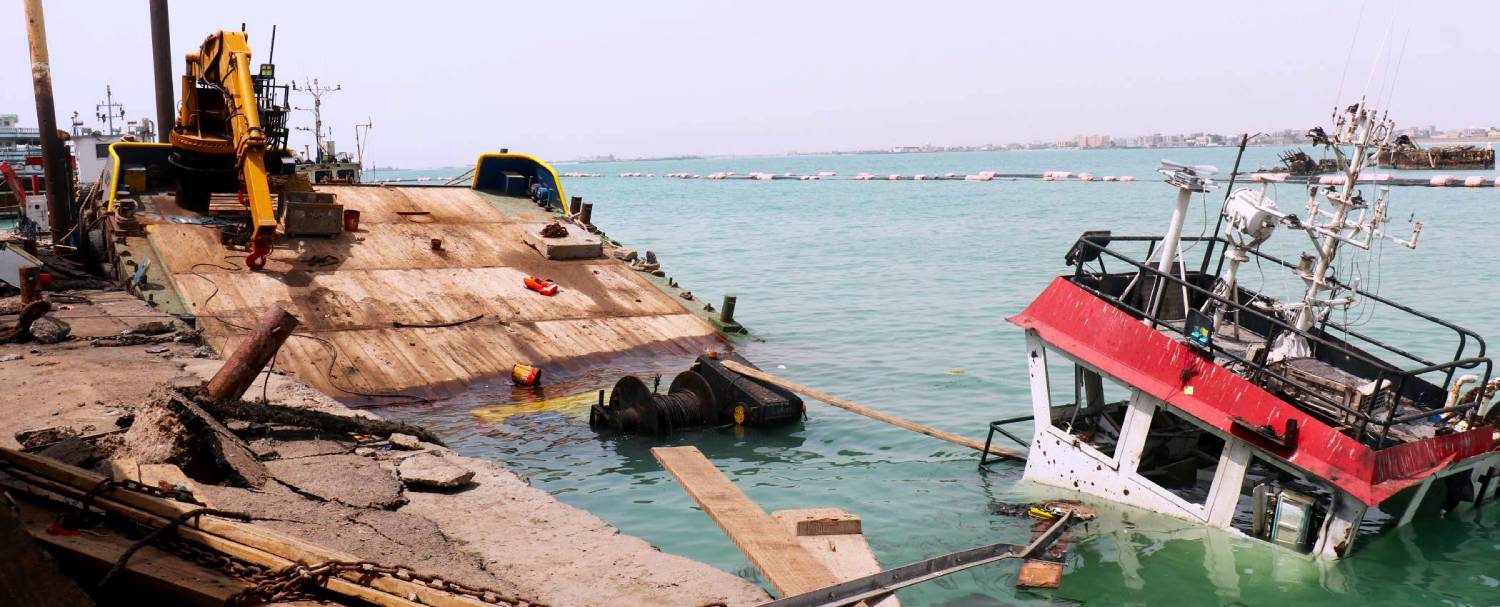
A sunken vessel in the Port of Mokha the day after an attack by the Houthis in August 2026. (Photo: AFP)
Following the attacks in 2023 and 2024, shipping lines reoriented their travel routes to avoid the Red Sea. This resulted in a 74-percent increase in transits around the Cape of Good Hope, adding up to 2 weeks and 6,000 nautical miles to their journeys. Shipping insurance premiums for ships transiting the Red Sea subsequently increased from 0.1 percent to 0.7-1.0 percent of the ship’s value. These costs equate to roughly $1 million in additional costs per vessel for each round trip.
The economies of Egypt, Sudan, Eritrea, Djibouti, and Somaliland have been directly harmed by reduced vessel traffic and heightened freight costs and insurance premiums.
Egypt is estimated to have lost 30-40 percent of the $9.4 billion in annual revenues it collects from fees transiting the Suez Canal.
Africa is also bearing the indirect economic costs of restricted Red Sea access. The continent imports 98 percent of its refined oil products. Rising oil prices are costing 13 African countries more than 1 percent of their gross domestic product. These costs are borne by consumers in numerous ways. Fuel prices in Somalia, for example, have risen from $0.60 to $1.50 per liter over the course of the year due to fuel price hikes.
The rising Red Sea shipping costs make African imports and exports more expensive—and less competitive. East African countries like Kenya, Uganda, and Ethiopia, which rely on imports from Europe for chemical products and manufactured goods, must pay higher prices due to the increased transportation costs.
Ethiopia’s population of 120 million is particularly impacted because of its reliance on the Doraleh Port in Djibouti for 90 percent of Ethiopian trade. Primary sources of Ethiopian foreign exchange—exports of coffee, flowers, and textiles—are dependent on access to markets. Likewise, Ethiopia is especially reliant on imports for fuel, cereals, fertilizer, and manufacturing inputs—costs for which have all gone up, including a 63-percent increase in fuel prices since April.
Port Sudan is almost entirely reliant on Red Sea shipping for its imports. Aside from the severe strains caused by its civil war, increased fuel costs have pushed up the prices of flour, rice and vegetables by 40 percent since February in Sudan.
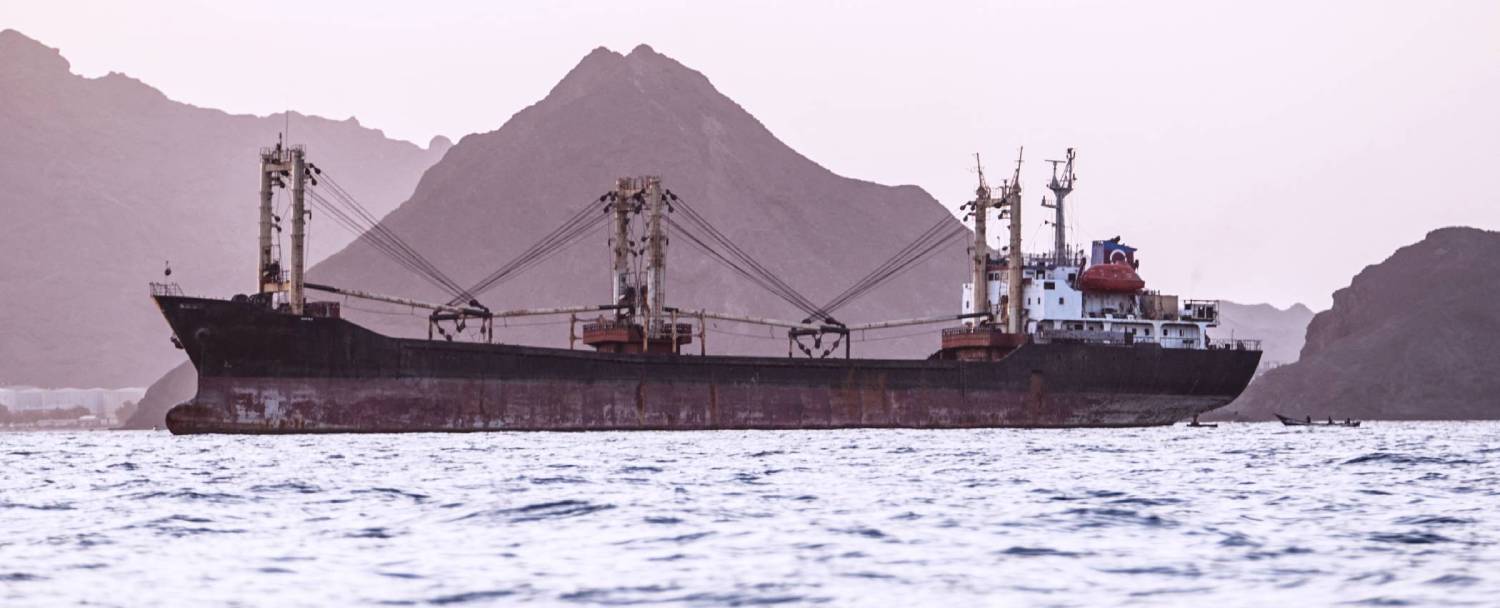
A commercial vessel is anchored off Yemen’s coast at Bab al Mandeb, the strait connecting the Red Sea with the Gulf of Aden. (Photo: AFP)
Continent-wide, African countries import between 25 and 30 percent of their cereals, on average, highlighting the breadth of impact from extended food and fuel price hikes.
These externally driven economic shocks are creating extended inflationary and foreign exchange pressures on many African economies.
Renewed Importance for Regional Maritime Security Cooperation
The renewed Houthi attacks on Red Sea shipping and increased leverage to disrupt maritime passage through the Bab al Mandeb Strait fundamentally alter the regional maritime security challenge. Previous maritime security cooperation efforts have focused on piracy and illegal fishing. Prospects that a militant group with strong ties to Iran could gain control over a vital international chokehold will have long-term impacts on the regional and international economy. It also forces a recalibration of a series of national and regional security equations.
International anti-piracy efforts in the Gulf of Aden were organized in 2008 to address the growing threat of piracy in the Horn of Africa. Initiatives led by the European Union (Operation Atalanta), NATO (Operation Ocean Shield), and the United States (Combined Task Force 151) worked closely with roughly 40 participating countries for many years to mitigate this threat. While scaled back over the years, Operation Atalanta and Combined Task Force 151 remain operational and provide a foundation for the evolving maritime security architecture in the region.
The enduring nature of this threat underlines the need for a sustained collective response.
The Djibouti Code of Conduct (DCoC), comprising 14 African countries as well as 8 Gulf states, has similarly been central to combatting piracy and armed robbery at sea along Africa’s east coast. The DCoC has focused on legal harmonization to enhance interdiction and prosecution of criminal actors. In 2009, the Government of Kenya and the European Union established the conditions and modalities for transferring detained piracy suspects and property seized by the Operation Atalanta naval force to Kenya for prosecution and adjudication.
Saudi Arabia launched the Multinational Maritime Security Alliance in August 2026 in response to the Houthi threat to shipping in the Red Sea and Gulf of Aden. The 15-member alliance, including 6 African countries (Egypt, Somalia, Djibouti, Sudan, Comoros, and Nigeria), is intended to serve as a defensive coalition to safeguard freedom of navigation through the Bab al Mandeb by facilitating intelligence sharing and coordinated maritime defense operations.
Each of these coalitions will be faced with reassessing their roles—and avenues for collaboration—to address the emerging maritime security reality around the Bab al Mandeb. The enduring nature of this threat underlines the need for a sustained collective response.
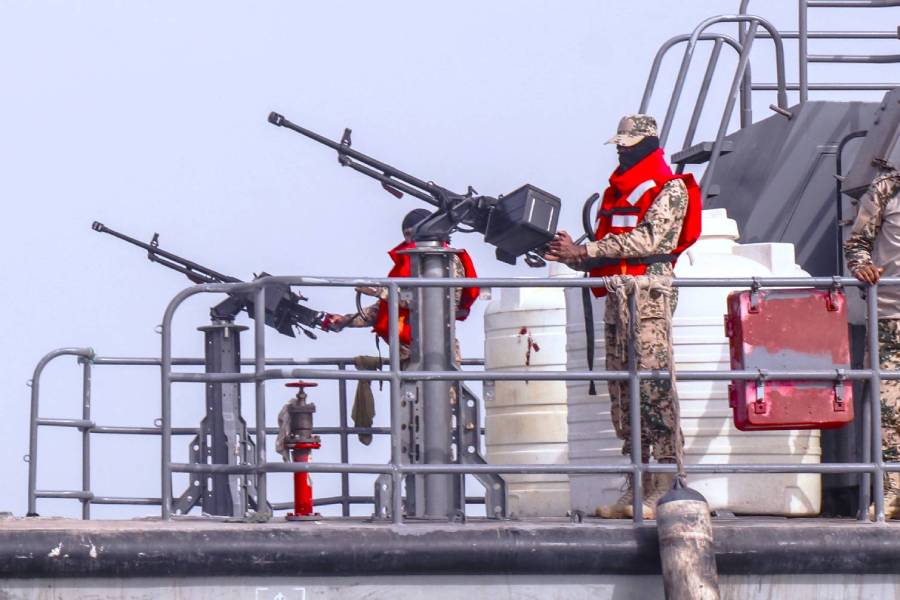
Yemeni sailors patrol the Red Sea. (Photo: AFP)
To more effectively operationalize the DCoC as part of this regional maritime stabilization effort, African countries will each need to maximize the different assets they bring to the coalition. Egypt, Kenya, Djibouti, and a stabilized Sudan represent logical pillars for this effort. Toward this end, Kenya has been working with the International Maritime Organization (IMO) to create a maritime task force.
The shared security threats posed by Houthi control of the Bab al Mandeb Strait provide strong incentives for regional security cooperation. However, they also risk amplifying pressures from the competing interests of regional actors. Illustratively, the United Arab Emirates and Saudi Arabia have been backing rival armed actors in East Africa as part of the Gulf actors’ quest to control ports and trade corridors. This has been highly destabilizing for the region, most evidently in the war in Sudan. Now, Red Sea port access—and the regional strategies for influence—for both of these Gulf countries is threatened by the constrictions of the Bab al Mandeb. The current crisis represents an opportunity to find areas of cooperation—or to continue fostering fragmentation that weakens regional coordination to keep open maritime access.
Ethiopia’s growing vulnerability to the closing of the Bab al Mandeb due to its heavy reliance on Djibouti for port access will similarly put pressure on Addis to accelerate steps to diversify its port options via Somaliland and Eritrea. While potentially an impetus for strengthening cooperation as part of shared interests, these pressures could also deepen regional tensions, rival regional bloc alignments, and conflict.
Maritime Insecurity Linked to State Fragility
A persistently lawless, unstable Red Sea and Gulf of Aden would be highly disruptive to international security and the global economy.
This threat is an outcome of the persistent instability of fragile states bordering valuable strategic territory.
While viewed as a maritime security issue, this threat is an outcome of the prolonged instability of fragile states bordering valuable strategic territory.
The growing leverage the Houthi–al Shabaab alliance is gaining over the Bab al Mandeb is evidence of how militant groups can exploit state fragility in two of the poorest countries in the world to impact regional and international security. Given that both militant groups are well entrenched in their respective host countries, significantly degrading this threat will likely require more than maritime action. Nor have air strikes alone been a sufficient deterrent.
Sustained political, economic, and security efforts will be needed to stabilize Houthi- and al Shabaab-held territories in Yemen and Somalia, respectively. Regaining this territorial stability can prevent these nonstate actors from leveraging their grip over a strategic maritime chokehold to expand their revenue flows and military capabilities at the expense of regional security and economic opportunity.
Additional Resources
- Peter Salisbury, Nadwa Al-Dawsari and Jay Bahadur, “From Spoke to Hub: The Houthis in Africa,” Century International, August 24, 2026.
- “Daisy Muibu and Nicole Mazurova, “Countering Terrorism Financing in East Africa,” Spotlight, Africa Center for Strategic Studies, August 6, 2026.
- Njoki Mboce, “UAVs in the Western Indian Ocean Forcing Adaptations in Maritime Security,” Spotlight, Africa Center for Strategic Studies, May 12, 2026.
- Africa Center for Strategic Studies, “Mapping Gulf Actors’ Expanding Engagements in East Africa,” Infographic, July 8, 2025.
- Africa Center for Strategic Studies, “Expanding Al Shabaab–Houthi Ties Escalate Security Threats to Red Sea Region,” Spotlight, May 28, 2025.
- Francois Vreÿ and Mark Blaine, “Red Sea and Western Indian Ocean Attacks Expose Africa’s Maritime Vulnerability,”Spotlight, Africa Center for Strategic Studies, April 9, 2024.
More on: Maritime Security