


The conflict in Sudan is regularly presented as a contest between two militaries—the Sudan Armed Forces (SAF) and the Rapid Support Forces (RSF). This obscures the accelerating fragmentation of the security space in Sudan. There are now an estimated 150 militias active in the conflict. Comprising a collection of military and paramilitary forces, tribal militias, Islamist brigades, community defense groups, criminal gangs, and foreign mercenaries, these armed actors represent a wide range of motivations, chains of command, organizational structures, and professional training.
Sudan has a long history of central authorities using militias to outsource their security agenda.
Sudan has a long history of central authorities using militias to outsource their security agenda. In 1983, President Gaafar Nimeiri armed Arab pastoralist militias, such as the Misseriya, to fight against the secessionist Sudan People’s Liberation Movement/Army in the south. In the 2000s, Sudanese leader, Omar al-Bashir, formed the infamous Janjaweed Arab militias to crush non-Arab groups in Darfur resisting political and economic exclusion. This systematic use of armed militias has fueled the growing fragmentation and deprofessionalization of Sudan’s security sector. It has also reshaped the political landscape as these armed groups have leveraged their security role to expand their political influence. The current competition for supremacy between the SAF and the RSF is an ongoing outcome of this fragmentation.
Both the RSF and the SAF are backing dozens of militias to advance the core belligerents’ military and political objectives. The increasingly transactional nature of these deals is fostering a series of defections and constantly shifting coalitions. This is simultaneously incentivizing predatory behavior by armed militias that are capturing revenues from gold smuggling, livestock raiding, looting, and control of key land and transit routes. This is creating further local drivers of the conflict.
Notwithstanding the critical role that external actors are playing in the Sudan conflict, the internal fragmentation of Sudan’s security environment holds far-reaching implications for the war’s trajectory—including the security, political, and economic challenges that will shape the post-conflict landscape. Mapping the current configuration of armed groups in Sudan provides a reference point for tracking this complexity and the competing interests vying for control within each of the two main military blocs.
Key Actors Supporting the Sudanese Armed Forces
- The SAF comprises the legacy statutory forces of Sudan, including Land Forces, Air Force, Navy, Military Intelligence, Border Guards, and Central Reserve Police. Led by General Abdel Fattah al-Burhan, the SAF is estimated to comprise approximately 200,000 troops.
- While the SAF retains some measure of a centralized chain of command, it turned to militias to bolster its capacity from the outset of the conflict. As the war has expanded in scale and scope, the SAF has increasingly relied on these units to pursue its military objectives.
- National militias such as the Sudanese Popular Resistance Force (also known as the Mustanfareen) have provided substantial manpower to the SAF-aligned security coalition. Drawn from the recruitment of local militias and tribal communities in eastern and southern Sudan, the more than 70,000-strong Sudanese Popular Resistance Force is among the largest armed militias operating across SAF-held territories.
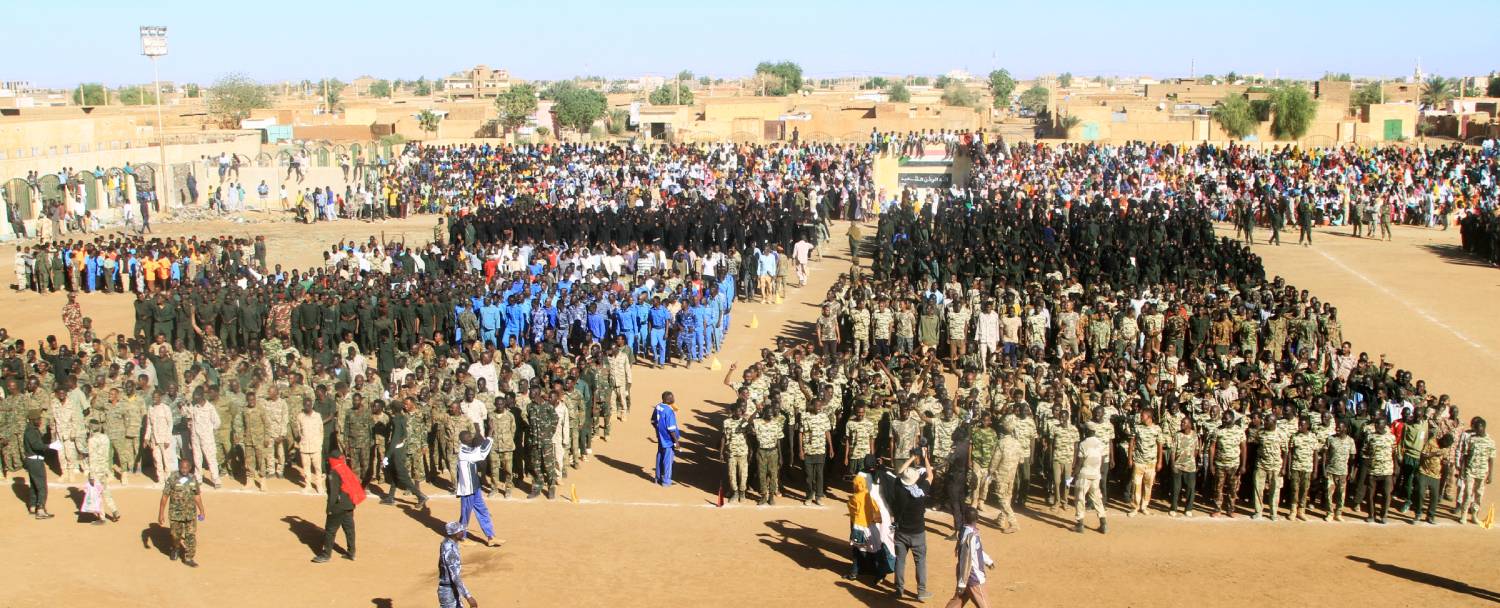
Soldiers in support of various units of the Sudan Armed Forces assemble at a graduation ceremony after completing a training. (Photo: AFP/Ebrahim Hamid)
- Another national militia is the Sudan Shield Forces (SSF). Comprising 70,000 troops, the SSF was founded by a retired SAF military officer, Abu Agla Keikel, in 2022 as part of a regional defense militia in eastern Sudan. The SSF has shifted allegiances at various stages in the conflict, tilting battlefield momentum. At the outbreak of hostilities, the SSF aligned with the SAF before defecting to the RSF in August 2023. The SSF subsequently defected back to the SAF in October 2024. Operating in Al Jazirah State, the SSF was instrumental in helping the SAF secure eastern parts of Sudan and ultimately retake Khartoum in March 2025. Keikel has been sanctioned for human rights violations by the European Union and the United Kingdom.
- The SAF increasingly relies on Islamist armed groups like the al-Baraa Bin Malik Brigade, under the leadership of al-Misbah Abu Zaid Talha, Anas Omar, and Hudhayfah Istanbul. Estimated at 20,000-45,000 troops, these Islamist militias operate beyond the groups’ stronghold in eastern Sudan and are active in the fighting in the three states of Kordofan. Deployed during the era of Omar al-Bashir, the al-Baraa Bin Malik Brigade was a central element of the National Islamic Front (NIF), later the long-ruling National Congress Party (NCP). Resentment toward the institutionalization of power by these Islamist groups led to their expulsion from any formal governance role following the 2019 revolution. The war has subsequently enabled these Islamist militias to re-embed themselves within the SAF and reclaim their stake in the political future of Sudan. The al-Barra Bin Malik Brigade has repeatedly resisted efforts to integrate under SAF command structures.
- Non-Arab regional militias based out of North and West Darfur States, formed in the 2000s to defend targeted communities against the Janjaweed, represent another important element of the SAF coalition. These primarily comprise the Sudan Liberation Movement/Army led by Minni Minawi (SLM-Minawi), and the Justice and Equality Movement led by Jibril Ibrahim (JEM-Ibrahim), each consisting of about 35,000 troops. At the outset of the war, a collection of Darfuri groups claimed neutrality under the banner of the Darfur Joint Forces. As RSF encroachment in the region intensified, most of these Darfuri groups joined the SAF. However, several split their allegiances, with some factions joining the RSF. Since the fall of El Fasher in October 2025, the SAF-aligned Darfuri armed groups have been redeployed to other parts of Sudan.
Reflective of the tenuous lines of command within the SAF coalition, there have been clashes among the various SAF-aligned armed groups.
- The most prominent armed tribal groups in the SAF coalition are the Zaghawa Council, which helped maintain SAF’s initial stronghold in North Darfur State at the onset of the conflict. These tribal groups largely operate as community militias protecting their home regions while also supporting the SAF. Another notable tribal group is the Dar al-Hamar militia (elements of which are fighting with both the SAF and RSF). Native to the Kordofan region, they have historical tensions with the Misseriya ethnic group, on which the RSF relies heavily for support.
- Reflective of the tenuous lines of command within the SAF coalition, there have been clashes among the various SAF-aligned armed groups. This includes battles between the SAF and the Military Intelligence Service as well as confrontations between the Sudanese Popular Resistance Force, the Sudan Shield Forces, and the Darfur Joint Forces.
| Sudanese Armed Forces and Pro-SAF Affiliates | ||
|---|---|---|
| Type | Designation | Location |
| Sudanese Armed Forces | Sudan Armed Forces Leadership: Abdel Fattah Al-Burhan Size: 205,000 SAF's Predominant Composition: • Military Forces of Sudan • Police Forces of Sudan • Military Intelligence Service | Khartoum Red Sea River Nile Kassala Al Jazirah Gedarif Sennar White Nile Blue Nile North Kordofan South Kordofan West Kordofan Northern North Darfur Central Darfur South Darfur West Darfur |
| National Armed Groups | Sudan Shield Forces* Leadership: Gen. Abu Agla Kekel Size: 75,000 | Gedarif Kassala Khartoum Al Jazirah North Darfur North Kordofan |
| Sudanese Popular Resistance Force/Mustanfareen Leadership: Gen. Yasir Al-Atta Size: 73,000 | North Darfur West Darfur Khartoum West Kordofan North Kordofan South Kordofan Kassala Gedarif White Nile River Nile Blue Nile Red Sea Al Jazirah | |
| Sudan People's Liberation Movement- North (SPLM-N-Agar)** Leadership: Malik Agar | Blue Nile | |
| Major General Al-Nour Ahmed Adam, "Al-Qubba" and Troops* Leadership: General Al- Nour Ahmed Adam Size: 80-180 | Unknown | |
| Ali Rizqallah-Al-Savan* | Unknown | |
| Regional Armed Groups | Darfur Joint Forces/Joint Force of Armed Struggle Movement (JSAMF) • Sudan Liberation Movement/Army (SLM-Minawi)** Leadership: Minni Minawi Size: 10,000-15,000 • Justice and Equality Movement (JEM-Ibrahim)** Leadership: Jibril Ibrahim Size: 35,000 • Gathering of the Sudan Liberation Forces (GSLF-Janna)** Leadership: Abdallah Janna • The Sudan Liberation Movement/Army -Transitional Council (SLM/A-TC)** Leadership: Salah Adam/Osman Jabar | North Darfur West Darfur Khartoum Al Jazirah Gedarif Kassala River Nile West Kordofan North Kordofan South Kordofan |
| Sudan Liberation Movement** Leadership: Mustafa Tambour Size: 10-15,000 | Central Darfur Kassala | |
| Joint Force of Armed Struggle Movement (JSAMF) - Zaghawa militias | North Darfur | |
| Sudanese Alliance Movement** Leadership: Khasim Abdallah Abkar | West Darfur | |
| Sudan Revolutionary Awakening Council* Leadership: Musa Hilal | North Darfur | |
| Islamist Armed Groups | Al-Baraa Bin Malik Brigade** Leadership: Al-Misbah Abu Zaid Talha, Anas Omar, and Hudhayfah Istanbul Size: 20,000-45,000 | North Kordofan Northern South Kordofan Northern Al Jazirah Kassala Khartoum |
| Sufi Muslim Group | Al Jazirah | |
| Popular Defense Forces** Leadership: Al-Bunyan Al-Marsous | South Kordofan | |
| Tribal/Communal Militias | Kawahala Militia Kababeesh Militia Zaghawa Council Smaller Tribal Groups: Beja, Karama Alliance, Duwaih, Kawahla, Gam, Ghadhiboon, Reserve Forces Eagles Brigade, Dar al-Hamar | Northern North Darfur West Kordofan South Kordofan |
| Foreign Fighters | Chadian Zaghawa Fighters/Parti socialiste sans frontières (PSF) Leadership: Ousmane Dillo | North Darfur Northern |
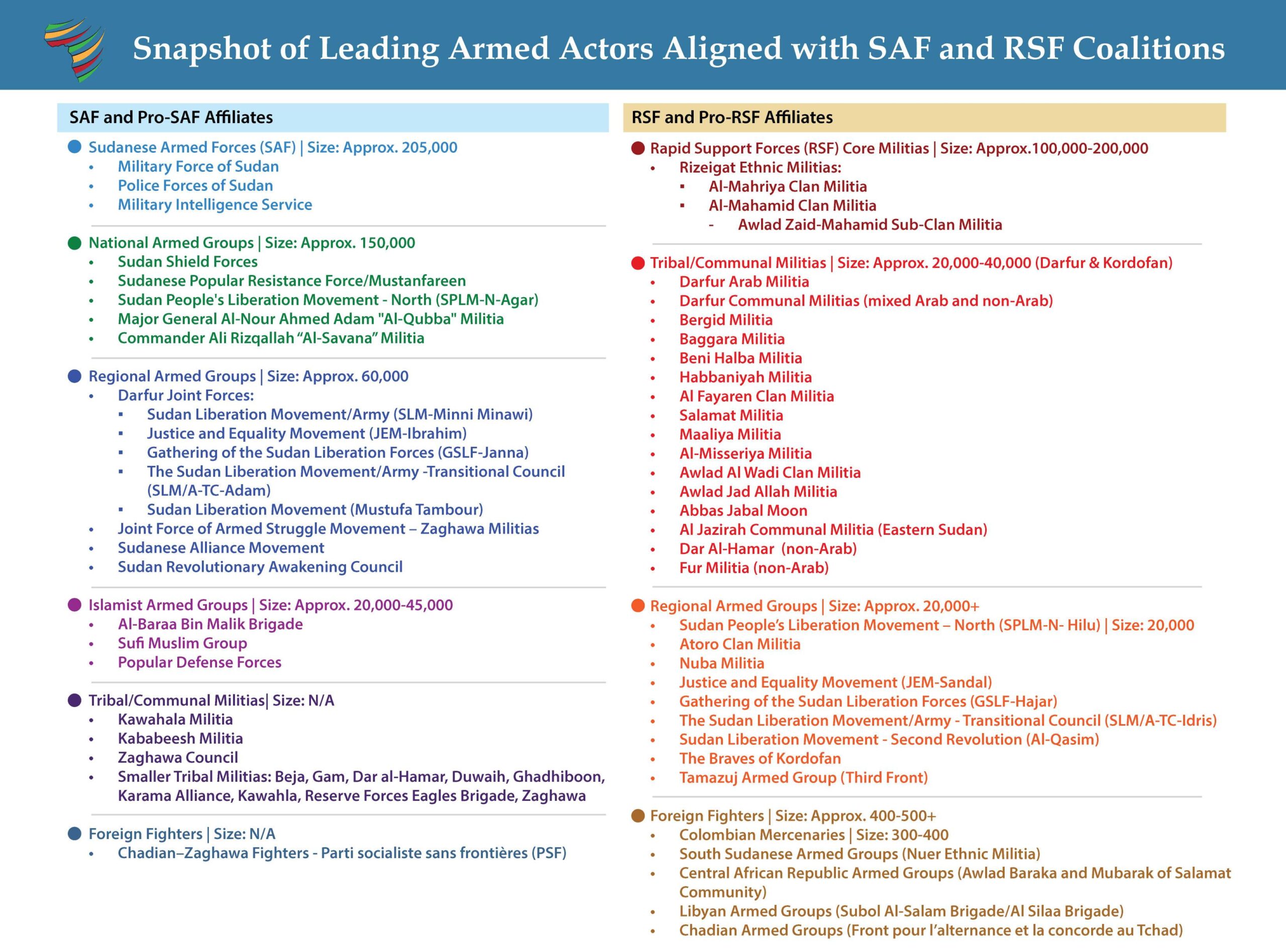 Click here for a printable PDF version
Key Actors of the Rapid Support Forces
- The RSF is a decentralized paramilitary force officially established in 2013 that draws heavily from Arab ethnic militias. Dominant among these are the seminomadic Rizeigat Arabs who, with an estimated population of 430,000, have historically moved through parts of northern, southern, and western Darfur, including border areas into Chad. Led by General Mohamed Hamdan Dagalo, the RSF emerged from the Janjaweed militia created under Bashir and was implicated in the Darfur genocide of the 2000s. Drawing from its major Mahriya and Mahamid clans, the Rizeigat militias constitute the core of the contemporary RSF force and comprise an estimated 100,000 fighters.
- Outside of the Rizeigat, the RSF draws support from roughly a dozen other mostly Arab tribal militias primarily based in the Darfur and Kordofan regions. Notable among these are the nomadic, cattle-herding Baggara and their subclans.
- While dominated by Arab militias, the RSF has increasingly recruited from non-Arab militias in the Darfur region and Nuba Mountains in Kordofan. The Darfur groups represent breakaway elements from those previously aligned with the SAF, including Suleiman Sandal’s faction of the Justice and Equality Movement (JEM-Sandal) and Al-Hadi Idris’s Sudan Liberation Movement/Army-Transitional Council (SLM/A-TC-Idris).
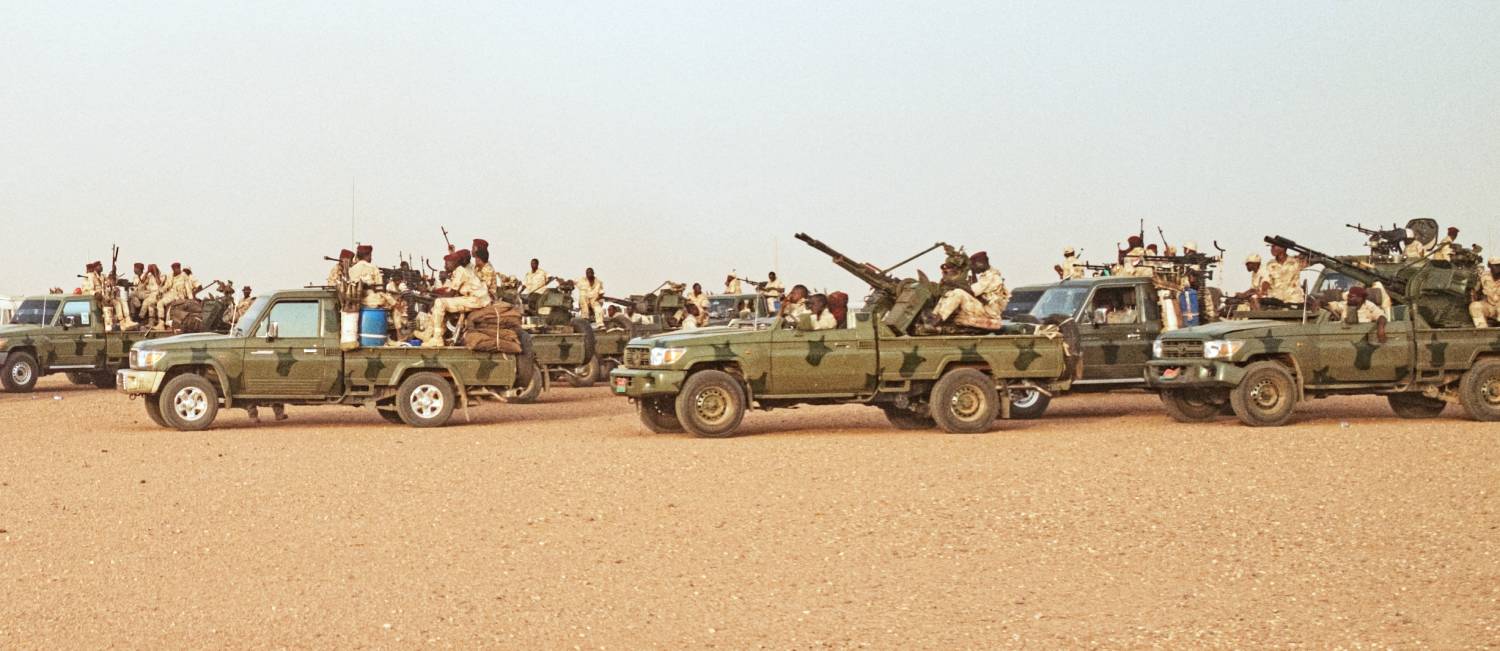
Rapid Support Forces’ “technicals” mounted with machine guns and anti-aircraft weapons (Photo: AFP/ Yasuyoshi Chiba).
- Militias from the Nuba Mountains (in South Kordofan and Blue Nile), meanwhile, have long sought autonomy from the central government in Sudan. The Sudan People’s Liberation Movement North faction led by Abdelaziz al-Hilu (SPLM-N-Hilu) is a remnant of South Sudan’s SPLM/A, which maintained a presence in the Nuba Mountains following South Sudan’s independence in 2011. Since declaring its alliance with the RSF, SPLM-N-Hilu has become one of the dominant forces in Blue Nile State as well as South Kordofan.
- In the effort to expand the forces it can mobilize, the RSF has also recruited foreign mercenaries. Most prominent of these are an estimated 300 Colombian mercenaries who have participated in the fighting as well as training of other RSF-aligned militias. The RSF has also deployed mercenaries from the neighboring countries of Chad, South Sudan, Libya, the Central African Republic, and (reportedly) Ethiopia.
- The relatively more fragmented collection of armed groups comprising the RSF coalition makes it less subject to a structured chain of command, with individual groups pursuing their parochial interests. As a consequence, intra-RSF clashes are common and, by some accounts, increasing over time.
| Rapid Support Forces and Pro-RSF Affiliates | ||
|---|---|---|
| Type | Designation | Location |
| Rapid Support Force | Rapid Support Forces: Leadership: Muhammad Hamdan Dagalo (Hemedti) Size: 100,000-200,000 fighters RSF's Predominant Composition: Rizeigat Ethnic Militia • Al-Mahriya Clan Militia -Rizeigat • Al-Mahamid Clan Militia - Rizeigat • Awlad Zaid-Mahamid Sub-Clan Militia | Khartoum Red Sea River Nile Kassal Al Jazirah Gedarif Sennar White Nile Blue Nile North Kordofan South Kordofan West Kordofan Northern North Darfur Central Darfur South Darfur West Darfur |
| Tribal/Communal Militia | Darfur Arab Militias | North Darfur West Darfur |
| Darfur Communal Militias | North Darfur East Darfur | |
| Bergid Militia | West Kordofan Abyei | |
| Baggara Militia | West Kordofan North Kordofan | |
| Beni Halba Militia | Al Jazirah | |
| Habbaniyah Militia | East Darfur | |
| Al Fayaren Clan Militia | East Darfur | |
| Salamat Militia | South Darfur Central Darfur | |
| Maaliya Militia | South Darfur | |
| Al-Misseriya Militia | Darfur Regions | |
| Awlad Al Wadi Clan Militia | West Kordofan | |
| Awlad Jad Allah Militia | West Darfur | |
| Abbas Jabal Moon | South Darfur Central Darfur | |
| Al Jazirah Communal Militia (Eastern Sudan) | West Kordofan | |
| Dar al-Hamar | South Darfur | |
| Fur Militia | North Darfur | |
| Regional Armed Groups | Sudan People's Liberation Movement North (SPLM-N-Hilu)* • Atoro Clan Militia • Nuba Ethnic Militia Leadership: Abdelaziz Al-Hilu Size: 20,000 | Blue Nile North Kordofan South Kordofan West Kordofan |
| Justice and Equality Movement (JEM-Sandal)* Leadership: Suleiman Sandal | West Kordofan | |
| Gathering of the Sudan Liberation Forces (GSLF-Hajar)* Leadership: Tahir Hajar | West Kordofan | |
| The Sudan Liberation Movement/Army - Transitional Council (SLM/A-TC-Idris)* Leadership: Al-Hadi Idris | West Kordofan North Darfur | |
| Sudan Liberation Movement - Second Revolution* Leadership: Mr. Abu Al-Qasim Imam | North Darfur West Darfur | |
| The Braves of Kordofan | West Kordofan North Kordofan | |
| Tamazuj Armed Group (Third Front) Leadership: Mohamed Ali Qureshi Size: 2,400 | Darfur Regions Kordofan Regions | |
| Foreign Fighters | Colombian Mercenaries Desert Wolves Brigade Leadership: Claudia Oliveros, Mateo Duque, and Alvaro Quijano Size: 300-400 | North Darfur South Darfur Central Darfur West Darfur West Kordofan |
| South Sudanese Armed Groups Nuer Ethnic Militia | West Kordofan North Darfur North Kordofan | |
| Libyan Armed Groups Subol Al-Salam Brigade Al Silaa Brigade | South Darfur North Darfur Northern | |
| Chadian Armed Groups Front pour l’alternance et la concorde au Tchad (FACT), led by Abdallah Jumeni of the Goran tribe | Northern North Darfur | |
| Central African Republic Armed Groups Awlad Baraka and Mubarak of Salamat Community | North Darfur | |
Points of Comparison between the Two Military Coalitions
A review of the composition of the two armed coalitions in Sudan indicates some similarities and notable differences. Both the SAF and RSF are organized around military structures that predate the current conflict. Whereas the largest contingent of forces supporting the SAF come from the legacy military, the RSF is composed almost entirely of Arab tribal militias. These core RSF forces have been fighting together for decades, tracing back to their days as the Janjaweed. This has helped the RSF to offset the overall numerical advantage in force size that the SAF can mobilize.
The composition of the SAF coalition has changed substantially over the course of the war as it has increasingly relied on militias. A notable difference with the RSF is the SAF’s expanding use of Islamist militias, harkening back to the NIF influence of the Bashir era. By contrast, the RSF has relied more heavily on foreign mercenaries.
Both the SAF and RSF have established political wings … in neither case are these civilian components very deep or representative.
The SAF has repeatedly stated that it is working to establish a unified chain of command over its disparate elements with the aim of creating more oversight and accountability for the actions of these forces. The RSF has seemingly not made establishing a structured chain a command a priority. This aligns with the more fragmented nature of the RSF coalition and the limited acknowledgements of accountability for the widespread reports of looting and human rights violations committed by the RSF-aligned forces.
Given their respective fractious coalitions, both the SAF and RSF encounter persistent intra-coalition fighting that contributes to the instability and unpredictability of the trajectory of this conflict.
Both the SAF and RSF have established political wings as they represent themselves as viable governing authorities. While these political elements comprise some civilians, in neither case are these civilian components very deep or representative. Both the SAF and RSF draw nearly all of their support from armed groups. Furthermore, the civilian arms of the SAF and RSF are subservient to the respective military leadership structures, underscoring the military focus of both coalitions.
Civilian Actors
While the conflict is commonly framed as a competition between two warring armed factions, this overlooks the extensive networks of civilian organizations that are a distinguishing feature of Sudanese society. Comprising a wide range of political, civic, professional, and community groups, these civilian actors see themselves as the embodiment of the ongoing 2019 revolution, envisaging a democratic Sudan accountable to the interests of citizens. While lacking a single, cohesive organizing structure, many of these groups remain active throughout Sudan in providing local governance, social services, and mediation roles. They are also actively pursuing pathways to a resolution of the conflict that leads to stable, cohesive Sudan.
National political organizations. These include political parties and national civic alliances aiming to articulate a vision of and structure for a civilian-led transitional and permanent government in Sudan. The most well-known of these is Somoud (Civil Democratic Alliance) led by former Prime Minister Abdalla Hamdok. Representing a broad-based coalition of 300 organizations, it has endorsed a set of principles around creating a unified and democratic Sudanese state based on a decentralized federal system that separates religion and state and establishes equal citizenship as the basis for rights and duties.
Professional Organizations. These include assorted networks of doctors, lawyers, business owners, and journalists that were key elements of the 2019 revolution and that continue to advocate for democracy, transparency, and merit-based governance reforms. These groups are well connected to the Sudanese diaspora as well as to international professional associations, drawing attention to the situation in Sudan.
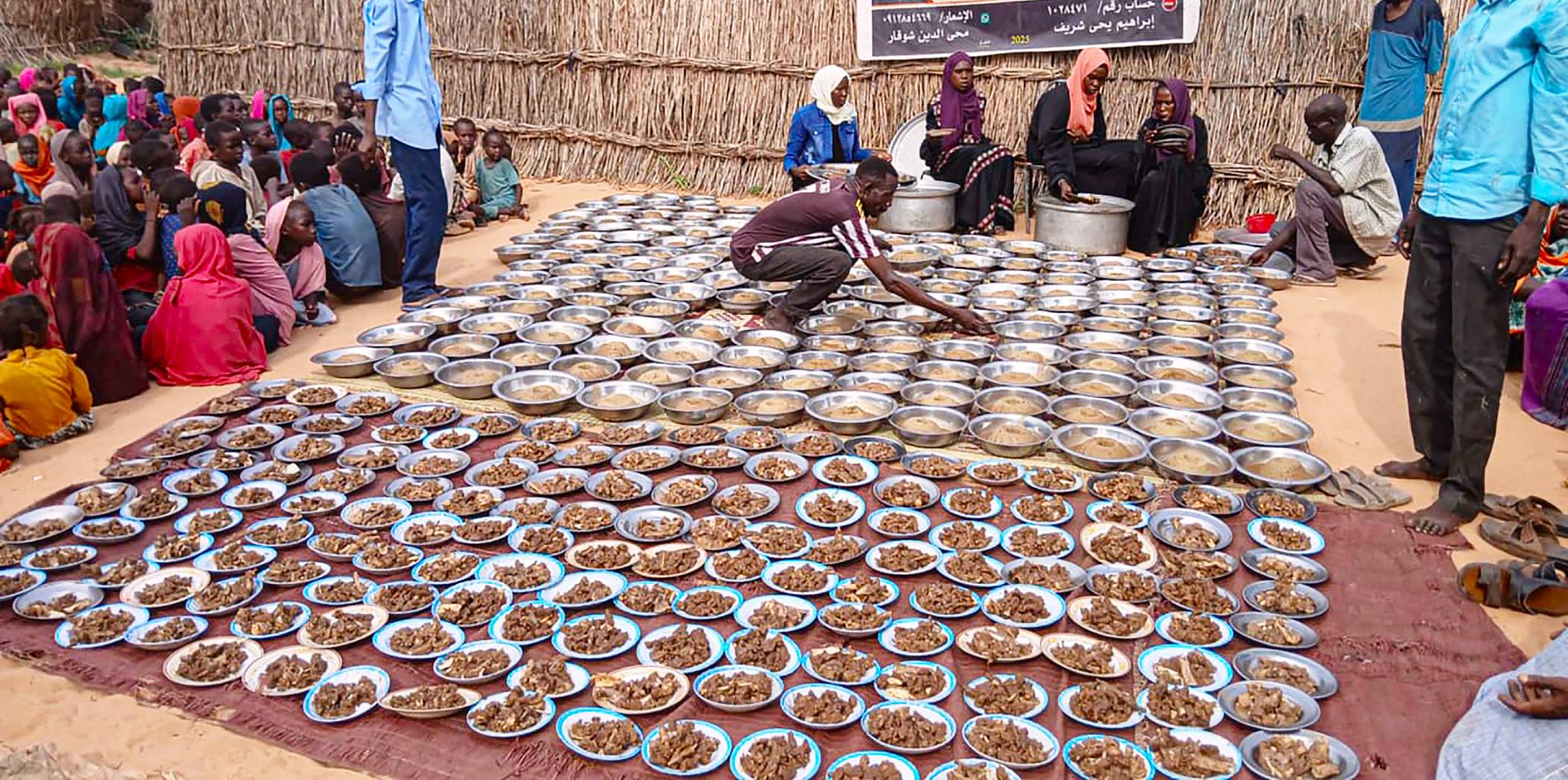
Sudanese volunteers prepare free meals for some of residents of El Fasher in August 2025. (Photo: AFP)
Emergency Response Rooms (ERRs). These include grassroots, community-led networks of an estimated 26,000 individuals that emerged during the war to provide health care, food assistance, education, and psychosocial support across all 18 states. Building on local traditions of mutual aid, ERRs have assisted millions and have gained extensive credibility among Sudanese civilians. They represent a service-oriented local governance system that is held up as a model for a future Sudan government.
Resistance Committees. These include neighborhood-based, grassroots pro-democracy groups that initially spearheaded the 2019 revolution. While they often remain independent from national political negotiations, they form the backbone of local mutual aid and antiwar activism.
Civic Groups. These include a wide range of community associations, comprising elders’ committees, youth groups, women’s alliances, and others focused on peacebuilding, economic development, and advocating for justice and accountability in Sudan.
National Civic Coalitions
Civil Democratic Alliance for Revolutionary Forces (Somoud)
Leadership: Abdalla Hamdok
Size: 300 participants and organizations
Sudan Civic Convergence Tracks (SCCT)
Leadership: N/A
Size: 40 diverse organizations, civil society, and political actors
Sudan Anti-Corruption Alliance
Emergency Response Rooms (ERRs)
Leadership: various
Size: 26,000 members
Resistance Committees*
Leadership: N/A
Size: 5,000+ committees across the country
Sudanese Doctors Network
Democratic Civil Society Platform
Sudan Peace Call
Professional and Trade Unions Coordination
Leadership: Taha Osman
Unionist Alliance*
Leadership: Babiker Faisal
The Coalition of Eastern Sudan Civil Forces*
Sudanese Declaration of Principles for Building a New Homeland Alliance
Sudan People’s Liberation Movement Revolutionary Democratic Current (SPLM/RDC)*
Intellectual Issues Center and Journal*
Sudanese National Alliance*
National Political Parties
Sudanese Congress Party*
Leadership: Omar Al-Digeir
National Umma Party*
Leadership: Al-Wathiq Al-Berier (Secretary-General)
Sudan People’s Liberation Movement-North (Revolutionary Democratic Current)*
Leadership: Yasir Arman
National Ba’ath Party*
Leadership: Kamal Boulad
Arab Socialist Ba’ath Party*
Leadership: Ali Al-Rih Al-Sanhouri
The People’s Congress Party
Leadership: Dr. Ali El Hajj
Ba’ath Party
Leadership: Mohamed Zia El Din
The Naserist Party *
The Republican Party *
The Unified National Unionist Party *
Sudan Liberation Movement/Army (SLM/A- WA)*
Leadership: Abdul Wahid Al Nour
Community-Based Coalitions
Youth Peace Ambassadors
Community leaders
Women, elders, IDP camp representative
Local Administrations in the Darfur Region
Elders and Mediation Committee of El Fasher (ECM)
Leadership: various
Size: 28 members, including religious actors, health practitioners, university representatives, and other social groups (women, Arab-identifying representatives, herders, and farmers).
Location: North Darfur
Committee for Evacuation of Wounded/Burial of the Dead
Committee led by a business, tribal, religious leaders, local authorities, and civilians (doctors, teachers and journalists)
Location: East Darfur
Darfur Bar Association*
Mechanism for Ceasing Hostilities and Peaceful Coexistence in South Kordofan
Location: South Kordofan
Youth Without Borders
Distributors of humanitarian aid in Kadugli
Location: South Kordofan
Youth for Our Country
A charity organization implementing programs for IDPs
Location: South Kordofan
Together for Dilling
A youth-led initiative that aimed to spread the culture of peace in the region
Location: South Kordofan
The Challenge of Rebuilding the Sudanese State
This snapshot of key actors operating in Sudan highlights the fragmented nature of both belligerent camps as well as the alliances of civilian actors attempting to advance a nonviolent and civilian-led alternative. Civilians, meanwhile, have been the frequent targets of elements of both belligerent factions—including the seizure of property, ethnically motivated violence, extortion, detentions, and assassinations aimed at weakening civilian civic and political leadership.
The growing incentivization of armed actors toward revenue capture and other criminal activities is deepening self-perpetuating drivers of the conflict.
The increasing fragmentation of the two military coalitions underscores the challenges underlying negotiating a ceasefire and transitioning to a stable state. The growing incentivization of armed actors toward revenue capture and other criminal activities is deepening self-perpetuating drivers of the conflict. These complexities and the expansive geographic spread of the conflict mean that navigating any prospective ceasefire, disarmament, and demobilization process will likely unfold at multiple levels and in stages.
How these respective fragmented coalitions evolve and engage with one another will be instrumental for determining the contours of a future Sudanese state, its capability to retain national sovereignty, and rebuilding cohesive national institutions that are representative and responsive to citizen interests.
More on: Sudan