


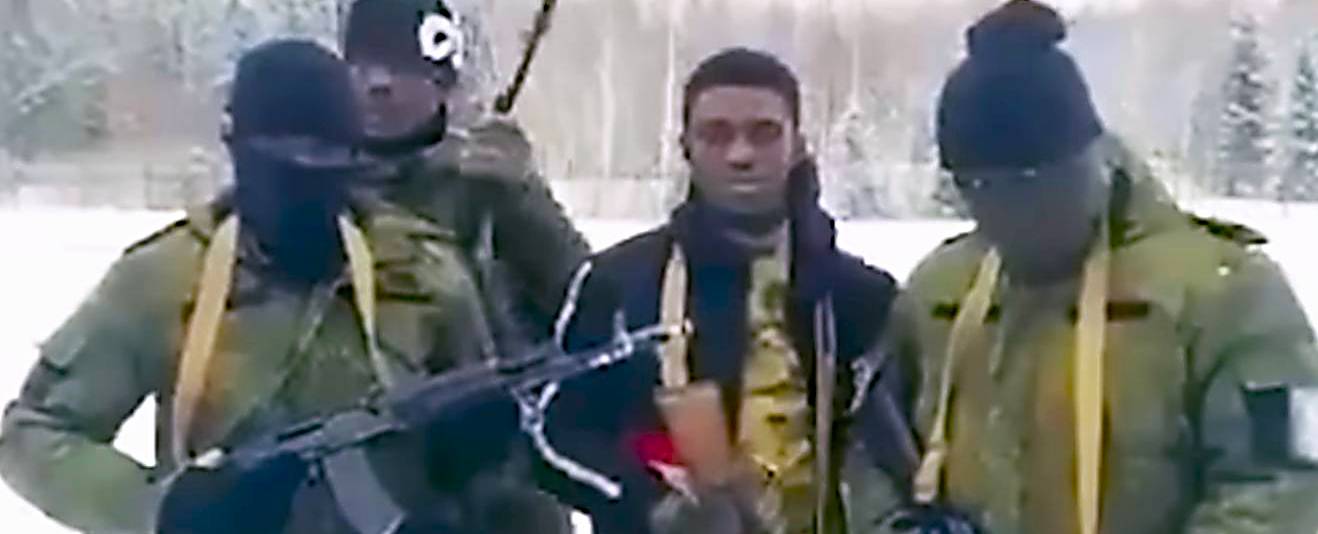
African recruits in Ukraine. (Image: screengrab)
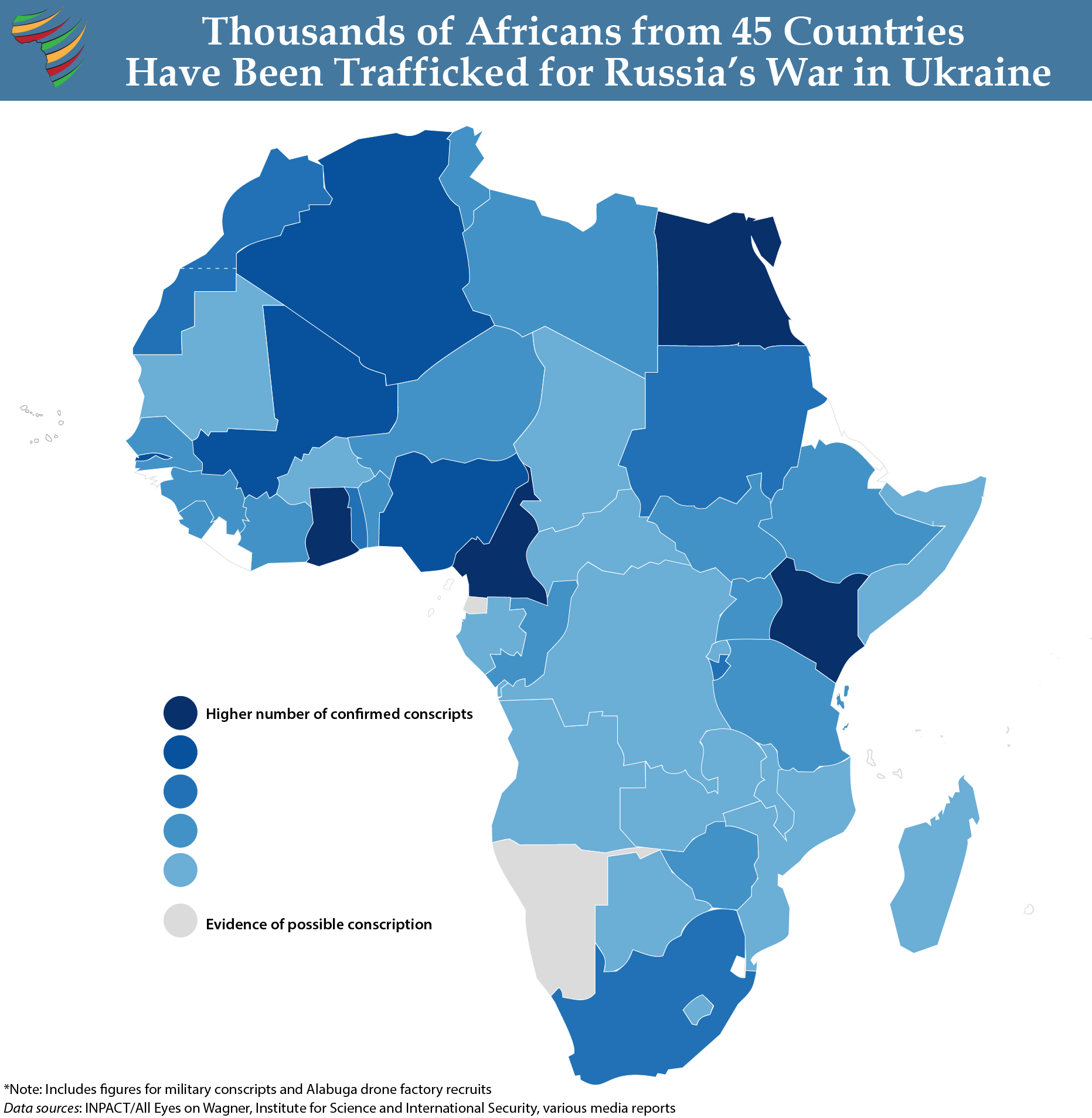
Through a shadowy network of online recruiters, Russia has quietly assembled a pipeline funneling thousands of Africans from nearly every country on the continent into the front lines and factories supporting Moscow’s war effort in Ukraine. These were not the destinations the young Africans thought they had signed up for. Many were looking for jobs, training, or opportunities abroad. Drawn by promises of life-changing salaries, they instead found themselves trapped in a war far from their home countries.
“The situation … is a confluence of disinformation, human trafficking, and foreign interference. This requires a coordinated response.”
Inquiries by African governments and investigative journalists have begun to sketch out the scope and means employed by Russian government operatives to entrap ordinary Africans—often with fatal consequences. Misled by Moscow’s recruiters, some have been pressed into military service and forced at gunpoint toward the front lines where casualty rates are exceptionally high. The Majority Leader of the Kenya National Assembly, Kimani Ichung’wah, has testified that once they arrive in Russia, these recruits are “basically just given a gun to go and die.” Others have been trapped in hazardous drone factories, suffering chemical burns and other injuries with no clear way home.
Ukrainian officials estimate that nearly 30,000 foreign nationals are currently fighting for Russia. With the full extent of these deceptive recruitment networks still unknown, African governments and families of victims are demanding more expansive investigations, an immediate end to these schemes, and accountability for those responsible. Following is a synthesis of what has been uncovered thus far.
Click here for printable PDF version
An Expansive and Systematic Recruitment Process
- Russia has built a deceptive recruitment pipeline that preys on African job seekers and students, channeling them into Russia’s ongoing war in Ukraine. Investigations reveal a recurring pattern. Young Africans are promised civilian work, sports opportunities, study programs, or legal status in Russia, only to arrive and be pressured to sign Russian-language military contracts.
- This scheme is intended to address Russia’s growing shortage of foot soldiers. Moscow needs roughly 30,000–35,000 new recruits each month to offset battlefield losses along the 1,200-km front line while avoiding a politically risky general mobilization of the Russian population. Estimates are that Russia has suffered approximately 1.2 million casualties—including as many as 325,000 deaths—since its attack on Ukraine in 2022.
- What first looked like isolated cases of recruitment scams of Africans has now been exposed as an extensive and systematic effort involving Russia’s Federal Security Service (FSB), the government’s principal intelligence agency. A leaked Russian database of African recruits from 2023 to 2025 illustrates a deliberate strategy to generate assault manpower for Russia’s war.
What first looked like isolated cases has now been exposed as an extensive and systematic effort.
- Estimates are that more than 1,700 Africans from 36 countries are currently fighting for Russia. This figure may represent only a fraction of the total number of Africans recruited by Russia, however. A Kenyan intelligence report presented to Parliament showed over 1,000 Kenyans had been recruited—a figure that is 2,100 percent higher than the number of Kenyans in the leaked database.
- Recruitment of Africans escalated in 2024, part of a larger clandestine effort to bolster Russia’s war effort with a pipeline of foreign fighters. Some recruitment is occurring through less visible channels such as informal networks and private military units, which have reportedly conscripted Africans directly from police custody in Russia and the Central African Republic. Yevgeny Prigozhin, the late leader of Russia’s paramilitary Wagner Group, said Africans recruited from Russian jails had fought and died in order to “‘repay (Africa’s) debts’ to Russia.”
Expendable with Little Recourse
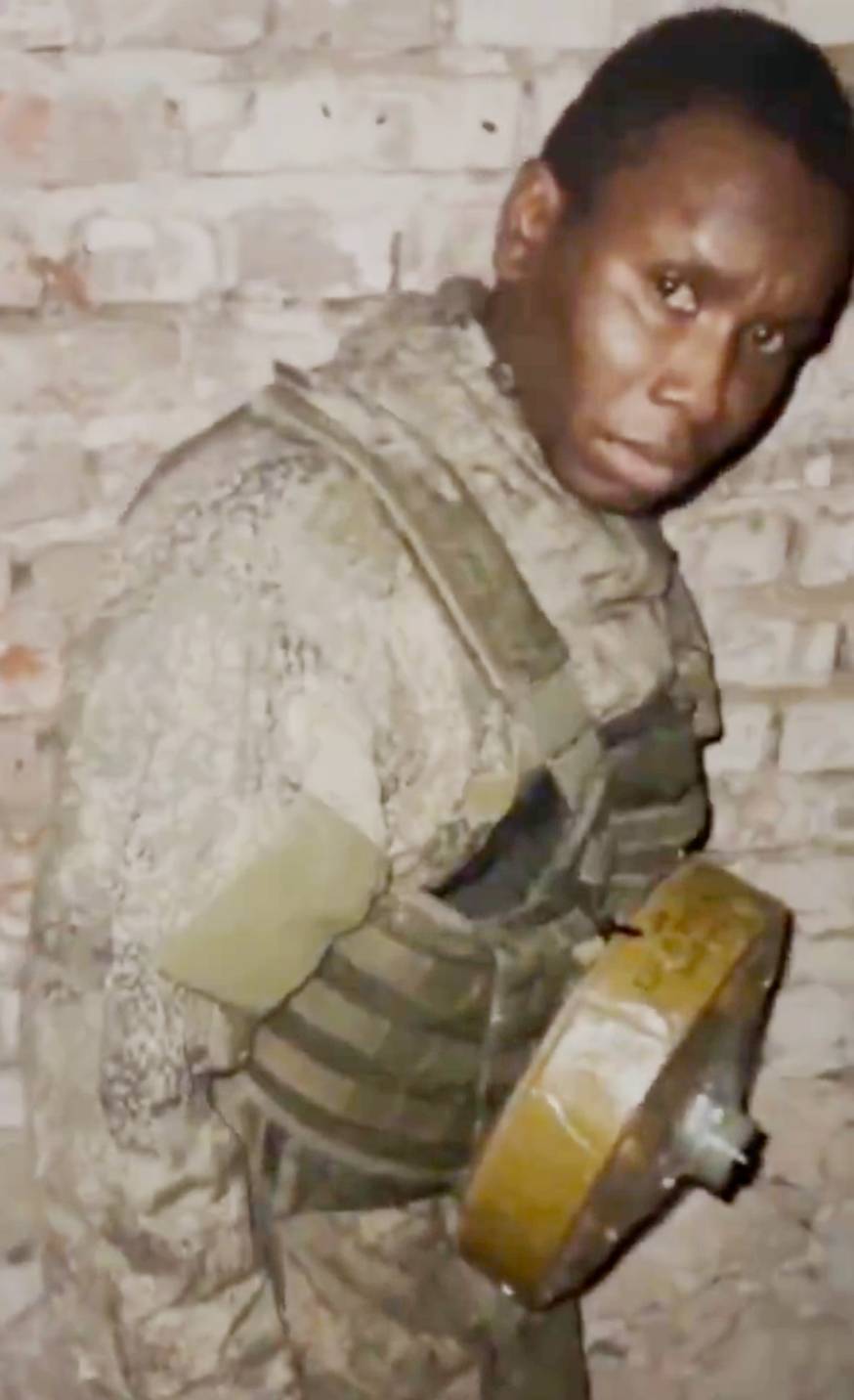
A young African soldier with an explosive strapped to his chest—thought to be a TM-62 anti-tank mine. He appeared to be forced at gunpoint to run toward a Ukrainian bunker. (Photo: Anton Gerashchenko)
- African recruits appear to be assigned to especially expendable battlefield roles. Survivors and investigators describe Africans being used in high-risk assaults. These accounts illustrate how Africans are being used to fill waves of Russian offensives intended to widen the battlefront through a strategy of attrition. They are pushed toward frontline positions with little training, poor equipment, limited supplies, and negligible apparent regard for their survival. African conscripts recount being sent to dig trenches, dodge drone attacks, and join doomed assaults. “We were cannon fodder. Some of us didn’t even know how to fire properly before they pushed us forward,” said a South African who had been misled into believing he was traveling to Russia to work as a bodyguard. In a video, Russian soldiers mock Kenyan recruits as “disposable ones.” In order to avoid being forced into what one recruit called “the death zone,” Africans in Russia report seeing “people shoot themselves in the hand to avoid going to the front.”
- The human toll has been severe. The leaked Russian database shows a 22-percent confirmed fatality rate of recruited Africans. Other reports calculate that 42 percent of foreign fighters die within 4 months in the Russian army. Ghana’s Foreign Minister has publicly acknowledged having one of the highest confirmed death tolls so far—55 Ghanaians killed (out of 272 Ghanaians known to have been lured into the war). Other African countries with high levels of recorded mortality include Cameroon (94) and Egypt (52).
- In South Africa, the father of a 20-year-old trapped near the front line quoted his son’s plea from Ukraine: “I want to come back home…. Please, Daddy, talk to someone.” Another Kenyan father lamented, “He didn’t know it was a job on the front line. Otherwise, I would never have allowed him to go. He’s my only boy.”
- On the opposite end of the continent from South Africa, an estimated 300 Egyptians have been deceptively recruited into the Russian conflict—often via the Telegram channel “Friends of Russia.” The primary motivation revolves around financial gain and the prospect of acquiring citizenship through expedited processes. However, enlistees have later reported that “We do not receive compensation or citizenship; rather, we face death.” The mother of one Egyptian recruit who is seeking intervention by the Egyptian government said, “If I’d known what was coming, I never would’ve let him go to Russia to study.”
- Testimonies from returnees describe amputations, severe maiming, untreated trauma, confiscated documents, withheld pay, and an ultimatum in which recruits were told to sign and fight or face death. Multiple survivors describe racial abuse and physical mistreatment by Russian soldiers, with one survivor recalling, “We were racially abused, beaten, and sent into the most dangerous areas.” When one wounded African man with no legs asked whether he could go home, he was told, “When your contract ends.” Another South African returnee said, “They made us burn everything we had—clothes, documents, even family photos. From the start, it was hell.” Zimbabwe’s Information Minister, Zhemu Soda, told reporters that for many recruits coerced into active combat, “the promised remuneration is never paid.”
Deception and Duress
- A review of the recruitment processes reveals a pattern of fraud, coercion, and social engineering. In Kenya and elsewhere, recruiters operating through various recruitment agencies and trafficking syndicates advertised jobs such as drivers, guards, electricians, plumbers, and salesmen—as well as purported sports opportunities—with salaries far above local norms. Some recruits were lured through WhatsApp groups in which other Africans acting under duress reassured them in Swahili that they were heading for exciting, well-paid work. Once in Russia, many were shown contracts in Cyrillic, threatened if they refused to sign, and in some cases pressured to send positive messages back home or recruit friends and relatives into the same pipeline. After being forced to sign contracts, Africans report that their passports are withheld, effectively preventing them from returning home. In Kenya, the deception was especially brazen: criminal syndicates allegedly posed as government-endorsed “Kazi Majuu” (work abroad) recruiters, then charged job seekers for placement in overseas work before covertly redirecting them to Russia’s war zone.
A review of the recruitment processes reveals a pattern of fraud, coercion, and social engineering.
- In South Africa, recruits alleged that Duduzile Zuma-Sambudla, daughter of former president Jacob Zuma, misled them into believing they would be trained as bodyguards in Russia. Zuma-Sambudla and two others were reportedly paid roughly $845,000 by the Wagner Group for funneling South Africans into the war. “Our children were sold off,” said the parent of one of the victims. Zuma-Sambudla resigned her seat in Parliament in December 2025 following the revelations and the initiation of a police investigation.
- Russia’s exploitation of African labor has extended beyond the trenches into its war industries, particularly drone production. Investigations have verified hundreds of African recruits—primarily young women—working under deceptive “work-study” schemes at facilities like the Alabuga drone factory about 1,000 km east of Moscow. Recruits are promised “professional training” in fields including logistics, catering, and hospitality—but are instead forced to build weapons under restrictive, coercive, and hazardous conditions. Many reportedly cannot afford to pay for a return flight, having only received a sixth of the salary they were promised. Estimates suggest this pipeline may involve over 1,000 Africans.
Growing Demands for Accountability
- African governments are increasingly speaking out and demanding accountability from Russia. As evidence has mounted, officials from countries including Kenya, Ghana, South Africa, and Nigeria have publicly raised concerns, summoned Russian diplomats, or called for the return of their citizens and an end to deceptive recruitment practices. Interpol has launched an investigation in Botswana regarding the Alabuga drone factory recruitment.
- Kenya’s independent press and Parliament have been at the forefront of documenting and exposing the clandestine Russian recruitment networks and pressuring authorities to respond. Criminal cases have been opened against recruiters, and families have publicly mobilized for answers. As a result, Kenyan security services have raided offices used by recruitment syndicates—in one case rescuing 22 individuals bound for Russia—and have increased screening at airports.
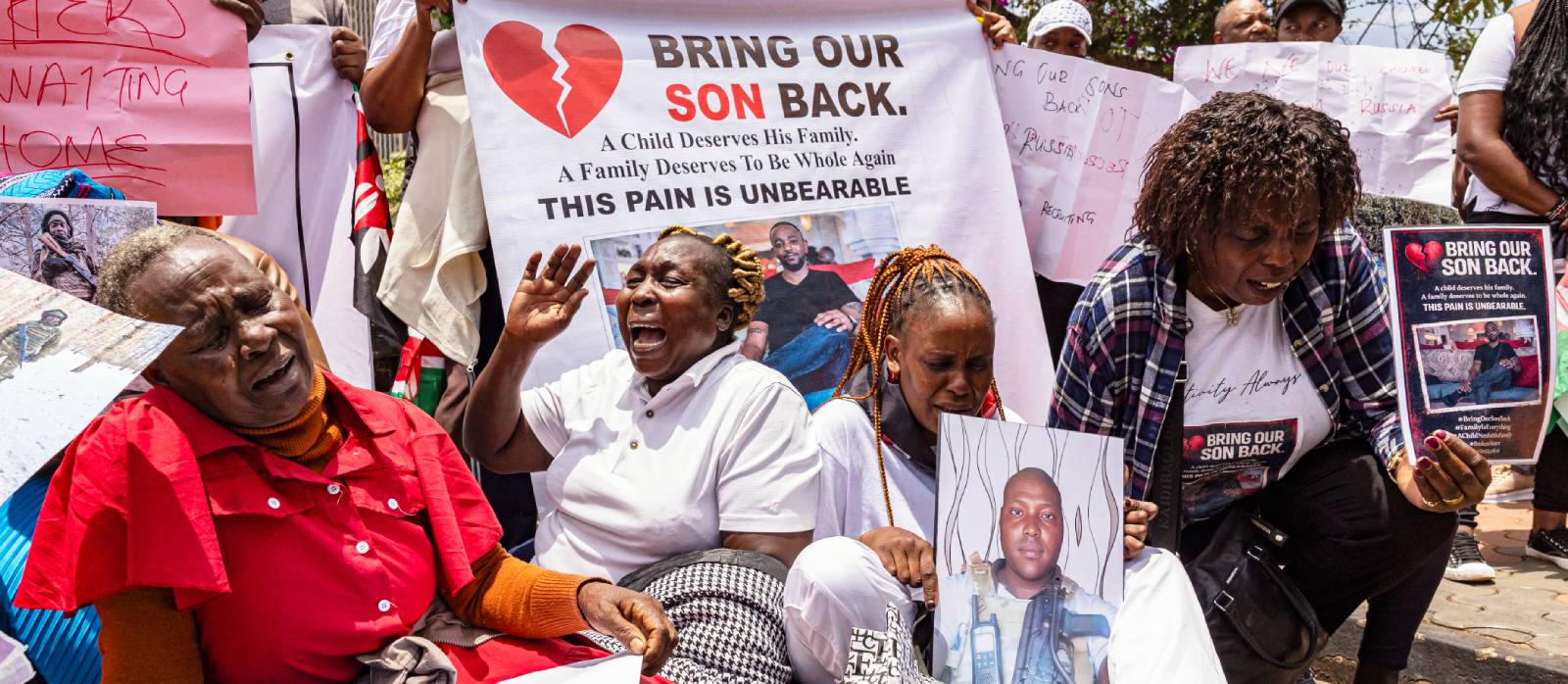
Family members of Kenyan nationals tricked into fighting for the Russian army in Ukraine. (Photo: AFP/Simon Maina)
- Kenya National Assembly Majority Leader Ichung’wah noted that the “organised transnational trafficking syndicate recruiting Kenyan citizens under false pretences and deploying them to active conflict zones in Russia” was still operating and shifting its routes from Istanbul and Abu Dhabi to move victims through the Democratic Republic of the Congo, Uganda, and South Africa to avoid detection. He urged further investigations into individuals within Kenyan directorates and ministries that had colluded with the criminal syndicates to enable these schemes.
- When confronted with the overwhelming evidence of Russia’s deceptive recruitment of Africans for the war in Ukraine, the Kremlin’s spokesperson said in May 2026 that “We are unaware of any such cases.”
- Given the scale, common patterns, and cross-border cooperation of these recruitment networks, African investigators are calling for greater regional coordination in investigating, prosecuting, and ending these illegal recruitment practices. As a Ghanaian civil society leader observed, “the situation [of the Russian government recruiting] within the continent should be seen as a confluence of disinformation, human trafficking, and foreign interference. This requires a coordinated response at the regional level.” Otherwise, African countries will continue pursuing the matter individually, limiting their leverage to hold Russia accountable.
Additional Resources
- Sasha Fokina, “A Gold Mine for Recruitment: How Russia is Recruiting Soldiers in Africa (translated from Russian),” Doxa, May 9, 2026.
- Brian Wasuna and Simon Ciuri, “The Russian Mercenary: Unmasking Man Recruiting Kenyans for Ukraine War,” Daily Nation, February 25, 2026.
- African Digital Democracy Observatory, “Techniques Used to Recruit and Co-opt African Nationals into Fighting in the Russian-Ukrainian War,” February 20, 2026.
- The Hansard V, no. 71, Kenya National Assembly (Nairobi: Clerk of the National Assembly, 2026), 11-14.
- Africa Center for Strategic Studies, “Tracking Russian Interference to Derail Democracy in Africa,” Infographic, June 21, 2023 (updated May 8, 2024).
- Africa Center for Strategic Studies, “Mapping a Surge of Disinformation in Africa,” Infographic, March 13, 2024.
- Joseph Siegle, “Inflection Point for Africa–Russia Relations after Prigozhin’s Death,” The Conversation, September 6, 2023.
More on: Russia in Africa