

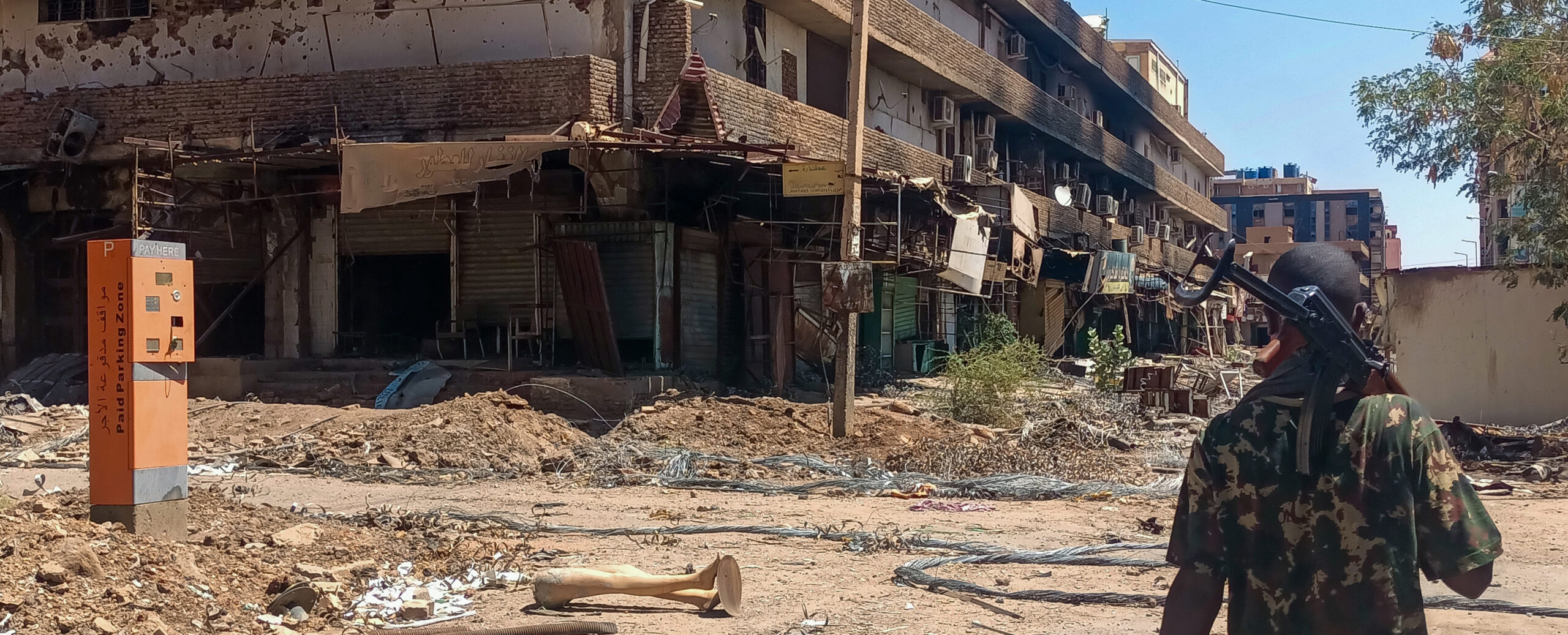
A fighter patrols a destroyed market in Khartoum, Sudan. (Photo: AFP)
Highlights
- Nearly 164 million Africans are estimated to be facing acute food insecurity—comprising households that are experiencing high rates of acute hunger (Integrated Food Security Phase Classification 3 (Crisis) and above).
- This is the third year in a row that over 160 million Africans have faced acute food insecurity, underscoring the sustained high levels of strain households are facing to meet basic food needs.
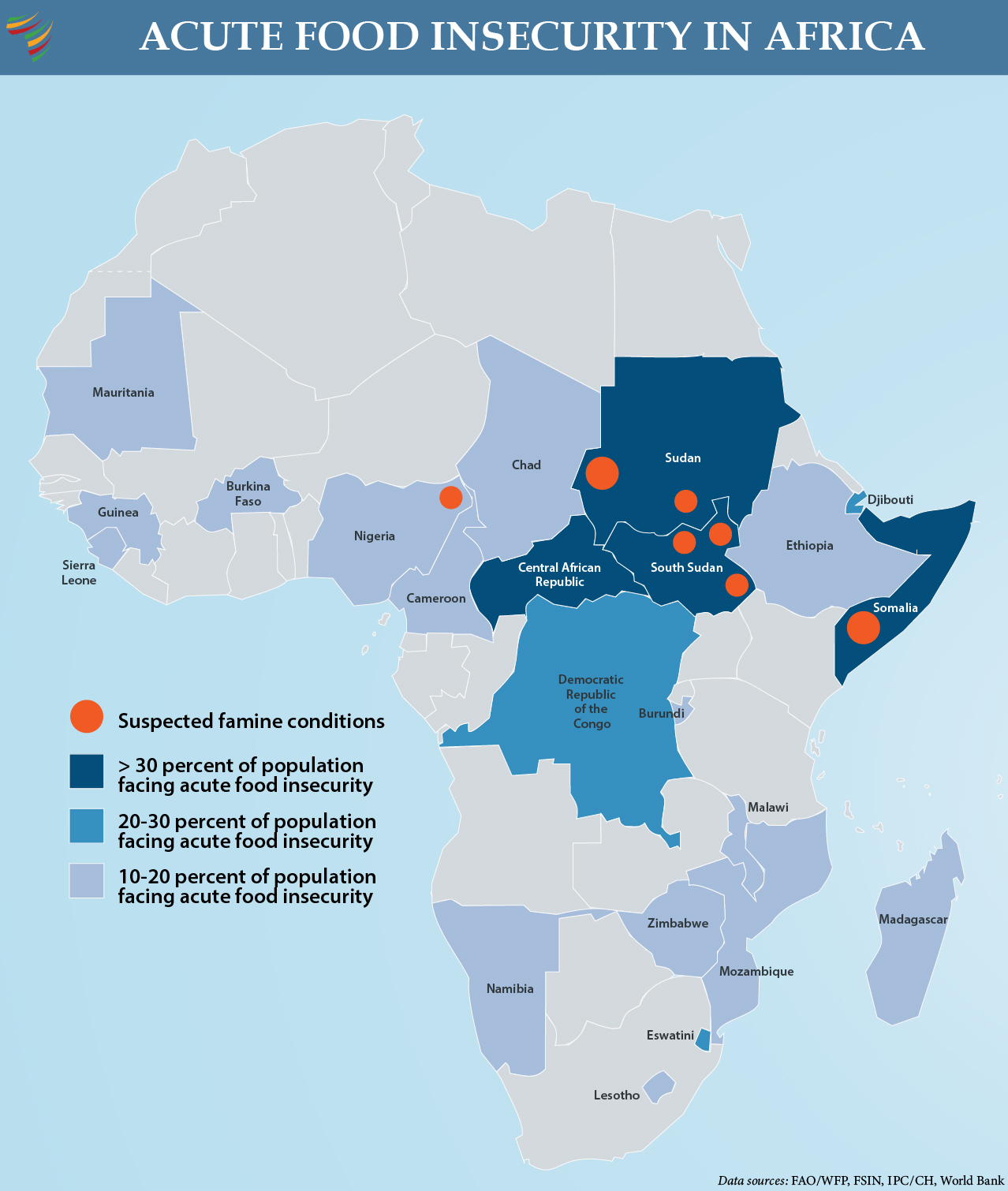
- Famine conditions persist in parts of Sudan, South Sudan, and Somalia that are most isolated because of the fighting. Moreover, an estimated 10,300 people in Borno, Nigeria, the heart of the Islamist militant insurgency, are also expected to experience famine conditions. While Mali is no longer reported to be facing famine, elevated food insecurity persists as security conditions continue to deteriorate.
Conflict continues to be the primary driver of acute food insecurity in Africa.
- Conflict continues to be the primary driver of acute food insecurity in Africa. Roughly 134 million (80 percent) falling under this classification in Africa, including all of those in famine, are in countries experiencing conflict.
- The number of Africans facing acute food insecurity today is nearly triple that of 2019, where 61 million were reported to face crisis levels of food security or above.
Deep and Broad
- 4 countries account for 60 percent of the number of people who are acutely food insecure—Nigeria, the Democratic Republic of the Congo (DRC), Sudan, and Ethiopia. Each has seen between a twofold and sevenfold increase in populations facing crisis levels of food insecurity since 2019.
- This geographic concentration of acute food insecurity reflects how the persistence of these conflicts has contributed to ongoing degradations to food production, livelihoods, and coping mechanisms.
- Nigeria saw the highest numerical increase of people facing acute food insecurity over the past year (6.3 million), which represents a 20.6-percent increase. This is due to the combination of militant Islamist group violence in the northeast and organized violence in the northwest of the country. The effect has been prolonged population displacements that have caused households to abandon their farming, pastoralist, and trading livelihoods.
- While the scale is most pronounced in those four countries, the challenge of acute food insecurity is widespread. More than 10 percent of the population in 22 African countries—traversing Central, East, West, and Southern Africa—are facing acute food insecurity. This pattern has also persisted with 20 or more African countries surpassing the 10-percent threshold since 2022. In 2019, only nine countries reached this breadth of food crisis.
- In four countries—South Sudan, Sudan, the Central African Republic (CAR), and Somalia—more than 30 percent of the population is experiencing acute food insecurity. In South Sudan, an estimated 64 percent of the population falls in this category—the highest percentage on the continent.
Central Africa
- At 18 percent, Central Africa was the region with the highest rate of its population facing acute food insecurity. In addition to the CAR and the DRC, roughly 10 percent or more of the populations in Chad and Cameroon are facing acute food insecurity. In both cases, conflict is the primary cause of disruptions in production and population displacements.
East Africa
Sudan continues to be the focus of acute food insecurity in East Africa with an estimated 19.5 million facing crisis level conditions.
- Sudan continues to be the focus of acute food insecurity in East Africa with an estimated 19.5 million facing crisis level conditions.
- After significant declines in levels of food insecurity following the ceasefire in the 2020-2022 conflict between the Ethiopian government and the Tigray People’s Liberation Front (TPLF), renewed TPLF attacks in Tigray and other parts of northern Ethiopia in September have disrupted food, fuel, and other supplies. This has caused the number of people facing acute food insecurity in Ethiopia to expand by 800,000 to an estimated 15.8 million.
- South Sudan, too, has seen a resurgence of conflict this year, sending waves of South Sudanese citizens and Sudanese refugees fleeing into neighboring Sudan’s war.
West Africa
- While Nigeria is driving the aggregate numbers of food insecure in West Africa, the conflict-affected Sahelian countries of Burkina Faso, Niger, and Mali collectively have 6.7 million people facing food-crisis conditions.
- Ongoing strains in food supply and access have also kept elevated the numbers of acute food insecure in Sierra Leone, Guinea, and Mauritania.
Southern Africa
Madagascar has seen the highest percent increase in acute food insecurity across the continent.
- Southern Africa has relatively fewer people facing acute food insecurity (7 percent) compared to other Sub-Saharan African regions. Nonetheless, conflict-affected Mozambique, as well as Malawi and Madagascar have more than 10 percent of their populations facing acute food insecurity.
- Madagascar, which experienced a military coup in October 2025, has seen the highest percent increase in acute food insecurity across the continent (96 percent). As a result, there has been a near doubling in the number of people (3.7 million) facing acute food insecurity in the country.
- Meanwhile, regional climatic patterns that were straining the entire southern African region a year ago have shifted. This has resulted in notable decreases in populations experiencing acute food insecurity in Zambia, Namibia, and Zimbabwe.
Acute Food Insecurity Dominated by Countries in Conflict
| Country | Conflict-Affected | IPC/CH Phase 3+ (millions) | IPC/CH Phase 4 (millions) | IPC/CH Phase 5 (millions) | % of Population |
|---|---|---|---|---|---|
| Nigeria | ✓ | 36.9 | 2.1 | 0.0 | 16 |
| DRC | ✓ | 26.5 | 3.6 | 0.0 | 24 |
| Sudan | ✓ | 19.5 | 5.0 | 0.1 | 38 |
| Ethiopia | ✓ | 15.8 | 0.0 | 0.0 | 12 |
| South Sudan | ✓ | 7.8 | 2.5 | 0.1 | 64 |
| Somalia | ✓ | 6.5 | 2.0 | 0.0 | 33 |
| Chad | ✓ | 3.5 | 0.3 | 0.0 | 17 |
| Burkina Faso | ✓ | 2.7 | 0.4 | 0.0 | 11 |
| Mozambique | ✓ | 3.5 | 0.3 | 0.0 | 10 |
| Cameroon | ✓ | 2.9 | 0.3 | 0.0 | 10 |
| Niger | ✓ | 2.4 | 0.0 | 0.0 | 9 |
| CAR | ✓ | 2.0 | 0.3 | 0.0 | 37 |
| Mali | ✓ | 2 | 0 | 0 | 6 |
| Libya | ✓ | 0 | 4 | ||
| Total Conflict | 131.6 | 17.1 | 0.2 | ||
| Estimated Share of All African IPC3+ Food Insecurity Among Confict Countries (%) | 80 | 91 | 100 |
Waves of External Shocks have Strained already Fragile Coping Strategies
- While conflict is the most direct and debilitating driver of acute food insecurity, the sharp and sustained rise in the size of Africa’s food insecure population also reflects the series of external economic shocks that have restricted food production, grain imports, and affordability since 2019.
- Despite efforts by producers and traders to adapt to these shocks, the FAO’s baseline measure of prices for a household food basket on the continent has increased by a third since 2019.
- Six countries facing severe food crises have seen food inflation rates exceed 15 percent since June 2026: Sudan (52 percent), South Sudan (18 percent), Libya (18 percent), Malawi (18 percent), Nigeria (18 percent), and Ethiopia (15 percent).
- Sudanese farmers already stressed by the domestic war are now watching costs rise for fertilizer, gasoline to power farm equipment, and diesel for irrigation pumps. This has forced many farmers to sell assets that they need for future production (from livestock to farm equipment), creating a vicious cycle of increased vulnerability.
- Nigerian farmers have seen costs for fuel and fertilizer rise by 56 percent over the past year, discouraging many from participating in the forthcoming farming season.
El Niño Impact
- Severe El Niño conditions are further aggravating food insecurity in parts of Africa including the conflict-affected countries of Nigeria, Chad, Cameroon, Somalia, Sudan, South Sudan, and Ethiopia.
- Sudan – Compounding the devastation of the conflict, severe drought due to El Niño is affecting more than half of Sudan. This has negatively impacted croplands in North Darfur, South Darfur, West Kordofan and South Kordofan, resulting not only in loss of food but also income. Pockets of households in each of these regions are facing famine conditions.
Severe El Niño conditions are further threatening food security conditions in parts of Africa including conflict-affected countries.
- Ethiopia – El Niño conditions resulted in below-average rainfall in various parts of Ethiopia. East and West Hararghe, for example, saw 40 percent crop production losses, significantly reducing household food availability and agricultural income.
- Somalia – El Niño has brought severe flooding to parts of Somalia. As many as 874,000 people could be displaced and their crops destroyed and water contaminated. About 2 million people are facing emergency (phase 4) levels of food insecurity, more than double the number recorded last year. Roughly 26,000 internally people displaced (IDPs) in Baidoa who were displaced by conflict or natural disasters are at risk of famine should the El Niño lead to more severe flooding.