

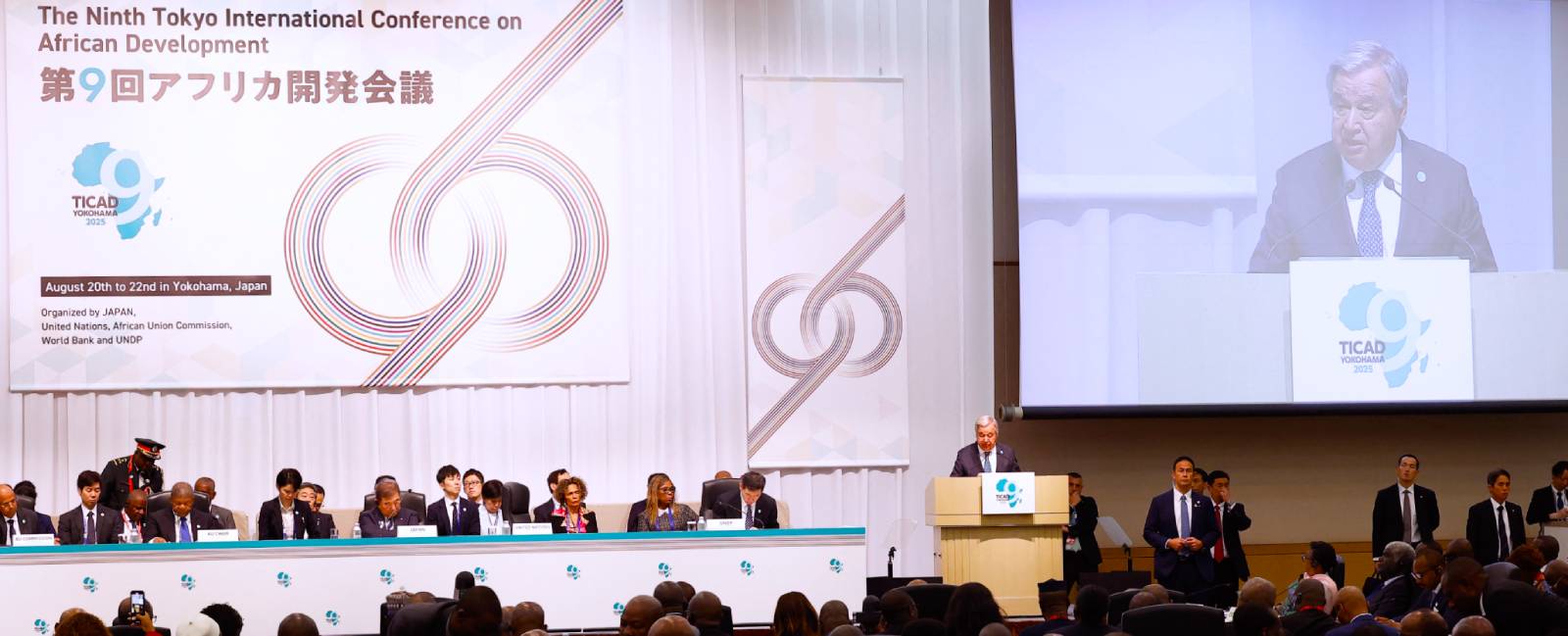
Antonio Guterres, Secretary General of the United Nations, addresses the opening ceremony of the 9th Tokyo International Conference on African Development (TICAD 9) in Yokohama, Japan, August 20, 2025. (Photo: AFP)
Operationalizing themes of co-ownership, blended finance, and adding value to African supply chains, Japan’s engagements in Africa continue a long legacy of innovation and mutuality that reinforce Japan’s commitment to the continent as Africa’s geostrategic importance grows.
Japan’s distinctive approach toward Africa was on display at the Ninth Tokyo International Conference on African Development (TICAD 9) held in Yokohama, Japan, in August 2025. The conference developed plans for the next iteration of Africa-Japan partnership focusing on interdependence, mutual benefit, and co-creation. Government leaders from 42 African countries joined Japanese Prime Minister Shigeru Ishiba and leaders from Japanese and African private sector, academia, and civil society. The gathering featured over 200 thematic networking events and 300 booths to facilitate exchanges between Japanese and African companies.
Japan’s engagements in Africa continue a long legacy of innovation and mutuality.
Launched in 1993, TICAD has met every 3 years in alternating Japanese and African venues, making it the oldest mechanism of its kind. Co-organized by Japan, the African Union (AU), United Nations Development Program (UNDP), and the World Bank, policy alignment was an explicit feature of the Yokohama Declaration that stated that “TICAD 9 is broadly aligned to Africa’s development priorities.”
Conveying the growing importance of Africa to Japan, the Japan International Cooperation Agency (JICA) designated four Japanese cities as official “hometowns” for residents of four African countries to promote ties. They are Nagai in the northern Yamagata Prefecture, which was paired with Tanzania; Kisarazu in Chiba Prefecture near Tokyo, which was assigned to Nigeria; Sanjo in Niigata Prefecture, which was linked with Ghana; and Imabari in the western Ehime Prefecture, which was aligned with Mozambique. Each of these cities have long-running historical ties with their assigned country.
Economy, Society, and Peace and Stability
TICAD’s creation reflected a confluence of Japanese and African interests. Concerned about the continent’s marginalization after the Cold War, TICAD was established to foster ongoing mechanisms of engagement and the joint commitment to peace, development, solidarity, and the banishment of tyranny. In doing so, Japan pioneered the tradition of Africa-focused summitry.
TICAD was established to foster ongoing mechanisms of engagement and the joint commitment to peace, development, solidarity, and the banishment of tyranny.
Ambassador Erastus Mwencha, former Deputy Chairperson of the AU Commission, participated in those early efforts, working with seven Japanese prime ministers and receiving Japan’s highest honor, the Order of the Rising Sun. Ambassador Mwencha noted, “TICAD underscores Japan’s peaceful intentions … and convinces us that [Africa] matters to Japan, and that our issues will not be ignored internationally.”
From its inception, the TICAD process has revolved around three pillars: economy, society, and peace and stability. The Yokohama Declaration advanced commitments on each of these fronts:
Economy
- Address the high debt premium of borrowing countries that pay significantly higher interest rates compared to their peers despite similar risk ratings.
- Support capacity building for African countries to engage effectively with financial market institutions, including credit rating agencies, and to facilitate balanced risk assessment reporting.
- Accelerate African regional integration by boosting efforts to develop value-chains and integrating African countries into global supply chains.
- Support African exports of value-added goods to Japan through agro-industrial zones, export certification hubs, and buyer-supplier networks.
Society
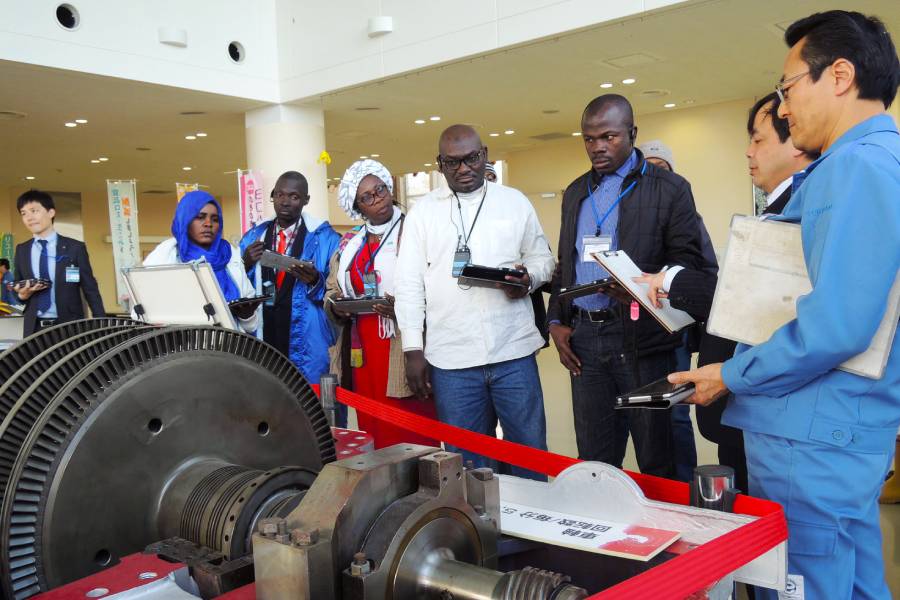
African participants in a technical training program on waste management systems in Yokohama. (Photo: City of Yokohama)
- Expand health, education, and social services with a particular focus on youth, women, and persons with disabilities.
- Strengthen Africa’s public health workforce and the local production of health commodities through mechanisms like the AU Local Manufacturing Initiative and Africa Medicines Agency.
- Ramp up opportunities for African youth to partner more directly with Japanese youth to solve problems and co-create transformative solutions.
Peace and Stability
- Support measures to address conflict, terrorism, and violent extremism, and strengthen coordination on peace operations in Africa.
- Redouble Japanese and African efforts to fill funding gaps in the AU Support and Stabilization Mission in Somalia (AUSSOM) while mobilizing the international community to ensure predictable, sustainable, and adequate financing for this mission.
- Improve Africa-Japan coordination to manage complex threats, including cyber intrusions, maritime insecurity, drug trafficking, transnational organized crime, human trafficking, and illicit financial flows.
- Adapt Japan’s experience in peacebuilding, institutional reform, and post conflict reconstruction to African contexts through technical assistance, exchange of expertise, policy coordination, training, and capacity building.
Commitments under the peace and stability pillar reinforce the African Peace and Security Architecture (APSA). For the past 23 years, Japan has strengthened Africa’s peacekeeping troop deployments through support to the AU’s peacekeeping training centers of excellence, technical assistance, and support to ongoing missions. Japan has also dispatched Japan Self-Defense Forces personnel to support African troop contributing countries, and has trained over 5,000 judicial officers to strengthen justice and rule of law initiatives.
Japan’s counterterrorism and countering violent extremism efforts in Africa support Nigeria as well as countries in the Sahel and the Horn of Africa with funding and training. Japan also sponsors vocational training for at-risk youth to dissuade them from terrorist recruitment. Maritime security and counter-trafficking efforts, similarly, focus on providing vessels, funding, and training to support coast guards in the Horn of Africa and the Gulf of Guinea.
Co-Ownership and Co-Management
TICAD’s concepts of co-ownership and co-management were designed with sustainability, cost-sharing, and multisectoral engagement in mind. The UNDP provides technical assistance at international, regional, and national levels on coordination and implementation. TICAD’s multitrack mechanism has ensured that the Japanese and African governments, private sector, and civil society participate as equals, making it unique among “Africa plus one” initiatives that tend to be primarily government-focused. Illustratively, the Japanese government invited African and Japanese professional groups to prepare proposals to host policy dialogues in the lead-up to TICAD 9 to help shape the agenda. This custom goes back to the first TICAD round. Successful applicants are selected on merit (ataisuru; 値する), not government endorsement.
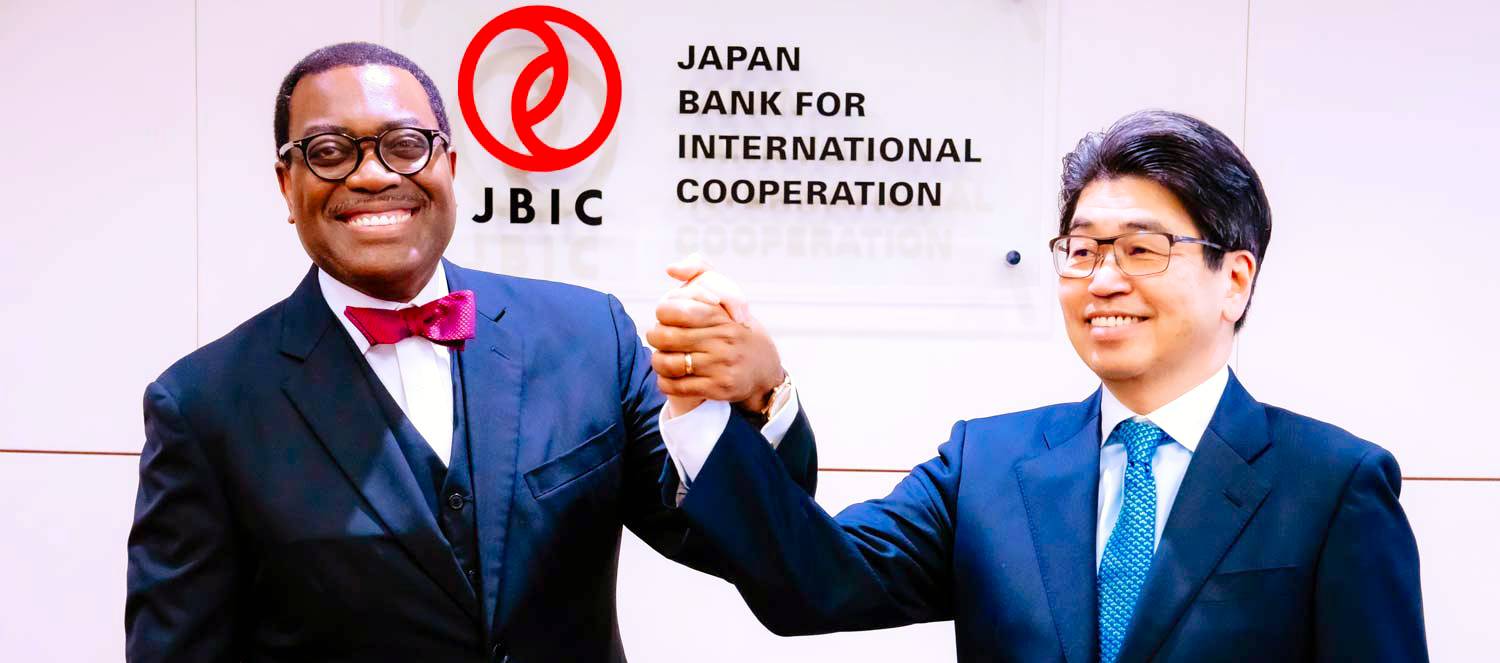
African Development Bank President Adesina (left) and Japan Bank for International Cooperation Governor Nobumitsu Hayashi in October 2024. (Photo: AfDB)
AFRI CONVERSE is another TICAD policy dialogue co-organized by JICA and UNDP since 2018. It brings together young African and Japanese innovators, academics, and private sector professionals to identify opportunities to improve innovation through joint research, knowledge sharing, and technology transfer.
Similar exchanges occur under the UN Industrial Development Organization (UNIDO), a mechanism for Japanese and African private sectors to interact with TICAD and influence its policies, programs, and priorities. The Japan-Africa Public-Private Forum, Africa Japan Forum, and Japan-Africa Business Forum are some of the networks that participate in these engagements.
Alternative Approaches to Catalyzing African Development
Instead of emphasizing headline-grabbing pledges of donor commitments, TICAD focuses on catalyzing ongoing processes for private sector investment, policy interaction, and what the Japanese and African sides have coined as “co-creation” (kyoso; 共創). Kyoso emphasizes collaborative efforts to find solutions and common interests to development challenges as opposed to traditional “donor-recipient” models. The attention given to these processes contributes to more enduring outcomes.
TICAD focuses on catalyzing ongoing processes for private sector investment, policy interaction, and “co-creation.”
Illustratively, Japan’s activities in support of African industrialization and value addition are coordinated through the UNIDO. An initiative announced in May 2025 will see Japan, UNIDO, and 14 Southern African countries collaborate on an industrial project to capture more value from critical energy transition minerals such as lithium, cobalt, and rare earths—which are vital for batteries, solar panels, wind turbines, and electric vehicles. This includes refining capacity, industrial supply chains, streamlined exports, and oversight.
The TICAD 9 meetings took place in the context of sudden and steep declines in development assistance by major Organization for Economic Cooperation and Development (OECD) countries. Japan has resisted this trend and, with a commitment to Africa of roughly $1.7 billion annually, continues to support development assistance as one of its “most important diplomatic tools.” This includes mobilizing and incentivizing private sector engagement, supporting companies in developing countries to issue bonds, and offering credit lines to banks in developing nations to increase lending to small businesses, among other innovations.
Japan has also made strong commitments to amplify African interests in international forums, including permanent African representation on the UN Security Council. At TICAD, African countries and Japan also committed themselves to defending and strengthening international law and coordinating their international positions.
Innovations in Financing
The TICAD 9 process also accelerated a shift from sovereign lending to what the two sides are calling “blended finance.” This refers to private sector-led solutions, public-private partnerships, and co-financing by Japanese banks and African financial multilateral institutions (AFMIs).
This includes a plan to provide an additional $5.5 billion in loans through the African Development Bank (ADB) to support African development priorities such as infrastructure. This is part of a TICAD flagship program known as the Enhanced Private Sector Assistance for Africa (EPSA) initiative, co-founded by Japan and the ADB in 2005. EPSA has invested over $12 billion since then on a 50-50 basis, signifying strong African co-ownership, co-management, and co-creation. The Mitsubishi UFJ Financial Group (MUFG), illustratively, has signed MOUs with the African Finance Corporation, African Trade and Investment Development Insurance (ATIDI), and private energy companies.

A train carrying coal along the Nacala line in Mozambique. (Photo: Matthias Hille)

TICAD 9 also announced new initiatives on “trade corridors” for investment, financial services, and regional connectivity. One part of this is a partnership with Japan, Mozambique, Malawi, and Zambia to expand previous investments in the Nacala Corridor to mainstream mineral supply chains and export capacity from Africa to Japan and the rest of Asia. This corridor is to be developed as a public-private partnership centered on strengthening transportation infrastructure, promoting industrial development, rigorous accountability and oversight, and involvement of private sector, civil society, and international organizations.
In Kenya, JICA has supported integrating transport facilities (ports, roads, etc.) and the Special Economic Zone in Mombasa as a gateway to the Northern Corridor as part of TICAD’s Integrated Corridor Approach. In Uganda, JICA-supported infrastructure projects include a new cable-stay bridge along with access roads across the Nile River, upgrading the Atiak-Nimule Road to boost trade between Uganda and South Sudan, a flyover and road upgrading project in Kampala, and a series of projects to strengthen the reliability of electric supply in the Kampala metropolitan area. JICA is also supporting the improvement of access to electricity in Kinshasa, Democratic Republic of the Congo.
These processes have avoided any African country from becoming saddled with odious Japanese debt.
The collective aim of these initiatives is to develop natural resources, infrastructure, and export capacity in ways that add value to products, respect local laws, regulations, and mechanisms of accountability and oversight, and bring in Japanese and African private investment.
Japanese finance in Africa is noteworthy in that it is nearly always disbursed, managed, and accounted for on a blended finance basis (i.e., through public-private partnership, co-partnership, private sector, and co-financing with local partners). These processes have avoided any African country from becoming saddled with odious Japanese debt—and is one of the reasons Japan is trusted and respected in Africa.
Strengthening Africa-Japan Economic Partnerships
African priorities for strengthening economic partnerships with Japan revolve around unlocking Japanese expertise in value addition, expanding access to Japanese markets, and building the capacity of Africa’s human resources. Practical outcomes toward this end announced at TICAD 9 include:
- A Japan-Africa Co-Creation for Industry initiative in which African startups and Japanese companies will jointly develop industries.
- Expansion of the Enhanced Private Sector Assistance for Africa initiative.
- Mobilization of $1.5 billion in impact investments through JICA’s overseas investment and financing fund.
- Training 300,000 young African professionals over 3 years, with a focus on AI skills development.
- A public-private-academia joint study group on strengthening the Japan-Africa economic partnership.
- Launch of the Economic Region Initiative of Indian Ocean-Africa to promote new trade and investment corridors between Africa and the rest of the Indian Ocean region.
- A fresh injection of $550 million into the Gavi Vaccine Alliance to support vaccine supply in Africa.
Japanese priorities have mostly centered on trade facilitation and overcoming hurdles to a traditionally risk-averse Japanese business culture. Other constraining factors include language and cultural barriers and distance. For example, only one African city, Cairo, currently has direct flights to Tokyo.
To redress some of these bottlenecks, ATIDI, MUFG, and Nippon Export and Investment Insurance have reviewed lessons learned from previous Japanese investments in Africa, institutional and political constraints, and opportunities to leverage more investment through de-risking. ATIDI’s role in issuing a 10-year political risk insurance policy to Sumitomo Corporation in 2025 serves as an illustration of the potential benefits. The arrangement enabled Sumitomo to participate in a consortium to launch Safaricom Telecommunications Ethiopia, one of the most significant Japanese-backed projects in Africa.
ATIDI and MUFG are planning to strengthen their cooperation to expand Japanese investment in Africa, which currently covers 72 insurance policies across the continent supporting over $5.4 billion in transactions.
Scaling Up
The deepening of Africa-Japan ties can be facilitated across a host of fronts, including between private sector, civil society, and academic actors.
In the more than 30 years since the first TICAD gathering, Africa-Japan relations have benefitted from the collaborative processes and shared objectives that have governed Japan’s engagements in Africa across the economic, social, and security sectors. This commitment to collaboration has established deep levels of trust vis-à-vis Africa’s external partners. This trust, combined with comanaged innovations and Africa’s economic dynamism, portends a vibrant era of deepened Africa-Japan partnerships. The speed and degree to which these opportunities can be brought to scale will, in part, be shaped by how reservations by Japan’s risk-averse private sector can be mediated. This will require continued close policy coordination, strong incentive structures, closer ties between the Japanese and African private sectors, and stronger personal, professional, and institutional contacts on both sides.
African governments and stakeholders can further maximize TICAD by consolidating national and regional coordination processes with Japan between official TICAD conferences. Since TICAD is not just a government-to-government initiative, the deepening of Africa-Japan ties can be facilitated across a host of fronts, including between private sector, civil society, and academic actors. This creates a myriad of pathways for greater dynamism and fresh thinking—and is part of what makes TICAD unique and especially attractive in the world of Africa plus one bilateral engagements.
Additional Resources
- Djenabou Cisse, “Japan in Africa: A Discreet yet Influential Partner Amid Growing International Competition,” Note de la FRS n°15/2025, Fondation Pour la Recherche Strategique, August 19, 2025.
- Paul Nantulya, “Expectations for Japan-Africa Relations at TICAD 9,” Japan Up Close, September 26, 2024.
- Redouan Najah, “Japan to Strengthen Ties with Africa,” Japan Up Close, July 8, 2024.
- Paul Nantulya, “The Tokyo International Conference on African Development—Fostering Stability through Peace and Security,” Spotlight, Africa Center for Strategic Studies, August 22, 2022.
More on: Security Cooperation