


Naval vessels from China, Russia, Iran, and South Africa docked in Simon’s Town Harbor in South Africa on January 9, 2026.
(Photo: AFP/Rodger Bosch)
The 9-day BRICS Plus naval exercise led by China’s People’s Liberation Army (PLA) in January 2026, coined “Will for Peace,” has underscored China’s growing use of military power in Africa to advance Chinese geostrategic objectives. Involving Russian, Iranian, and South African as well as Chinese naval forces off South Africa’s Western Cape, the exercise reinforces China’s role as the primary convening power of this emerging security bloc.
The exercise appears to be an attempt to normalize military cooperation within BRICS Plus, without formally declaring a military alliance. Although BRICS—a loose coalition of Brazil, Russia, India, China, and South Africa—was originally conceived of as an economic bloc, it has increasingly undertaken geopolitical engagements.
African countries risk deeper entanglement in China’s geopolitical bloc without clear external engagement strategies that define long-term national interests.
Iran’s first-ever participation marks a significant departure from previous iterations of Russian, Chinese, and South African naval exercises, and aligns with China’s broader objective of expanding the security dimension of the BRICS Plus alliance (the bloc added Egypt, Ethiopia, Iran, and the United Arab Emirates in 2024 and Indonesia in 2025). The deeper political significance of Iran’s inclusion was made particularly stark given that, at the time of the naval exercises, Iranian authorities were conducting a brutal crackdown on protesters that resulted in the deaths of an estimated 6,000–12,000 Iranian civilians. The symbolism of these actions for the exercises, and the BRIC-Plus alliance more generally, drew extensive domestic criticism in South Africa.
African governments defend their military engagements with China as needed to address Africa’s pressing development and security priorities as well as a means of maintaining relations with all partners within a shifting global geostrategic landscape. Nonetheless, concerns persist that African countries risk deeper entanglement in China’s geopolitical bloc without clear external engagement strategies that define long-term national interests, systematically assess partners, and allow for policy recalibration—capabilities that remain underdeveloped.
Decoding China’s Strategic Intent
China invests heavily in securing African participation in Chinese-led global institutions to enhance their legitimacy, build regional voting blocs, and strengthen China’s leverage amid global rivalries. Beijing has spearheaded BRICS expansion and promoted deeper political and security cooperation under frameworks such as the Global Security Initiative (GSI) and One Belt One Road, also called the Belt and Road Initiative.
Chinese policymakers view BRICS Plus as part of an alternative global security and geopolitical architecture.
Chinese policymakers view BRICS Plus as part of an alternative global security and geopolitical architecture intended to counterbalance Western and U.S.-led institutions. China was the leading advocate for expanding membership in 2024 as well as adding prospective members, including Belarus, Bolivia, Cuba, Kazakhstan, Malaysia, Nigeria, Thailand, Uganda, and Uzbekistan.
Beijing has also driven political and security coordination within BRICS, including a standing forum for national security advisors, which has convened 15 times since 2009. China has further expanded professional military education (PME) exchanges and military exercises involving BRICS Plus members, while avoiding formally labelling the bloc as a military alliance.
The effort to normalize BRICS Plus security cooperation in an African context aims to build on previous Chinese multilateral military drills. The PLA has conducted between 80 and 100 joint drills with Russia since 2003. China has also participated in roughly a dozen exercises with Russia and Iran and three with Russia and South Africa since 2019.
Expanding China-Africa Defense and Security Engagements
The Forum for China-Africa Cooperation (FOCAC) Beijing Action Plan (2024–2027) is notable for having more military and security commitments than any previous plans, including explicit integration within GSI, joint exercises, PME training of 6,500 African military and police personnel by September 2027, and defense and security coordination.
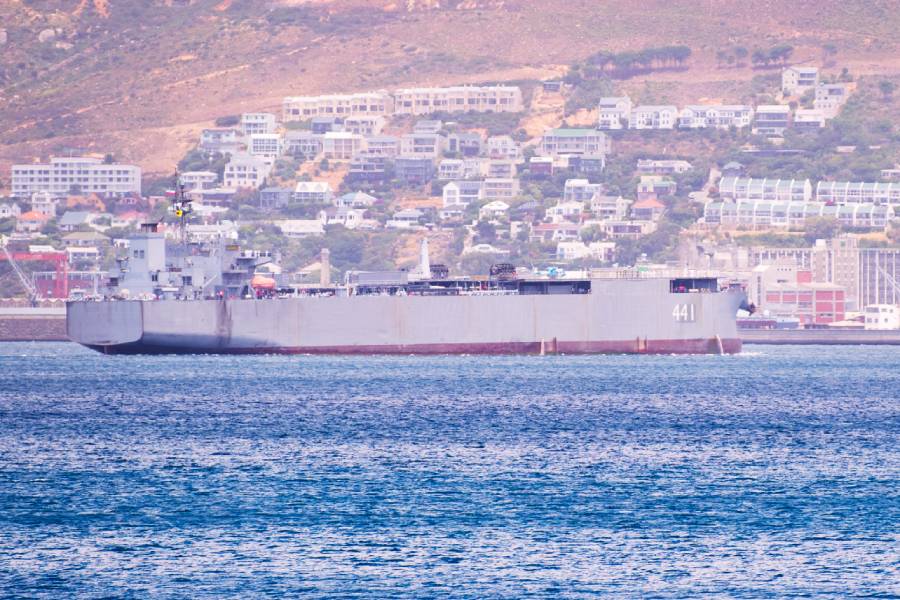
Iranian navy ship IRIS Makran 441 near Cape Town, South Africa, on January 8, 2026. (Photo: AFP/Rodger Bosch)
The PLA has conducted three military exercises in Africa in the past 18 months, each signaling a qualitative shift. In August 2024, the 2-week “Amani na Umoja” (Peace and Unity) exercises with Tanzania and Mozambique represented the largest ever PLA deployment in Africa. Unlike past drills that relied on PLA Navy antipiracy escort task groups in the Gulf of Aden, this exercise deployed units directly from mainland China, employing naval and air force strategic lift, including Y-20 transport aircraft and Yuzhao-class amphibious landing docks. It featured both land operations in Tanzania and naval operations in Mozambican waters, marking a first in PLA Africa exercises.
Amani na Umoja 2024 included a battalion-sized deployment of Chinese ground, air, marine, and special forces, and the first inclusion of the PLA Joint Logistics Support Force and the PLA Information Support Force in Africa. Both structures are designed to strengthen China’s expeditionary or “far seas” (yuan hai, 远海) operations. The drill also incorporated unscripted opposing forces, combined-arms maneuvers, and amphibious landings, capabilities not previously demonstrated in PLA exercises in Africa.
Momentum continued to build in April 2025 when the PLA Air Force and Egyptian Air Force conducted the 18-day “Eagles of Civilization” drill, China’s first air force exercise in Africa. It again relied on Y-20 aircraft to deploy personnel from China, supported by YY-20 aerial refueling tankers, at least six J-10C fighter jets, J-10S trainer jets, and a KJ-500 airborne early warning aircraft. The exercise emphasized aerial and ground operations, logistics, tactical coordination, and real-time combat scenarios, representing a shift away from earlier symbolic or scripted PLA drills.
Chinese military media framed Amani na Umoja 2024 and Eagles of Civilization 2025 as demonstrations of China’s growing power-projection capacity (known in China as “far seas maneuvering operations” (yuanhai jidong zuozhan nengli, 远海机动作战能力).
The growing militarization of China’s Africa policy also risks distracting from Africa’s priorities for its relationship with Beijing.
In this context, Will for Peace 2026 is an example of interregional coalition building and interoperability, signaling an expansion from previous African region-specific PLA exercises. Chinese analysts have emphasized that it was the first multinational drill held under the BRICS Plus format. The 2024–2027 FOCAC cycle, furthermore, reflects China’s broadening expansion into far seas operations and extra-regional interoperability.
In October 2025, the 48th PLA Navy Escort Task Group (ETG) deployed to the Gulf of Aden for antipiracy patrols, continuing a mission that began in 2008 and that also supports port visits, defense diplomacy, joint exercises, and non-combat missions such as civilian evacuation. That month, the guided-missile destroyer Baotou, attached to the 47th ETG, conducted a 5-day technical port call in Mombasa, Kenya and then conducted an exercise on passage and maneuver with the Kenya Navy. This was the first Chinese naval visit to Kenya in nearly 6 years.
The PLA Navy conducted at least 15 African port calls between 2024 and 2025, exceeding all previous annual African recorded port-call totals within PLA datasets—underscoring the notable expansion of China’s naval presence, reach, and defense diplomacy in Africa.
Between August 2024 and July 2025, China sent troops to participate in Independence Day military parades in Côte d’Ivoire, Madagascar, and Comoros, an unusual form of defense diplomacy with unclear strategic intent.
China’s support to these regimes raises questions about the impact of Chinese security assistance on popular sovereignty and state fragility.
In line with the 2024-2027 FOCAC Plan, China has become the leading arms supplier in West Africa (and second largest for the continent overall). This includes the Sahel, where Chinese military assistance to junta-led regimes in Burkina Faso, Mali, and Niger has generated controversy. These juntas have been sanctioned and suspended by the African Union (AU) and Economic Community of West African States (ECOWAS), placing Beijing at odds with African regional bodies’ norms against unconstitutional seizures of power. China’s continued support to these regimes exposes tensions in Africa-China security relations and raises questions about the impact of Chinese security assistance on popular sovereignty and state fragility.
African Participation in Chinese Global Security Architecture
The Ninth FOCAC Summit in 2024 designated Africa a “demonstration zone” for China’s GSI. Since September 2024, at least 10 GSI-linked activities have been operationalized. Among other objectives, the GSI prioritizes regime security (described in Chinese ruling party literature as “stability maintenance,” or weiwen, 维稳).
In addition to military support, and in line with GSI formulations, China has also become more active in domestic law enforcement training and norms in Africa. Since 2024, Chinese and African governments have held four multilateral ministerial level law-enforcement gatherings, including the:
- China-East Africa Ministerial Dialogue on Law Enforcement and Security Cooperation (Beijing, September 2024)
- East Africa Police Chiefs Cooperation Organization meeting and memorandum of understanding with the Chinese Ministry of Public Security (Beijing, Spetember 2024)
- Second China-East Africa Ministerial Dialogue Law Enforcement and Security Cooperation (Kigali, Rwanda, November 2025)
- China-Africa GSI Seminar with the African Union (Addis Ababa, Ethiopia, December 2025)
In September 2025, officials from 40 African countries attended the Global Public Security Cooperation Forum (Lianyungang Forum), where GSI-linked public security cooperation featured prominently. China’s Ministry of Public Security (MPS), the lead GSI implementing agency, convened the event.
China-led security platforms carry major implications for African domestic security norms, governance, and strategic autonomy.
African engagement has also expanded in Chinese-led security forums, including the Beijing Xiangshan Forum, hosted by the Academy of Military Science, which formulates Chinese military strategy and advises the Central Military Commission. While the forum was initially exclusively focused on the Asia-Pacific, it has included African delegations since 2019 and is sometimes synchronized with FOCAC’s China-Africa Peace and Security Forum.
The FOCAC Legal Forum and the China-Africa Prosecutorial Cooperation Forum are other venues China uses to reinforce its security outreach. These forums train African judicial officials and paralegals, promote legal integration, and expand law enforcement cooperation.
Growing African Concerns Over the Adoption of Chinese Policing Tactics
China’s growing role in shaping Africa’s domestic security structures is causing increasing concern. Analysis by African scholars shows that such assistance strengthens the coercive capacity of recipient governments, contributes to human rights violations, and enables the repression of opposition parties. Illustratively, the transfer of military arms, radio jamming devices, surveillance technology, bugging equipment, and water cannons to Zimbabwean security forces enabled the government of Robert Mugabe to block broadcasts of independent media outlets, eavesdrop on opposition activists, and suppress rallies and protests—practices that have continued under Emmerson Mnangagwa.
Analysis by African scholars shows that Chinese security assistance strengthens the coercive capacity of recipient governments, contributes to human rights violations, and enables the repression of opposition parties.
Pressure by African civic coalitions has helped shape AU and regional policies on arms transfers, including oversight, accountability, and preventing uncontrolled transfers during sensitive events like elections. Nonetheless, concerns about the policy implications of Chinese transfers in fragile and authoritarian contexts will continue to grow as China’s Ministry of Public Security conducts more African engagements than China’s Ministry of Defense and the PLA, often outside public scrutiny.
Strategic and Political Implications for Africa
The Chinese-led BRICS naval exercises held in 2026 should be understood as part of a systemic effort to expand Beijing’s military presence on the continent while bringing African countries within China’s global security frameworks. This growing integration poses potential risks to African countries’ frequently stated desire to remain unaligned amid geostrategic rivalries. The growing militarization of China’s Africa policy also risks distracting from Africa’s priorities for its relationship with Beijing—to advance sustainable development through greater infrastructural development, investment, African valuation over supply chains, and skills enhancement.
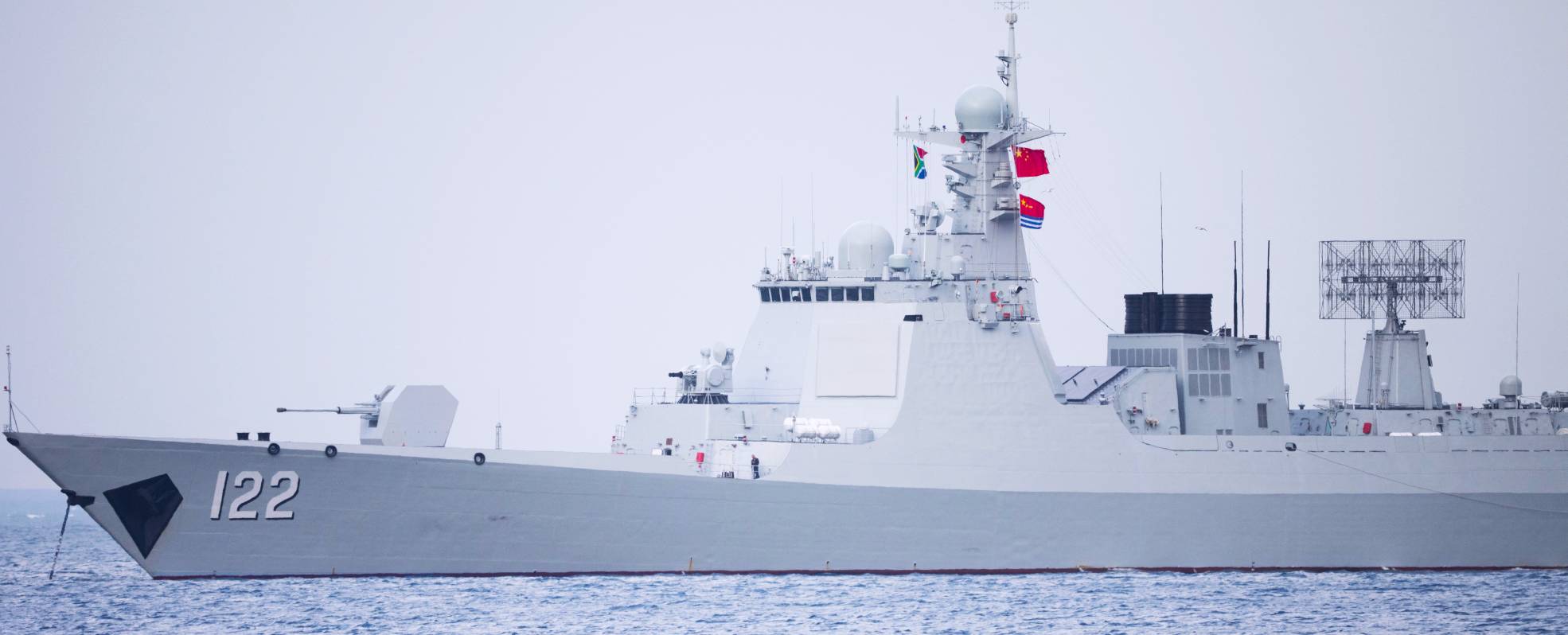
The Chinese guided-missile destroyer Tangshan, moored near Cape Town, South Africa, on January 6, 2026. (Photo: AFP/Rodger Bosch)
African reactions to these developments are reflected in competing perspectives:
Hedging. This view from some African governments holds that deeper engagement with Chinese security architectures diversifies foreign partnerships. This ensures access to Chinese security assistance on relatively cheaper terms, positions African countries to secure larger Chinese economic support, and underscores African countries’ right to select and balance their international partners.
Regime security. Ruling parties preoccupied with survival believe they can leverage their access to Chinese security funding and equipment to bypass Western sanctions (if those exist), strengthen their regime’s hold on political power, subdue opposition parties, and enhance diplomatic legitimacy.
These competing perspectives point to the need for African countries to formulate national strategies for engaging China.
Threat to democracy. Many African civil society and democracy advocates believe uncontrolled and unaccountable Chinese security cooperation can entrench repression, especially in contexts where governments have taken an authoritarian turn. According to this perspective, the adoption of Chinese domestic security practices without citizen oversight will contribute to worsening of human rights, shrinking democratic space, and weaker government accountability.
Strategic autonomy. African countries can engage China in ways that avoid bloc entrapment, respect public demands for oversight and accountability, advance African countries’ national interests, and achieve balance and sustainable outcomes. This requires the formulation of whole-of-government national strategies to engage China in a more equal and transparent manner, as well as greater coordination at the national, regional economic community, and AU level.
These competing perspectives point to the need for African countries to formulate national strategies for engaging China (and other foreign powers) to ensure these arrangements advance African national security interests. At the regional level, AU resolutions on establishing a secretariat for China coordination and increasing the regional body’s representational authority should be implemented to support national oversight. Toward this end, the AU and its relevant organs should continue engaging African nongovernmental professionals and coalitions to mobilize expertise and ensure the representation of citizen interests. Finally, the AU and African governments should strengthen platforms for regularly sharing best practices for constructively engaging China.
Toward Comprehensive African Policies for External Engagement
Adopting transparent assessment processes can advance the pursuit of security pathways that are consistent with African interests.
China’s efforts to bring African countries into its geostrategic fold through BRICS Plus, GSI, and other China-led security platforms carry major implications for African domestic security norms, governance, and strategic autonomy. To safeguard African interests, policymakers and thought leaders must critically assess the domestic and foreign policy risks and opportunities of such alignments. Adopting such systematic and transparent assessment processes can advance the pursuit of security pathways that are consistent with African interests of nonalignment, sustainability, and citizen-centered governance.
Additional Resources
- Paa Kwesi Wolseley Prah, “Will for Peace 2026: China’s Strategic Naval Diplomacy in Africa and Reshaping of Global Security Architecture,” China-Africa Security Radar, January 26, 2026.
- Nadia Helmy, “China Recalibrates Military Outreach, Strengthening Officer Training for Africa and Arab States,” Modern Diplomacy, January 21, 2026.
- Africa Center for Strategic Studies, “What to Expect from Africa-China Relations in 2026,” Spotlight, January 16, 2026.
- China-Africa Security Radar, “China Africa Police Collaboration,” November 9, 2025.
- “Q&A: China’s ‘Feeling the Stones’ Approach to African Security Takes Shape,” China Global South Project, July 23, 2025.
- Paul Nantulya, “China Widening Its Influence in Africa through Expanded Security Engagements,” Spotlight, Africa Center for Strategic Studies, June 10, 2025.
- China Africa Security Radar, “China’s Growing Influence in Africa’s Professional Military Education,” May 25, 2025.
- Paul Nantulya “What to Expect From Africa-China Relations in 2025” Spotlight, Africa Center for Strategic Studies, January 7, 2025.
More on: China in Africa