

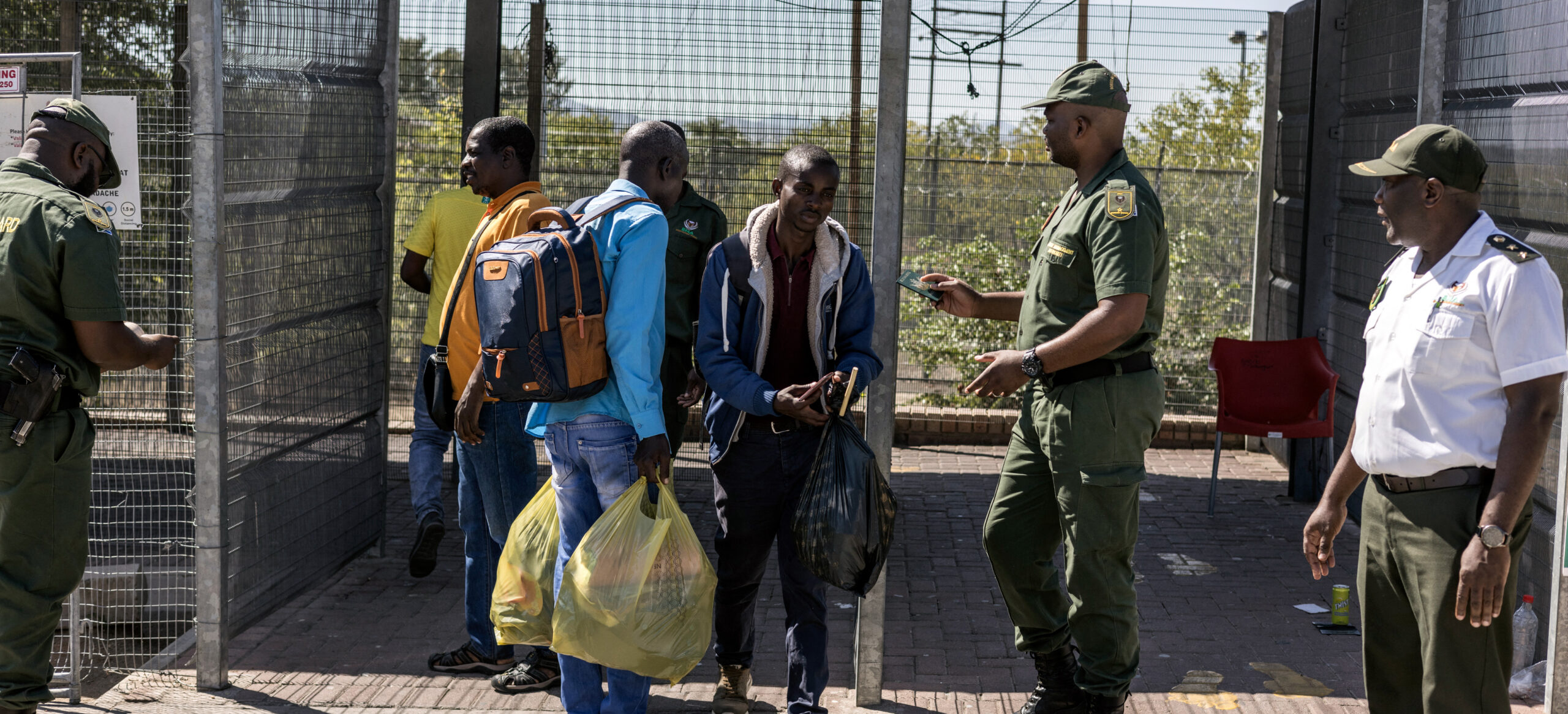
Border Management Authority agents check documents of Zimbabwean migrants wishing to enter South Africa at the Beitbridge crossing.
(Photo: AFP/Marco Longari)
Population Movements in Flux
- The world’s most youthful continent continues to be highly mobile. With 12 of the world’s top 20 fastest-growing economies, a median age of 19, and roughly 600 million people of working age, millions of Africa’s increasingly educated workforce are moving to towns and urban areas every year.
Millions of Africa’s increasingly educated workforce are moving to towns and urban areas every year.
- Intra-African migration is the most common form of cross-border population movement, with over 25 million Africans living in another African country. A majority of these migrants are men, many have a secondary school education, and most are seeking seasonal employment—often attracted by jobs in regional economic hubs like Abidjan, Johannesburg, Lagos, and Nairobi.
- Documented cases of migrants intercepted while attempting to enter the European Union irregularly totaled 99,846 in 2025—roughly half what they were 2 years earlier.
- This decline reflects stepped-up border enforcement mechanisms in all North African countries, as well as Mauritania and Senegal.
- Enhanced enforcement efforts have also been observed on the other primary off-continent migration route—from East Africa to Yemen and the Arabian Peninsula. This was accompanied by a 58-percent increase in reported drownings and an accelerated pace of deportations from Saudi Arabia.
The number of migrants intercepted while attempting to enter the European Union irregularly were roughly half what they were 2 years earlier.
- These patterns of off-continent migration overshadow a more complex and varied migration picture for Africa. Enhanced interdiction has caused migrants to shift to secondary routes and increase their reliance on smugglers. This has enriched and empowered criminal networks, while heightening risks to migrants’ safety. These dynamics reinforce the importance of understanding and mitigating the underlying drivers of migration.
Drivers of African Migration
Demographics and Economic Pressure
- Despite robust economic growth in many African countries, roughly three-quarters of African migrants cite economic pressures as the primary driver—underscoring the need for continued, broad-based economic development.
Africa’s population is projected to grow by 70 percent by 2050, adding more than 620 million work-ready youth to the labor force.
- Many African countries are struggling to keep pace with job creation—a task made more challenging by constantly shifting goalposts. Africa’s population is projected to grow by 70 percent by 2050, reaching approximately 2.4 billion people, adding more than 620 million work-ready youth to the labor force.
- Even diversified economies like South Africa face high youth unemployment rates, with almost half unable to find jobs in the formal economy. Likewise, although it has a large middle class and educated youth population, Nigeria is experiencing the flight of young people abroad.
Conflict and Fragility
- Conflicts are a major jolt to African economies, resulting in destroyed infrastructure, capital flight, failed businesses, and eliminated jobs—a major driver of migration. Conflict is estimated to reduce annual economic growth in Africa by 2.5 percent—the cumulative effect of which increases over time. Conflicts in 15 African countries—many of which have persisted for years—incur severe economic costs for these countries and their neighbors.
- Citizens from some of the continent’s most destabilizing conflicts and/or repressive governments—such as Sudan, South Sudan, Somalia, the Democratic Republic of the Congo (DRC), Mali, Burkina Faso, and Eritrea—comprise the largest numbers of migrants within their regions.
- An example of such a nexus between conflict and economic migration is observed along the border of Burkina Faso and Côte d’Ivoire. Militant Islamist insurgents in the western Sahel have been stealing the livestock of herders as a tactic of coercion. No longer able to support themselves or their families, thousands of pastoralists from Mali and Burkina Faso have moved to the outskirts of Abidjan in Côte d’Ivoire to pick up odd jobs to make ends meet.
Malians will continue to comprise among the largest number of migrants within West Africa.
- With the deterioration of security in Mali, “many Malians now view irregular migration as a necessity rather than an opportunity.” The fuel blockade on Bamako imposed by militant Islamist groups has further disrupted economic activity in the heavily populated cities of southern Mali. As a result, it is expected that Malians will continue to comprise among the largest number of migrants within West Africa and via the West African route toward Europe.
Intra-Regional Migration Dynamics
Most cross-border African migration is within Africa—and often within subregions. These movements are precipitated by a combination of push (political instability and lack of jobs) and pull (relatively greater economic opportunities) factors. Consistently high-ranking destination countries include Côte d’Ivoire, South Africa, Uganda, Nigeria, and Kenya. Meanwhile, leading countries of origin include Burkina Faso, South Sudan, Zimbabwe, Sudan, and the DRC.
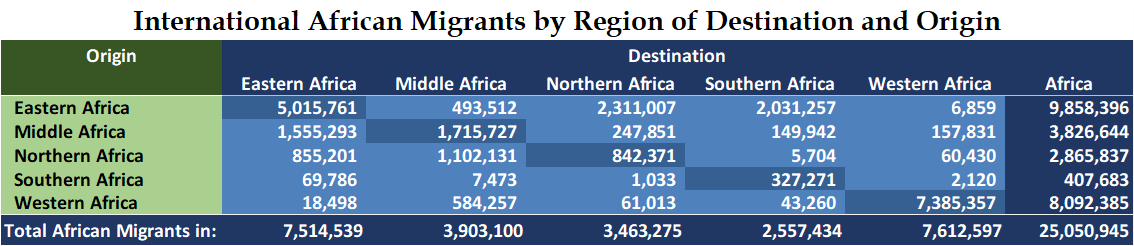
Data source: UNDESA, 2024
- Intra-African migration has also been the source of an estimated $20 billion in annual remittances—roughly 20 percent of all African remittances. South Africa is the primary source of such intra-African remittances, with nearly $1 billion per year being sent back to Zimbabwe. These patterns underscore the strong economic rationale for African mobility and the motivation of young, able-bodied migrants to send money back home to support their families.
North Africa
- North African countries have long attracted sub-Saharan African migrants due to their relatively stronger economies. This avenue for migration may be closing, however, as all North African countries, with the exception of Morocco, have intensified their forced expulsions.
- Libya has seen a 63-percent rise in its migrant population (currently estimated at 922,000) since 2020. Much of this rise is due to the war in Sudan. Sudanese migrants now comprise 36 percent of the immigrant community in Libya, compared with 19 percent before the war. Other top migrant nationalities include Egypt, Niger, Chad, and Nigeria. An estimated 74 percent of these migrants are employed, suggesting that much of this migration is for work and not transit toward Europe. Nevertheless, it has also been well documented that sub-Saharan migrants routinely face abuse in Libya.
- Tunisia and Algeria have pursued increasingly punitive approaches toward sub-Saharan migrants in recent years, including expulsions of tens of thousands of people into remote desert areas, where many have died. Survivors describe suffering beatings and other abuses by security forces.
- Morocco has also experienced rising immigration (a 44-percent increase since 2020, to 148,152). This is so despite Morocco ramping up its interdiction efforts for Mediterranean crossings that are estimated to have prevented 42,000 attempted crossings in the past year.
West Africa
- West Africa hosts over 32 percent of the 25 million African migrants living on the continent. However, 97 percent of the international migrants in West Africa are West Africans themselves. This reflects the region’s enhanced interregional mobility facilitated by the Economic Community of West African States’ free-movement protocol. Established in 1979, the protocol established the right of members’ citizens with proof of nationality to entry, residence, and establishment in any other member country.
- A key development over the past year has been a spike in the outflow of Nigerien migrants at the end of 2025, reflecting the deteriorating living conditions and job prospects. Of the estimated 1.8 million people who left Niger, 61 percent migrated to West and Central African countries, 38 percent left for North Africa, while less than 1 percent left for Europe.
Southern Africa
- There are an estimated 3.96 million “foreign-born” residents in South Africa, mostly from neighboring countries of Zimbabwe, Mozambique, and Lesotho. Drawn by South Africa’s dynamic economy, between 10,000 and 50,000 irregular migrants from East African countries move annually toward South Africa. There are now an estimated 120,000-200,000 Ethiopians and 70,000 Somalis in South Africa. However, increased immigration enforcement in the region has made traveling without a smuggler difficult. Some 7,600 migrants without documentation were arrested or deported along the Southern Route countries of Tanzania, Zambia, Zimbabwe, and South Africa in 2025.
Shifting Off-Continent Routes, Greater Risk
- There are three primary migration routes off the continent—the Mediterranean routes to Europe, the West African route through the Canary Islands, and the East African route, typically from Djibouti to Yemen and onto the wealthy Gulf countries.
- A review of the top African nationalities among intercepted border crossings (IBCs) on European borders over the last 5 years reveals that North Africans have consistently accounted for the largest share among African migrants. This is primarily due to geographic proximity as well as historical and economic ties.
Mediterranean Routes
- The irregular migrant corridor from Africa to Europe across the Mediterranean follows three main routes: Eastern, Central, and Western Mediterranean.
- The Eastern Mediterranean route saw a 57-percent increase in IBCs over the past year. This reflects a growing surge of migrants from East African countries in conflict, as well as smugglers seeking new pathways. Greece, for example, saw a fivefold increase in migrants from Libya. The East Mediterranean route, for the first time, now accounts for a quarter of all IBCs. In fact, the top five nationalities intercepted across all Mediterranean routes in the past year were Egyptians, Sudanese, Algerians, Eritreans, and Somalis.
- The Central Mediterranean route (departing from Libya and Tunisia to Italy and Malta) has historically tended to be the most common. However, heightened interdiction efforts have resulted in a significant decline in crossings in recent years. Those attempting to use this route are now departing from more obscure and riskier locations.
- There was a 14-percent increase in usage of the Western Mediterranean route in the past year (to 19,038 IBCs), continuing a 3-year trend. Though this route is mostly from Algeria and Morocco to the Spanish mainland, irregular migrants have been increasingly exploiting a longer, more hazardous route to Spain’s Balearic Islands from Algeria. A reported 7,321 migrants (mostly Algerians but increasingly Moroccans, Sudanese, Somalis, and Malians) landed on Balearic Island shores in 2025. Almost 300 migrants drowned or went missing using this route in the past year.
- As a result of these shifts, there is now more balance across the four European (three Mediterranean and the West African) routes than at any time over the past decade.
West Africa Route
- There was a 61-percent decrease in usage (17,816 IBCs) of the West Africa route over the past year. This reflects heightened efforts by Mauritania and Senegal—with funding from the EU—to block departures from their shores toward the Canary Islands. As a result of these interdiction efforts, there has been a spike in the number of migrants departing from the more dangerous southerly route in Guinea—a 2,200 km journey (750 km longer than the shorter route). This extends exposure to hazards such as engine failure, sea currents, harsh weather, dehydration, and hunger. Over the last 2 years, 1,872 migrants have died or gone missing attempting to cross to the Canary Islands.
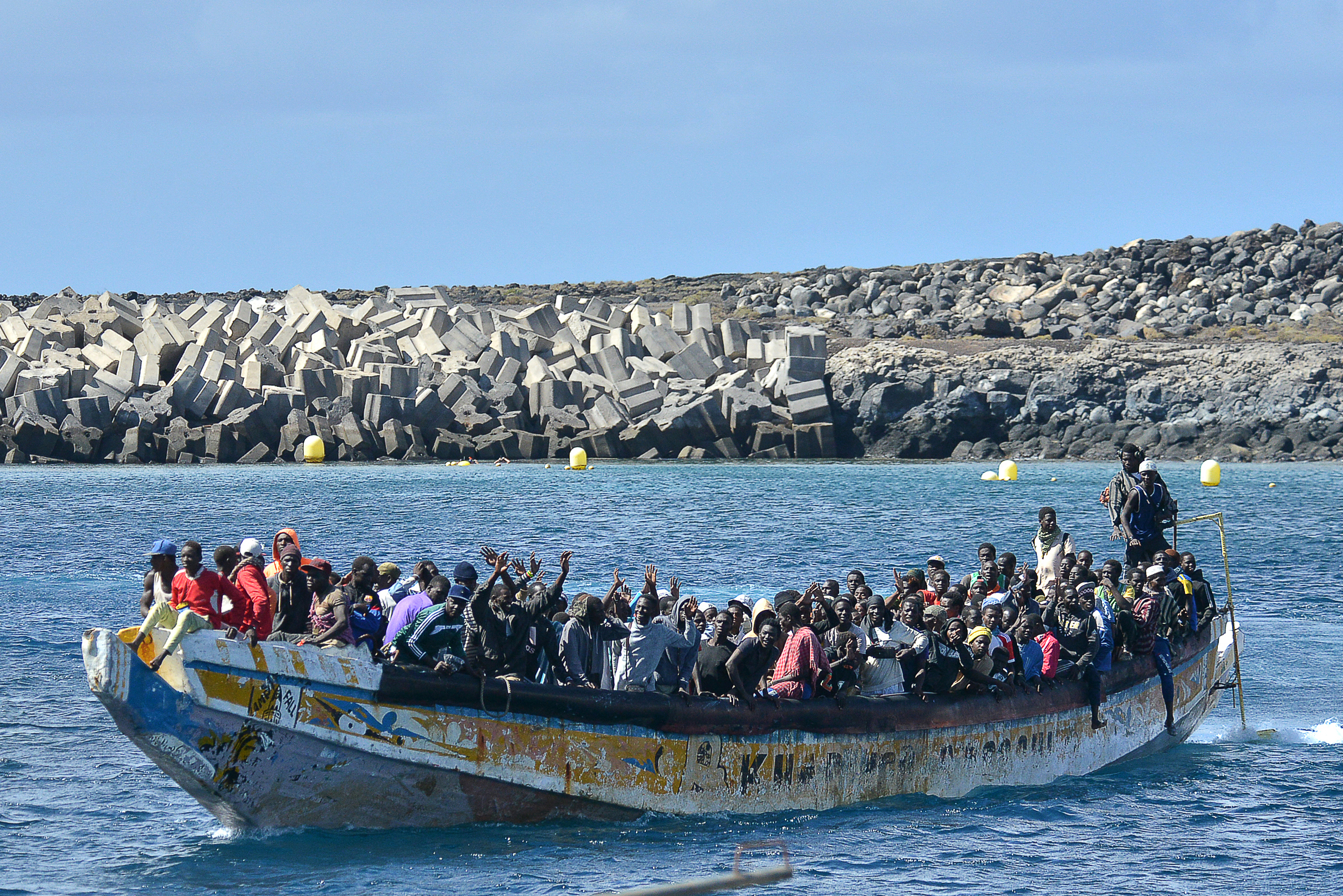
West African migrants on a boat to the Canary Island port of El Hierro. (Photo: AFP/ Stringer)
East African Route
- The East African route, crossing the Red Sea and the Gulf of Aden to the Arabian Peninsula, is one of the most active routes in Africa. The past year saw an 80-percent increase in irregular migrant flows (totaling an estimated 110,000) to Yemen from Djibouti and Somalia.
- This route has seen growing restrictions as Djibouti’s coast guard has shut down known embarkation opportunities on the Bab al Mandab Strait. Djibouti officials in 2025 also announced a deportation program for “illegally present” foreigners. This was accompanied by an accelerated pace of deportations from Saudi Arabia (totaling an estimated 95,076 African migrants in 2025).
- Roughly 730 migrants drowned attempting to cross the East African Route in 2025.
Smuggling, Trafficking, and Exploitation Are on the Rise
- As a result of the increased difficulty of off-continent embarkations, many irregular migrants have come to rely on smugglers. This has exposed migrants to new risks. Among surveyed migrants who used a smuggler to cross from the Horn to Yemen in 2025, 82 percent felt misled about the journey, and nearly half described their smugglers as criminals—66 percent would not have started the journey had they known what it entailed.
- An evolving development for African migration is the expanding linkages to transnational criminal groups from outside the region, preying on the growing numbers of unemployed African youth. Increasing numbers of Africans are applying for what they believe are legitimate overseas jobs only to find that they were being trafficked or otherwise exploited. Illustrations include:
- Africans have been recruited online for IT or customer service jobs in Thailand, then trafficked to neighboring Southeast Asian countries.
- Many Kenyan women recruited to work in private homes in Saudi Arabia have found themselves trapped without remuneration in conditions that amount to forced labor and little recourse.
- An escalating scheme of deceptive Russian recruitment of Africans with the promise of high-paying work has trapped and forced many African migrants to fight for Russia as part of its invasion of Ukraine. It is estimated that several thousand African nationals from at least 36 countries—including more than 1,000 from Kenya—have been pulled into this often-fatal fraud.
An evolving development for African migration is the expanding linkages to transnational criminal groups from outside the region.
- In some cases, the promise of employment opportunities involves scams on the continent:
- Lured by influencers on social media offering high-paying jobs in dollars, some West Africans have been trafficked to work in Burkina Faso’s illegal gold mines.
- Attracted by the promise of job opportunities in Canada, migrants in Côte d’Ivoire were swindled out of as much as $9,000 and then held against their will until they recruited additional victims. Victims were from Benin, Burkina Faso, Togo, and Ghana.
- In Sierra Leone, the promise of work off-continent has resulted in migrants being scammed out of their earnings and transported to neighboring countries, where they were then forced to recruit more victims—typically from friends and family—before they could be released.
Innovations to Watch
African governments increasingly recognize that migration must be managed proactively through job creation, skills development, and capable institutions, rather than through enforcement alone. Existing continental frameworks—such as the 2006 Migration Policy Framework for Africa and the AU’s 2018 Free Movement of Persons Protocol—remain unevenly implemented. However, momentum is growing, which will be necessary to address the demographic changes underway.
A Framework for Job Creation
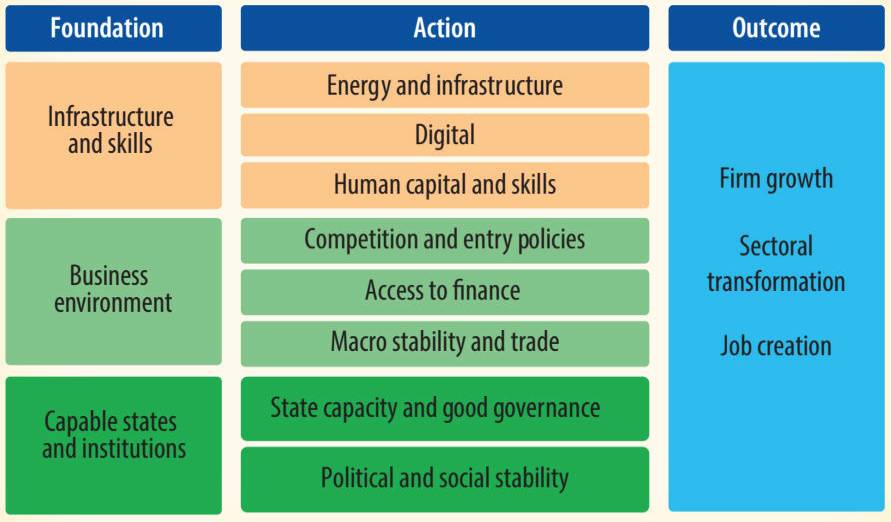
Source: World Bank
Policy and Governance
- The AU Pan-African Parliament adopted a Draft Model Law on Labour Migration in November 2025. This model law, informed by existing migration policy frameworks (including the 2006 Migration Policy Framework for Africa), provides AU member states with a legislative template from which they can harmonize their domestic labor migration frameworks, thereby coming closer to the market integration principles underpinning the African Continental Free Trade Agreement (AfCFTA). As more African countries domesticate this model law, there will be stronger measures to facilitate legal migration while protecting migrants from traffickers and criminal organizations.
The African Union is also establishing a Migration Advisory Council in 2026 to provide expert guidance on migration governance.
- The African Union is also establishing a Migration Advisory Council in 2026 to provide expert guidance on migration governance. This Council is expected to provide technical and policy guidance to member states, AU institutions, and stakeholders to advance the harmonization of migration governance in line with the AU’s Migration Policy Framework.
- The World Bank notes that a fully operational AfCFTA has the potential to create 18 million new jobs, lifting some 50 million people out of extreme poverty by 2035. The steps African countries take toward implementing AfCFTA will have implications for job creation within their own economies. More generally, economic growth will increasingly rely on African countries better aligning labor mobility with development and stability outcomes.
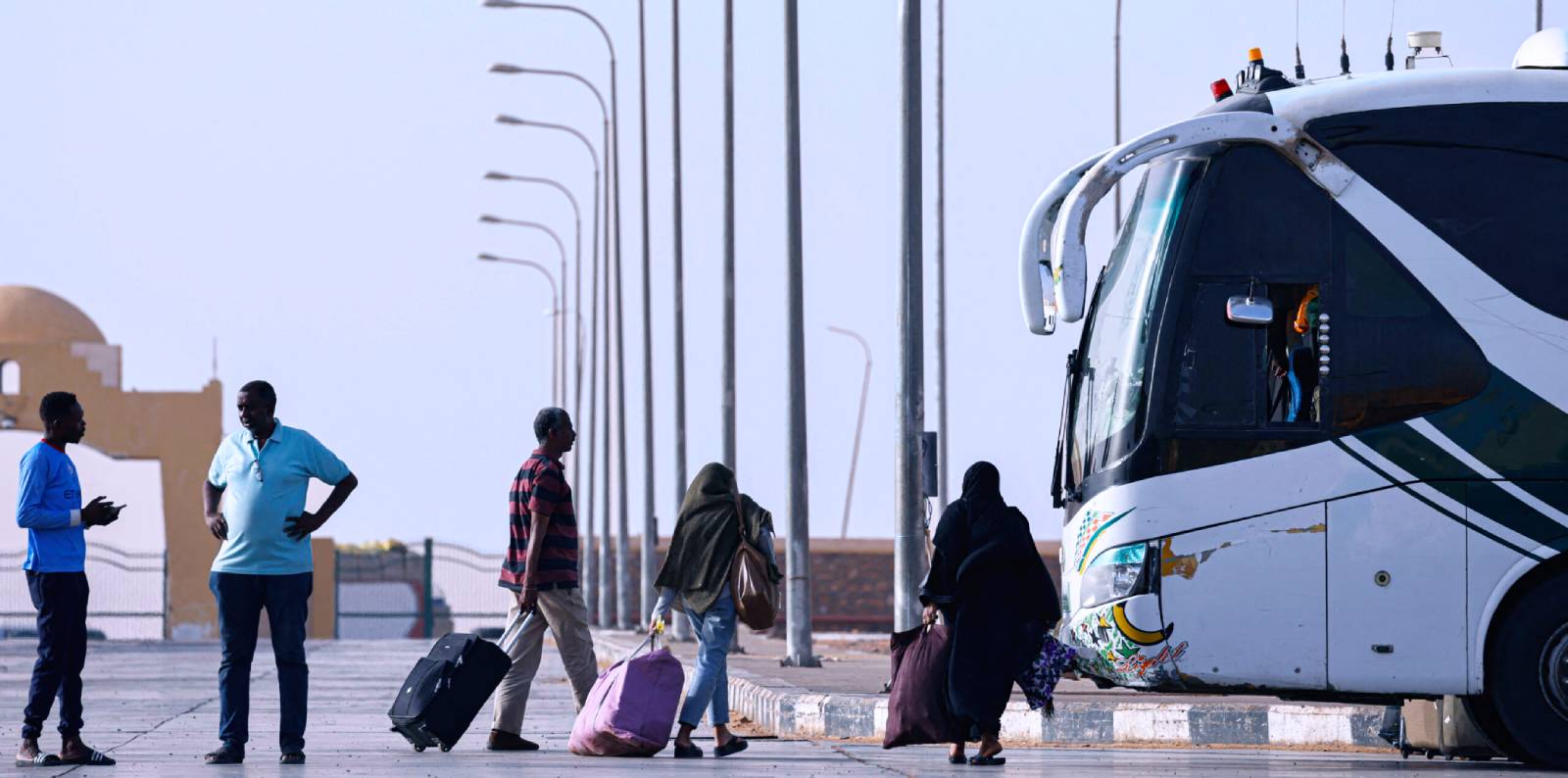
Passengers from Sudan cross into Egypt through the Argeen Land Port. (Photo: AFP/Khaled Desouki)
- With Africans representing roughly half of all new workers entering the global labor force by 2030, innovations focused on effectively integrating African workers not only within the regional economic initiatives but also internationally will take on greater importance.
- With the assistance of 18 African countries, Interpol arrested 1,209 cybercriminals targeting nearly 88,000 victims, and seized $97.4 million between June and August, 2025. In one raid of a scam center in Zambia, enforcement officers uncovered and disrupted a human trafficking network. This raid builds on another cybercrime operation in Cameroon in 2024 that discovered trafficking victims from seven different countries forced to run a multilevel marketing scam.
- Given the direct impact of conflict on African migration, coalitions of willing national, civil society, and regional bodies, along with international partners, can address a key root driver of migration by elevating conflict mediation, mitigation, and prevention initiatives.
National Innovations
- Kenya adopted a labor-export initiative in 2023 as a means of harnessing its growing youth labor pool to support its national development strategy. Working through bilateral agreements (with Austria, Germany, Saudi Arabia, Qatar, the United Arab Emirates, and the United Kingdom), Kenya has reportedly placed 400,000 workers abroad. Kenyans are estimated to have remitted over $5 billion in 2025, up from $4.5 billion the previous year.
Kenya’s designation of the Kakuma and Dadaab refugee camps as cities will enable refugees access to local governance structures and to seek employment opportunities outside of the camps.
- This initiative has faced numerous allegations of fraud and exploitation of Kenyan workers abroad, however, largely through fake recruiting scams. In response, the Kenyan government has banned more than 500 recruitment agencies while Kenya’s Labour Migration Management Bill has proposed stronger safeguards for Kenyan workers abroad. Meanwhile, the Kenyan State Department for Diaspora Affairs has partnered with nongovernmental organizations, such as HAART Kenya, to assist in the return of Kenyans who have been trafficked to Myanmar.
- Kenya also redesignated the Kakuma and Dadaab refugee camps (home to over 723,000 mostly Somali refugees) on the border with Somalia as cities in 2025. The camps have been in existence for more than 34 years, and this move will enable refugees access to local governance structures (education, health, public services) and the ability to seek employment opportunities outside of the camps. While the approach addresses the unsustainability of long-term encampment, logistical constraints and limited economic opportunities pose serious implementation challenges that other countries will watch closely.
Additional Resources
- Jennifer Vallentine, Bram Frouws, and Roberto Forin, eds., “Mixed Migration Review 2025,” Mixed Migration Centre, 2025.
- Economic Commission for Africa, “Economic Report on Africa 2025: Advancing The Implementation of The African Continental Free Trade Area: Proposing Transformative Strategic Actions,” United Nations, March 2025.
- World Bank, “Pathways to Job Creation in Africa,” Africa’s Pulse No. 32, October 2025.
- Mohamed Abdel Jelil, Samik Adhikari, Quy-Toan Do, Heidi Kaila, Federica Marzo, Olive Nsababera, Ganesh Seshan, and Maheshwor Shrestha, “Migration: Africa’s Untapped Potential,” Africa Development Forum series, World Bank, 2025.
- Wendy Williams, “African Migration Trends to Watch in 2025,” Infographic, January 9, 2024.
- Wendy Williams, “Shifting Borders: Africa’s Displacement Crisis and Its Security Implications,” Africa Center Research Paper No. 8, Africa Center for Strategic Studies, October 2019.
More on: Migration and Forced Displacement