

 Côte d’Ivoire: Efforts to Forge Resiliency Face Stiff Test
Presidential Elections
October 25
Côte d’Ivoire’s elections are shaping up to be among the most consequential for the continent in 2025. An economic powerhouse in West Africa, this country of 32 million people has been a relative font of stability in the region over the past decade while making significant gains in combatting corruption.
The rivalry between Ouattara and Gbagbo has long dominated Ivorian politics, seemingly keeping the country locked in stasis—and fear of returning to the violent polarization of the early 2000s.
Côte d’Ivoire’s comparatively propitious position leading into the 2025 elections is noteworthy, given its history of electoral violence. The country experienced nearly 3,000 deaths in the violent aftermath of the 2010 election crisis, when then-President Laurent Gbagbo refused to concede defeat, precipitating an armed conflict until the rightful victor, Alassane Ouattara, took power in 2011. This followed a civil war between 2002 and 2007 triggered by transitional military government leader Robert Guéï’s refusal to step down after losing the 2000 elections to Laurent Gbagbo. The conflict fueled inter-communal divisions pitting the south of the country versus the north.
The rivalry between Ouattara and Gbagbo has long dominated Ivorian politics, seemingly keeping the country locked in stasis—and fear of returning to the violent polarization of the early 2000s. An effort on both sides to engage in constructive dialogue facilitated the 80-year-old Gbagbo’s return to Côte d’Ivoire in 2021, following an acquittal at the International Criminal Court for his part in crimes against humanity linked to the 2010-2011 political crisis. In the spirit of reconciliation, Ouattara has accorded Gbagbo the full benefits of an ex-president.
This magnanimity has been overshadowed in the run-up to the election by uncertainty over which presidential candidates would be competing.
The 83-year-old Ouattara announced in July that he will contest for his fourth term. During the 2020 election, nearing the end of his second term in office, Ouattara had initially decided to step aside for then-Prime Minister Amadou Coulibaly to lead the ruling Rassemblement des houphouëtistes pour la démocratie et la paix (RHDP) party. Following Coulibaly’s sudden death in the run-up to the elections, however, Ouattara stepped back in. A Constitutional Court ruling supported his contention that the 2016 constitutional revision had reset the term-limit clock allowing him to run for two more terms.
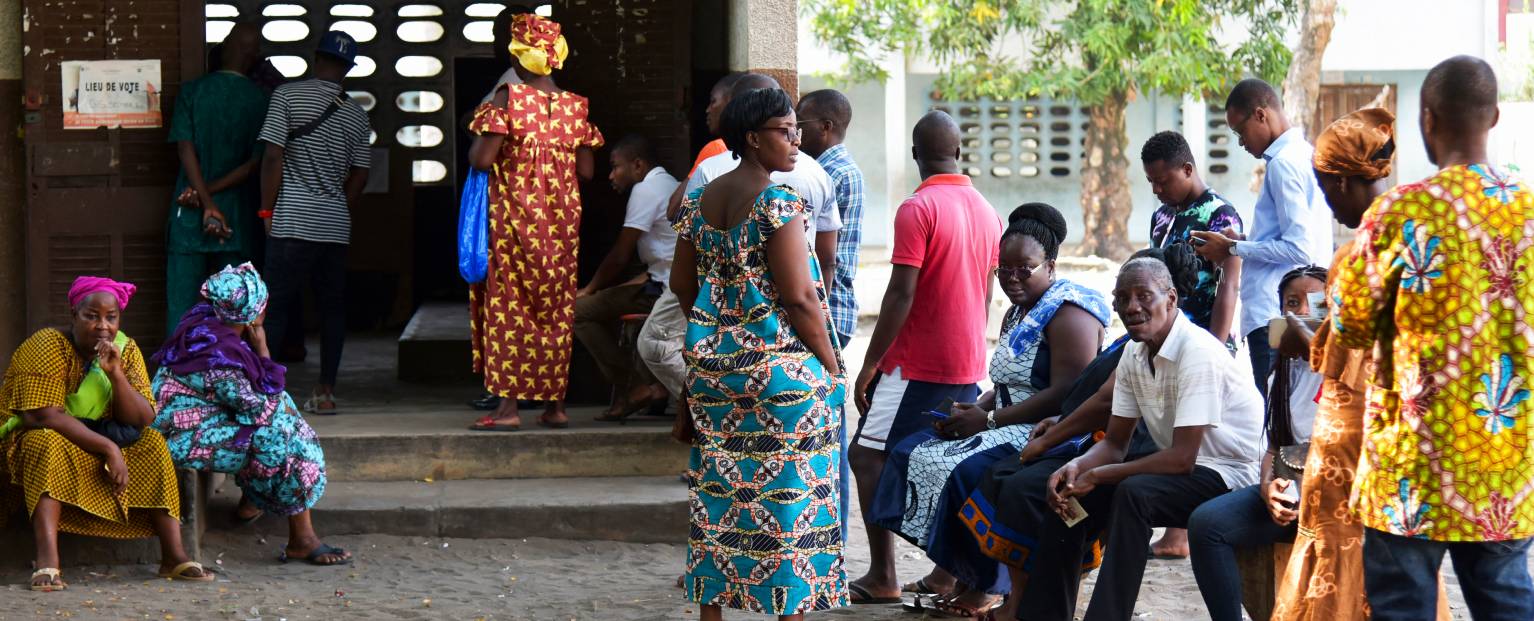
Ivorians queue outside of a polling station to cast their ballot in Port Bouet during local elections in Abidjan. (Photo: AFP)
Former Ivorian Prime Minister Pascal Affi N’Guessan is slated to be the presidential candidate for the Front populaire ivoiriene (FPI). N’Guessan had previously contested for the presidency in both 2015 and 2020.
Simone Gbagbo, former First Lady of Côte d’Ivoire and ex-wife of former President Laurent Gbagbo, is running under the banner of her Mouvement des générations capables (MGC) party. Like her ex-husband, Simone Gbagbo was acquitted by the International Criminal Court for crimes against humanity and was subsequently pardoned under an amnesty declaration by Ouattara in 2018.
Businessman and Minister of Trade Jean-Louis Billon is running as an independent candidate as are Gnangbo Kacou Vincent, a member of the National Assembly, and Vincent Toh Bi Irié.
A central storyline, however, has been the exclusion of four candidates from contesting. Key among these is Tidjane Thiam, a former minister of development and the former chief executive of Swiss bank Credit Suisse. He was barred from participating in the elections by the Independent Electoral Commission in early June given that he held dual French and Ivorian citizenship when he filed to run. Steps to remediate the exclusion through the courts were unsuccessful, leaving his Parti démocratique de Côte d’Ivoire – Rassemblement démocratique africain (PDCI-RDA) without a flagbearer for the elections.
Appeals to the African Union’s African Court on Human and Peoples’ Rights by Gbagbo and Soro to have their candidacies restore were rejected.
Another barred candidate is Laurent Gbagbo. The former president had declared his intention to run again under the Parti des peuples africains – Côte d’Ivoire (PPA-CI). He is prohibited from contesting, however, due to a jail sentence for diverting funds from the Central Bank of West African States (BCEAO) during the post-election crisis of 2011. While pardoned by Ouattara in 2022, Gbagbo has not been amnestied, barring him from electoral lists. Charles Blé Goudé, the organizer of Gbagbo’s armed youth wing during the 2010-2011 electoral crisis, was similarly prevented from running.
Guillaume Soro, a former prime minister under Ouattara, had also announced his plan to contest the 2025 election, though he has been in exile since 2019. He has also been disqualified stemming from a conviction in absentia in Côte d’Ivoire for “undermining state security” and “handling misappropriated public funds.”
The disqualifications of the four candidates have generated protests and some arrests. This includes a two week detention of Joel N’Guessan (no relation to the presidential candidate), a former human rights minister (2006-2007), for “discrediting the judicial institution and magistrates.” He had warned that the exclusion of certain political actors could lead to a national crisis.
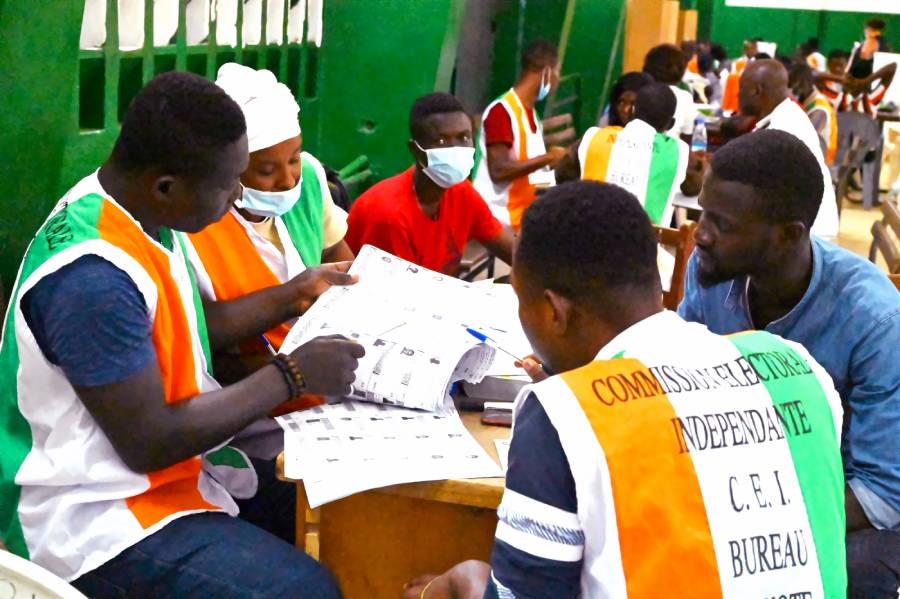
Electoral commission officials check the voter’s roll as they count votes at a polling station in Abidjan on October 31, 2020. (Photo: AFP/Issouf Sanogo)
In an effort to marshal their efforts, 25 opposition parties formed the Coalition for Peaceful Alternation in Côte d’Ivoire (CAP-CI) in March. However, the alliance has been unable to agree on a single candidate, underscoring the fragmentation and rivalries among the opposition. CAP-CI may nonetheless play an instrumental role if no candidate wins a 50 percent majority in the first round and the election goes to a second round between the top two candidates.
The controversy over the excluded candidates has overshadowed notable areas of progress in Côte d’Ivoire’s electoral processes. The Independent Electoral Commission oversaw a robust and simplified voter registration drive at the end of 2024, which is estimated to have added 4.5 million new voters to the rolls. The drive was extended by a week at the request of opposition parties to allow more citizens to be registered.
Recent legislative elections have largely been conducted in a transparent, credible manner. Lower-house elections in March 2021 saw the RHDP lose 28 seats, dropping their total to 139 in the 251-member chamber. In the September 2023 municipal and regional elections, the RHDP won 123 of 201 municipalities and 25 of 31 regions. While Laurent Gbagbo’s PPA-CI has claimed vote rigging, the bigger issue seems to be the PPA-CI’s waning influence, having boycotted all post-2011 elections.
Conditions for the media have also improved in recent years, though reporters may still face intimidation.
Conditions for the media have also improved in recent years, though reporters may still face intimidation during their investigative reporting. Journalists are also concerned that an electronic communications bill being considered by the legislature could be misused to hinder their work.
Working closely with civil society, the Ivorian government’s Haute Autorité pour la bonne gouvernance (HAGB) has also made sustained efforts to counter corruption over the past decade. This has resulted in a steady improvement in Côte d’Ivoire’s ranking on Transparency International’s Corruption Perceptions Index—now at 87 out of 180 countries, among the top third of African countries.
To address the growing threat of violent extremist groups spilling across the border from Burkina Faso and Mali, the Ivorian government launched its Programme spécial du Nord in 2022. Combining an increased security presence in its northern border regions with investments in infrastructure and social programs targeting unemployed youth, the program is seen as having contributed to the mitigation of militant Islamist activity in Côte d’Ivoire. Citing the modernization of its armed forces and reflective of the country’s growing self-confidence, President Ouattara publicly announced in early 2025 the negotiated withdrawal of 600 French military forces who had long been stationed in Côte d’Ivoire.
Sustained efforts to counter corruption over the past decade have resulted in a steady improvement in Côte d’Ivoire’s ranking on Transparency International’s Corruption Perceptions Index.
Côte d’Ivoire’s efforts to strengthen its democratic institutions over the past decade have generated tangible benefits for Ivorian citizens. The economy has grown by an average of 5 percent per year during this time, lifting real per capita incomes to over $2,700—an 80-percent increase since 2011.
Perhaps the biggest wildcard to the Ivorian 2025 elections will be from external influences. Russia has been systematically attempting to undermine democratic processes on the continent as a means of leveraging its influence with unaccountable autocratic regimes. A key element of this has been the aggressive information manipulation campaigns that aim to sow distrust in government and disillusionment in democracy. Côte d’Ivoire is in the crosshairs of this effort being a democratic-leaning Francophone country in West Africa—the locus of Russian influence efforts.
Increasingly, Russia has tried to seed dissension by sponsoring local influencers who have more credibility with local populations.
Increasingly, Russia has tried to seed dissension by sponsoring local influencers who have more credibility with local populations. At times, these efforts are channeled through a political party who can benefit from antigovernment sentiments, an angle that some members of Laurent Gbagbo’s PPA-CI party appear to be employing. Of the constellation of Russian-front or Russian-sponsored organizations in Côte d’Ivoire are Solidarité Panafricaniste Côte d’Ivoire, Alternative Citoyenne Ivoirienne, Jeunesse Panafricaine Côte d’Ivoire, Mouvement Citoyen Panafricain Sursaut Africain, and Total Support for Vladimir Putin in Africa.
Having observed the impact of Russia’s information manipulation campaigns elsewhere in West Africa, the Ivorian government and civil society groups have been organizing to counter these intentionally destabilizing narratives through public awareness raising and improving their capacity to expose these Russian-sponsored tactics.
Côte d’Ivoire’s 2025 presidential election benefits from years of still ongoing work to create resilient democratic institutions. How these institutions fare over the course of the year will be a central issue to watch. Integral to a successful process will be the leadership shown by competing candidates while articulating their visions for the future of the country without falling into the trap of polarizing narratives that aim to undercut the many gains the country has realized over the past decade.
Previous
« Cameroon (October 12)
Next
Tanzania (October 29) »