
 Cameroon: Change is Coming but More of the Same?
Presidential Elections
October 12
On the surface, Cameroon’s 2025 presidential election looks to be a continuation of the unvarying political system in place since President Paul Biya came to power in 1982. Africa’s second longest serving leader (following Teodoro Obiang in Equatorial Guinea), Biya is standing for his eighth presidential term in the October elections. Biya’s extended terms in office are further remarkable in that presidential terms in Cameroon are for 7 years. Biya’s extraordinarily long tenure has been enabled by a constitutional amendment engineered by his party in 2008, abolishing the two-term presidential limit.
Biya’s Rassemblement démocratique du Peuple Camerounais (RDPC) party has held power in this country of 29 million people since independence in 1960, reflecting the dominant party system in place despite the introduction of multiparty elections in 1992.
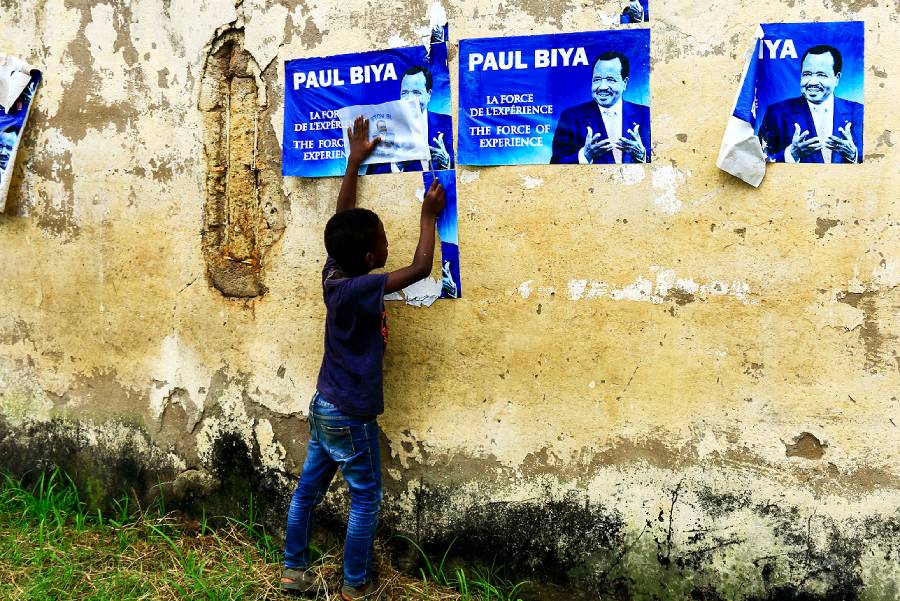
A young child hanging posters of Cameroonian President Biya on a wall in Yaoundé. (Photo: AFP)
Biya and the RDPC have maintained their stranglehold over Cameroonian politics via their control over all government institutions, including the electoral commission and judiciary. This has resulted in what independent observers have viewed as a series of fraudulent elections, leading opposition parties to boycott the 2020 legislative and municipal elections. Opposition candidate, Maurice Kamto, and over 200 of his supporters were arrested for protesting the controversial 2018 presidential polls. While Kamto was released after 10 months, 41 of his supporters remain behind bars after being sentenced to 7 years in prison.
The 2025 electoral cycle is destined to be an inflection point in this trajectory, in one way or another. Now 92 and the world’s oldest head of state, Biya has been in failing health and has been out of public view for extended periods over the past year. This has set off a nervous behind-the-scenes succession battle within the RDPC. Should Biya die or step down while in office, the Cameroonian constitution states that the responsibilities of the head of state would transfer to the President of the Senate, Marcel Niat Njifenji. He would be required to organize elections within 20 to 120 days but would be barred from running himself or otherwise modifying the constitution or composition of the government. A longtime member of the RDPC, Njifenji has held the position of President of the Senate since its inception in 2013 and would not be expected to oversee any dramatic changes in policy.
A unified opposition is vital in Cameroon’s single-round plurality system that favors the incumbent.
Recognizing that change is imminent, two former allies of Biya have broken from the RDPC and declared their candidacies. These include former Prime Minister Bello Bouba Maigari, a close Biya confidante for the past 30 years, and Issa Tchiroma Bakary, a former Minister of Employment who resigned his post in June.
Biya, meanwhile, has reshuffled his military leadership for a second time just days after announcing his intention to run for re-election. This comes amid rumors of a potential coup.
Kamto, the most recognizable opposition candidate, has been barred from contending in the election by the Constitutional Council (ELECAM) on technical grounds. Kamto officially garnered 14 percent of the votes in the disputed 2018 presidential election.
Kamto was one of roughly 70 opposition candidates to have their nominations rejected by ELECAM. This leaves 11 opposition candidates contesting, however, their inability to unify behind a single candidate will bolster Biya’s prospects for prevailing in Cameroon’s single-round plurality system.
Dr. Enow Abrams Egbe, the chair of ELECAM, has actively engaged the public in citizen awareness raising about the electoral process. This has led a robust voter registration drive that added over 750,000 citizens to the polls, and is seen as having significantly increased the registration of women and youth. This has dovetailed with civil society efforts, some of which have been organized by the Catholic Church, to instill a fervor for civic engagement among Cameroonian youth.
The electoral playing field remains highly uneven.
The electoral playing field remains highly uneven and pliable to RDPC influence, however. An illustration of this is the government’s ban on the two leading opposition coalitions, including the APC, declaring them “illegal” and “clandestine movements.” The ruling RDPC is attempting to exploit this designation by postponing legislative elections until 2026, even though they are normally held concurrently with the presidential election.
The electoral landscape has also been marked by an increase in arbitrary arrests, intimidation, and military court trials for opposition party members, journalists, and civil society leaders. This has occurred within a broader crackdown against journalists deemed to be critical of the government. This includes the suspension of media outlets’ licenses and violent attacks and arrests of journalists who have reported on government corruption or mismanagement.
While Cameroon has long been dominated by a single party, the use of repressive tactics has grown in recent years, belying Cameroon’s legacy of inclusivity in line with its rich sociocultural and linguistic diversity. This is most vividly seen by the harsh measures taken to restrict the rights of the English-speaking communities in Northwest and Southwest Regions (comprising 15 to 20 percent of the population) since 2016. The resulting conflict, in which human rights abuses are alleged to have been committed by both sides, has resulted in over 3,000 deaths, nearly 700,000 displaced people, and the interruption in school for roughly 600,000 children. The insecurity and growing alienation of these Anglophone regions will certainly depress voter turnout there, contributing to the underrepresentation of these communities.
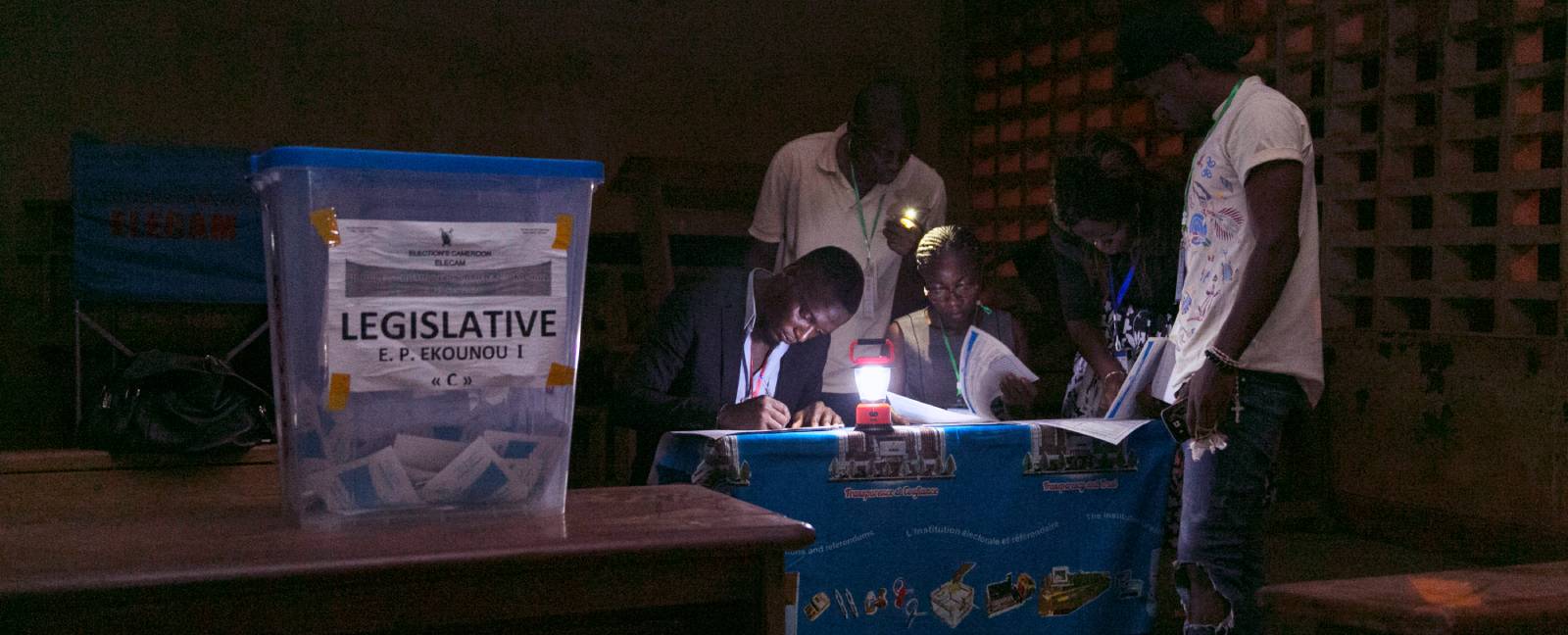
Electoral officials count votes after the general and municipal elections in Yaounde. (Photo: AFP)
Cameroon’s election will also have regional security implications as Cameroon, along with Nigeria and Chad, is confronting a more than decade-long threat from militant Islamist groups (Boko Haram and the Islamic State in West Africa). This threat, focused in Cameroon’s Extreme North Region, has been escalating with the country experiencing a 50-percent increase in the number of annual fatalities (now over 800) linked to these groups in the past year. The degree to which Cameroon’s presidential elections contribute to a legitimating and unifying outcome will directly impact the government’s ability to gain popular support and pursue a holistic stabilization strategy to this threat.
Cameroon is also central to the regional security challenge of protecting the Congo Basin rainforests. Illegal logging in these forests—often linked to transnational organized criminal groups—costs the country billions of dollars in lost revenues, undermines thousands of livelihoods, and threatens the world’s most important terrestrial carbon sink as well as a vital component in Africa’s water transpiration cycles. Cameroonian government leadership will be vital in building both the national and regional security and financial monitoring mechanisms to control this exploitation.
The Cameroon presidential election will likely be subject to external interference.
The Cameroon presidential election will also likely be subject to external interference. Afrique Média, the Russian-sponsored news organization that promotes pro-Russian narratives across Africa, is headquartered in Douala. Russian-linked information networks have supported Biya’s extended tenure, and Cameroon has been a priority target of Russian anti-Western, anti-United Nations, and antidemocracy campaigns.
As Cameroon navigates the inevitable transition from Biya’s four-decade rule, a central theme to watch in the 2025 election is whether reformist forces within and outside the RDPC can gain sufficient traction to build a coalition to address the country’s festering domestic political tensions and regional security threats while realizing the country’s enormous potential.
Previous
« Seychelles (September 27)
Next
Côte d’Ivoire (October 25) »