
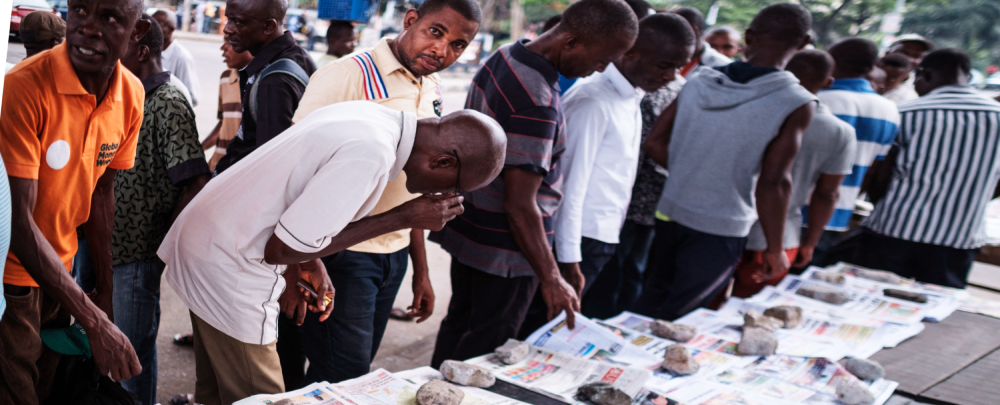
Poor in an Oil-rich Country: Republic of Congo’s Youth Hope for Change
For many young Congolese, daily life is a paradox: though they live in a resource-rich country – the third largest oil producer in sub-Saharan Africa and a producer of liquefied natural gas (LNG) – nearly half the population live below the poverty line. This Sunday, Congo goes to the polls in which President Denis Sassou Nguesso, 82, is again seeking another term. … According to the World Bank, oil accounts for about 70 percent of Congo’s exports and nearly 40 percent of its gross domestic product (GDP). But this wealth does not automatically translate into an improvement in living standards for most of the populace. The World Bank estimates that more than 40 percent of Congolese people live below the poverty line, despite the country’s significant natural resources. … As the country’s oil wealth fails to filter to the majority of the population, young people are particularly affected and many face unemployment. According to data from the World Bank and the International Labour Organization, the youth unemployment rate in Congo is among the highest in Central Africa, while the informal sector absorbs the majority of new entrants to the labour market. Al Jazeera
Sudanese Army Drone Strike Kills 13 near Chad Border
A Sudanese army drone strike killed 13 people, including Chadian nationals, and wounded several others on Thursday after targeting groups active in fuel smuggling from Chad through the Adre crossing. The Sudanese military has intensified its air campaign over recent weeks against positions in the Darfur region. The paramilitary Rapid Support Forces (RSF) currently control the majority of the territory in the western province. The army maintains its strikes are directed at military hardware, including advanced air defence systems and drones. These operations are part of a broader strategy intended to cripple the RSF’s defensive and offensive capabilities. A military source told Reuters that armed forces drones targeted groups involved in the transport of fuel from Chad into Sudanese territory. The source said the fuel was being moved through Adre toward El Geneina, the capital of West Darfur State. The same source added that the targeted groups included Chadian traders who allegedly exploit border instability to supply fuel to elements linked to the RSF. These intermediaries then facilitate the delivery of the fuel into El Geneina. The El Geneina Emergency Rooms Coordination Council said in a statement that 13 people working in the fuel trade were killed, including five women. Five others sustained various injuries during the strike on the Adikong area of West Darfur. … The council stated the strike occurred less than 50 meters from the nearest Chadian security post, calling it a direct threat to Chad’s security. The group described the incident as a violation of international humanitarian law. Sudan Tribune
At Least 38 Civilians Killed in Burkina Faso in Wave of JNIM Attacks
Burkina Faso is facing another surge of violence as jihadists intensify attacks on civilians. According to Human Rights Watch, militants killed at least 38 civilians and kidnapped nine women in less than a month. The attacks are blamed on the Group for the Support of Islam and Muslims, also known as JNIM, one of the most powerful Islamist militant groups operating across the Sahel. The group has spent years expanding its insurgency across Burkina Faso and neighboring countries, including Benin. Human Rights Watch documented three separate incidents between January 29 and February 22. In one case near the northern village of Solle, militants abducted nine women and threatened them with rape and death before releasing them the next day. Then on February 14, fighters attacked a military base in the northern town of Titao. During the raid, at least 34 civilians were executed and homes and telecommunications infrastructure were burned. Just days later, on February 22, another attack in the eastern town of Manni left four shopkeepers dead and several businesses destroyed. The violence highlights the deepening crisis in Burkina Faso, where jihadist conflict since 2015 has killed tens of thousands and displaced millions across the Sahel. Africanews and AP
Nigeria: Senate Urges FG to Establish Military Base in Benue’s Kwande over Insecurity
The Senate of Nigeria has called on the Federal Government to establish a military base in Kwande Local Government Area to strengthen security and enable displaced residents to return safely to their communities. The upper chamber also urged security agencies to intensify surveillance, coordinated patrols and operations in affected areas to prevent further attacks. Specifically, lawmakers called for the establishment of a military base along the Ikyurav–Ya–Ukusu axis to ensure a sustained security presence in the troubled communities. The Senate further appealed to telecommunications companies to install communication masts in the area to enable residents to make distress calls during emergencies. … It also asked the National Emergency Management Agency to provide relief materials and humanitarian assistance to families affected by the attacks in Kwande and other parts of Benue State. Lawmakers observed a one-minute silence in honour of victims killed in recent attacks in Abande, Awu, Asinuba, Awapacho and other communities. The resolutions followed a motion of urgent public importance moved by Senator Emmanuel Udende over escalating attacks in Kwande communities. … According to him, poor road networks, weak communication infrastructure and the absence of permanent security formations have continued to hinder rapid response to distress calls in the affected rural communities. Vanguard
Ivory Coast Marks 10 Years since Deadly Grand-Bassam Beach Attacks
It’s been ten years since one of the biggest terror attacks happened in the Ivory Coast. On March 13, 2016, three gunmen moved along the beach and stormed three adjacent hotels, sometimes shooting people in the sand. The victims included a Nigerian, four French citizens, a German, a Macedonian and a Lebanese national, as well as Ivorians. The jihadists claimed the attack was in retaliation for anti-terror operations in the Sahel region led by France and its allies. Fifteen people have been arrested in connection with the first jihadist attack in the Ivory Coast that was claimed by Al-Qaeda in the Islamic Maghreb in retaliation for anti-terror operations in the Sahel region led by France and its allies. It was the third such attack in four months in West Africa and a blow to a nation working to lure back foreign tourists to its palm-fringed beaches and rainforests as it recovered from a brutal civil war. Africanews
Uganda: Court Sets New Timelines in Besigye Treason Case over Witness Secrecy Bid
The High Court in Kampala has set new timelines in the treason case involving opposition figure Kizza Besigye after the prosecution failed to properly serve an application seeking to conceal the identities of six State witnesses. Presiding judge Emmanuel Baguma directed the prosecution to formally serve the accused and all defence lawyers who appeared in court before the matter proceeds. … The judge gave the defence two weeks to file a response. Any rejoinder from the prosecution must be filed by March 30. The case will return to court on March 31 for mention. Justice Baguma also adjourned the pre-trial hearing of the main treason case to April 16. The dispute arose after defence lawyers argued that the prosecution had failed to comply with an earlier court order directing it to fully disclose all evidence and witnesses it intends to rely on at trial. … Besigye also expressed concern about the proceedings, telling the judge he had not seen the application. “I am extremely concerned about continuing to dismiss our concerns. You are hearing an application which, myself, I have not seen,” Besigye said before threatening to stop attending court. The East African
Libya: UN Calls for Data Sharing to Combat Drug Trafficking
The United Nations Support Mission in Libya has underscored the need for stronger regional cooperation in the face of a rapidly expanding synthetic drug market. The United Nations Support Mission in Libya (UNSMIL) called for enhanced data sharing and regional cooperation to address the growth of synthetic drug trafficking across the Arab region, at a high-level meeting held on the sidelines of the 69th session of the Commission on Narcotic Drugs. The gathering brought together representatives from international organizations and regional partners, including the Deputy Special Representative of the UN Secretary-General and Resident Coordinator in Libya, Ulrika Richardson. The event was jointly organised by Naif Arab University for Security Sciences and the United Nations Office on Drugs and Crime (UNODC). The discussions centred on the rapid expansion of the synthetic drug market across the region, a phenomenon drawing growing attention from international institutions given its security and social implications. In her remarks, Ulrika Richardson said that drug trafficking has now moved well beyond the strictly criminal sphere to become a broader challenge for security and development, noting that organised crime networks are operating with increasing reach across national borders. She added that these criminal networks are also tending to intersect with other illicit economies, exploiting fragile contexts and contributing to the spread of informal circuits that can fuel instability. APA
Tanzania Set to Benefit as Lifezone Signs Burundi Nickel Agreement
On March 10, 2026, Lifezone Metals, parent company of Tembo Nickel, signed a 14-month exclusivity agreement with the Government of Burundi, with the potential for extension, covering the Musongati nickel laterite deposit. The deposit has an average nickel grade of 1.31 percent, copper at 0.21 percent and cobalt at 0.09 percent, and is estimated at over 150 million metric tonnes. It is located about 200 kilometres south-west of Kabanga, Ngara, within the East African Nickel Belt. The agreement was signed by Lifezone Metals chief executive officer Chris Showalter and Burundi’s Minister of Mineral Resources, Energy, Industry, Trade and Tourism, Dr Hassan Kibeya, at the United States Department of State in Washington, D.C., in the presence of the US Deputy Assistant Secretary of State for Central Africa and Commercial Engagement, Sarah Troutman. The development highlights the strategic role of Tanzania’s Standard Gauge Railway (SGR), its mineral beneficiation policies, and efforts to position the country as a regional industrial and refinery hub, in line with Vision 2050, which aims for a $1 trillion economy. The Citizen
Burundi Signs Deal with Bezos, Gates-linked Miner
Burundi has signed a deal with leading US miners KoBold Metals and Life Zone Metals for exploration for minerals essential to the American energy transition. KoBold, which already mines lithium, coltan, rare earths, tin, manganese, and gold in eastern Democratic Republic of Congo and Zambia, is looking for possible exploitation of lithium, cobalt, copper, and other metals. KoBold, a company linked to US billionaires Jeff Bezos and Bill Gates said it plans to digitise Burundi’s geological data by July. … The deal covers three years with the possibility of renewal. KoBold will provide experts to analyse large geoscientific databases and identify new mineral deposits using advanced technology and artificial intelligence. Mining investments could follow this research. The East African
Mine Collapse in Central African Republic Kills 8
An artisanal mine collapsed in the Central African Republic on Thursday morning, killing eight people, according to miners who are at the scene. The collapse, which also injured five other people, happened in a mining town in Nourroum, the capital of Ouham-Péndé prefecture in the northwestern region. “The victims were deep inside the mine, digging, when the collapse happened. We were speechless and helpless,” Alban Moussa Yakata, a mine operator in Nourroum, told The Associated Press. The Ministry of Mines and Geology did not respond to a request for comment. Artisanal mine collapses are common in the Central African Republic, where several thousand people work in small-scale extraction mining. The work is risky as miners do not have enough protection. The government issues licenses to mining cooperatives to run the mines. AP
East Africa Braces for Floods as More Rain Forecast
With rains expected to continue until May, countries in Eastern Africa are bracing for a harsh outlook. Meteorological authorities warn that heavy rainfall will persist, forecasting wetter-than-usual conditions across the Greater Horn of Africa through May. The Intergovernmental Authority on Development Climate Prediction and Applications Centre (ICPAC) this week projected a 45 percent probability of wetter-than-normal conditions across most of the Greater Horn of Africa during the March–May 2026 season. ICPAC has warned of a high likelihood—over 70 percent—of rainfall exceeding 300mm in parts of western Kenya, southern Uganda, much of Rwanda and Burundi, and northwestern Tanzania. … Severe flash floods which occurred a week ago, have already killed at least 49 people in Kenya, with low-lying areas and riverine regions worst affected. … In the Democratic Republic of Congo, a landslide triggered by heavy rainfall struck the Rubaya mining area of North Kivu province on March 6, causing dozens of deaths. Reports suggest hundreds of unconfirmed fatalities among miners and families in surrounding areas. Flooding has also been reported in northern and southern Mozambique, southern Malawi, eastern Angola, western, central, and eastern Zambia, northern Botswana, and northwestern Madagascar. High flood risks remain in northern South Africa, Zambia, Tanzania, Kenya, and southern Ethiopia, due to heavy rainfall in the coming week. The East African