

Download this Brief as a PDF: 
English | Français | Português
Irregular armed groups in West Africa have exploited tactical deficiencies in military force structures, requiring greater integration of mobility, intelligence, and sustainment capabilities within African counterinsurgency operations.

Members of the Nigerian Special Forces Unit rappel from a helicopter during a training exercise at General Ao Azazi barracks outside of Abuja. (Photo: AFP/Stefan Heunis)
Highlights
- Legacy battalion-based formations designed for conventional, linear warfare are poorly matched for the dispersed, fast-moving insurgent threats confronting multiple West African countries.
- Enhanced operational mobility ensures reach, speed, and tactical unpredictability.
- Effectiveness in contemporary irregular warfare depends on integrated tactical units, intelligence-enabled maneuver, and sustained operational reach.
Nigerian soldiers of 25 Task Force Brigade came under “sudden and heavy” insurgent fire near the village of Wajiroko, in the Damboa Local Government Area of Borno State that borders the Sambisa Forest in November 2025. Following the ambush, the Islamic State in West Africa (ISWA) claimed responsibility for the attack. ISWA announced they had captured and executed the brigade commander, heightening public anxiety. The Nigerian Army initially denied the claim, though the general’s killing was later confirmed.
That the attack was both sudden and heavy underscores a critical pattern: insurgent groups increasingly dictate the tempo of engagements, routinely achieving tactical surprise and forcing government units into reactive, defensive postures. The subsequent scramble to dismiss rumors of the commander’s abduction further illustrates the contested information environment in which these forces operate. Together, these dynamics highlight recurring challenges—reactive engagements, stretched operational capacity, gaps in intelligence and mobility, and persistent struggles to seize or retain the initiative against agile adversaries.
Recent developments point to a sharp intensification in the ambition, coordination, and operational reach of insurgent groups.
Irregular armed groups across the Sahel and Lake Chad Basin have steadily expanded their influence by employing improvised explosive devices (IEDs), rapid mobility, and deep local knowledge. When they come under pressure, these irregular forces have gained the freedom to choose when and where to strike by dispersing, regrouping, and sustaining themselves through coerced local support to retain the initiative. These tactics have allowed them to outmaneuver government forces and shape the tempo of violence across multiple theatres.
Government forces, by contrast, often rely on conventional, reactive, and poorly coordinated operations, leaving many militaries unable to contain or defeat these groups as their territorial reach grows. In West Africa, militants now hold or contest extensive borderlands, and stretches of inland terrain, and key transportation corridors in Nigeria, Mali, Burkina Faso, Niger, and Benin. Sustained clashes since 2020 have resulted in heavy security-force losses, widespread civilian killings, and the displacement of millions.1
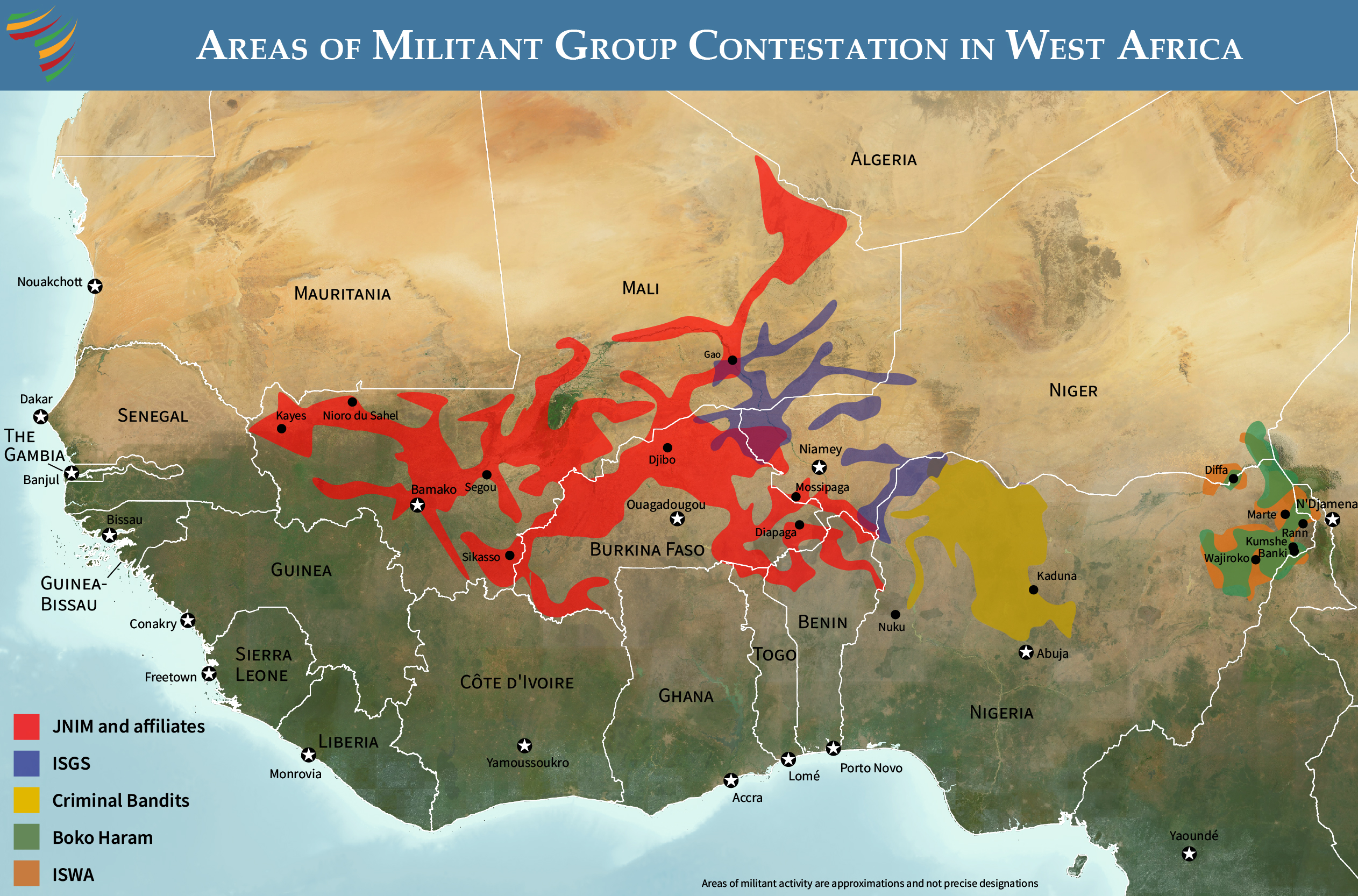 Click for a printable PDF version.
In the Sahel, Jama’at Nusrat al Islam wal Muslimin (JNIM), a coalition of insurgent Islamist groups, has intensified its campaign and widened the scope of its operations. On May 11, 2025, Ansaroul Islam—a JNIM-affiliated group—mounted a major offensive against the Burkinabé town of Djibo, overrunning the area for several hours and inflicting heavy casualties on civilians, soldiers, and paramilitary personnel. Dozens were abducted, government facilities were destroyed, and the town’s defenses were overwhelmed before any meaningful reinforcement could arrive—highlighting persistent weaknesses in mobility, coordination, and rapid-response capability.
Only 2 days later, on May 13, JNIM militants carried out a comparable attack more than 500 kilometers from Djibo in Diapaga, again seizing the locality and withdrawing at a time of their choosing. These incidents form part of a sustained pattern of near-daily assaults since early 2025 that reveal the insurgents’ growing confidence, improved organization, and capacity to strike urban nodes while maintaining pressure on rural areas. The ability to mass forces, disrupt supply lines, and impose blockades underscores the insurgency’s expanding reach.
In Mali, a parallel deterioration has unfolded. In October 2025, violence surged from Segou to Kayes as the Malian Armed Forces attempted to break a tightening fuel embargo on key transport corridors imposed by JNIM’s Maçina Liberation Front. Despite extensive use of air power and drones, the blockade remained largely intact. Meanwhile, JNIM-affiliated militants continue to ambush convoys, torch fuel trucks, and intimidate civilians along critical routes, further weakening government control.
Insurgent groups increasingly dictate the tempo of engagements, routinely achieving tactical surprise.
Niger has witnessed its own steady decline in security. Since the 2023 coup, militant violence has increasingly penetrated major towns and cities, exposing the growing weakness of government authority. The Islamic State in the Greater Sahara (ISGS) has pushed into urban spaces—most notably with an attack on Niamey’s international airport on January 29, 2026—and coordinated strikes on security and administrative facilities in the Tahoua and Tillabéri Regions. These incidents point to a deliberate effort by the group to expand beyond remote border areas and challenge the government where it is most visible.
Simultaneously, Katiba Hanifa, another JNIM element, has stepped up its activities along the Benin and Nigeria frontiers, using IEDs, destroying communications and municipal infrastructure, and targeting civilians in a campaign designed to unsettle local governance structures. The group’s first acknowledged operation on Nigerian soil in October 2025 underscores the evolving strategic importance of the Benin–Niger–Nigeria tri-border corridor and highlights the increasing difficulty governments in the region face in containing cross-border militant networks.2
Although militant Islamist influence has been expanding across West Africa for over a decade, recent developments—from Wajiroko to Djibo, and from Segou to Tillabéri—point to a sharp intensification in the ambition, coordination, and operational reach of insurgent groups. These actors are now capable of mounting mass-casualty assaults, seizing territory (even if temporarily), and conducting increasingly sophisticated cross-border operations. Government forces, by contrast, remain largely reactive: frequently ambushed during routine movements, constrained by limited mobility and weak intelligence support, and too often responding to events rather than shaping them.
Key Operational and Structural Challenges
Irregular conflict across the Sahel and Lake Chad Basin has exposed a series of structural, operational, and doctrinal weaknesses within African security forces. These deficiencies have limited governments’ capacity to counter increasingly assertive insurgent groups, whose irregular tactics, cross-border mobility, and growing operational sophistication now threaten the stability of entire regions. Rooted in force design, intelligence integration, mobility, and sustainment challenges, these gaps are visible across theatres such as Mali, Niger, Burkina Faso, Benin, and Nigeria.3
Structural Mismatch with Irregular Threats
Many West African security forces continue to operate with legacy structures optimized for conventional warfare, leaving them ill-suited for dispersed insurgent threats. These traditional formations—large battalion-sized units with rigid command hierarchies—struggle to respond effectively to the fluid, decentralized operations of groups like ISGS, ISWA, Boko Haram, and JNIM affiliates. The events in Burkina Faso in May 2025, where JNIM rapidly seized the provincial capitals of Djibo and Diapaga, illustrate this mismatch. Insurgents exploited nonlinear battlefields, approached urban centers through multiple axes, and withdrew before larger government formations could mobilize.
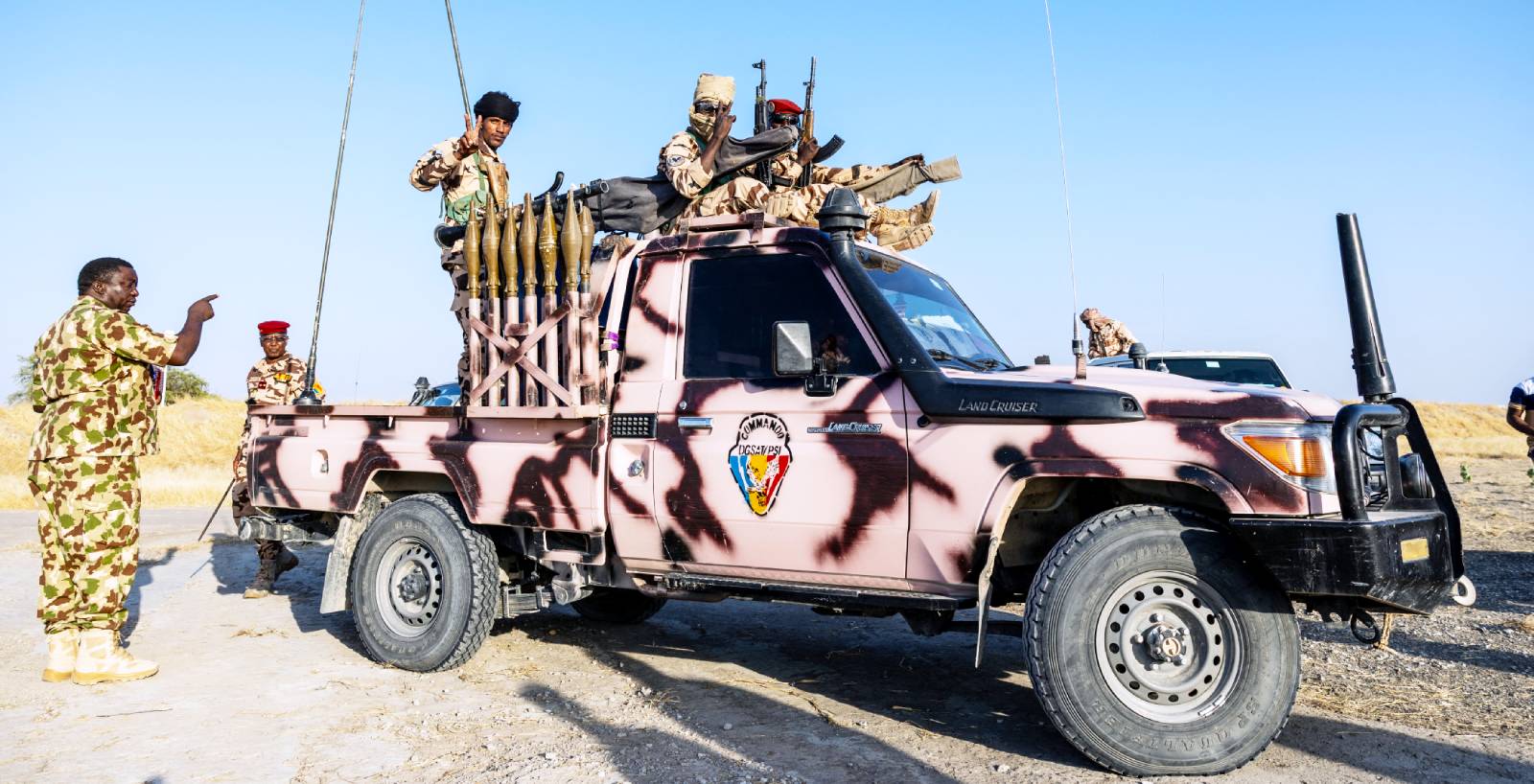
Chadian soldiers from the anti-terrorist unit wait in the back of a vehicle at the Baga Sola military base in Lake Chad Province in November 2025. (Photo: AFP/Joris Bolomey)
Similarly, in Nigeria’s Borno State, ISWA’s attacks on bases in Marte and Rann demonstrated how conventional defensive postures fail against groups capable of rapid concentration, surprise, and dispersal. These patterns reveal that armed forces remain structurally misaligned with the irregular, terrain-adaptive adversaries they face.
ISR Integration and Decision-Support Gaps
The absence of embedded, real-time intelligence, surveillance, and reconnaissance (ISR) capabilities continues to deny tactical units the situational awareness required to operate effectively. A deficit of ISR in the field can leave soldiers operating blind and exposed. Similarly, the inability to transmit actionable intelligence promptly to commanders can result in missed opportunities or cede the pace of operations to insurgents. This weakness has been evident in Mali, where JNIM’s ambushes along the Kayes and Sikasso corridors since August 2025 occurred despite clear prior indicators of militant activity. In Nigeria, ISWA’s coordinated raid on the Kumshe and Banki forward operating bases in May 2025 similarly highlighted the inability to translate available intelligence into timely action.
Companies and platoons are routinely outmaneuvered or overpowered at the tactical level—even when security forces hold numerical or firepower advantages.
Although some forces possess tactical unmanned aerial vehicles (UAVs), these assets are rarely integrated with fire-control centers or decision-support systems, resulting in an incomplete sensor-to-shooter chain. A major part of the problem lies in the disconnect between the deployed company, its battalion elements, and their operational headquarters. Communications, surveillance feeds, and intelligence flows are often slow, intermittent, or absent, rendering rapid decision-making almost impossible. Even when units receive warnings or external intelligence—such as satellite imagery indicating insurgents’ movements—forces frequently lack the operational flexibility or mobility to respond. In some instances, for example, Nigerian units have been unable to act on such intelligence beyond isolated airstrikes, which are rarely synchronized with ground maneuver.4 Without ground forces to exploit the effects of air-delivered fires, insurgents simply disperse, regroup, and reconstitute.
This reveals a deeper structural gap: ISR assets, already insufficient in number, are not matched by the ground strike capability or the command-and-control architecture needed to act on intelligence at speed. Battlespace management remains slow and fragmented. It often takes hours for headquarters to gain awareness of an unfolding attack, during which time frontline units are left to fight alone with minimal reinforcement or resupply. As a result, companies and platoons are routinely outmaneuvered or overpowered at the tactical level—even when security forces hold numerical or firepower advantages overall. Until ISR integration, decision-support processes, and rapid deployment mechanisms are strengthened, insurgent groups will continue to seize the initiative.
Mobility Constraints
Mobility remains one of the most debilitating shortcomings for African forces. A shortage of armored personnel carriers, weak all-terrain mobility, and limited rotary-wing lift restrict units’ freedom of maneuver and slow their ability to respond to fast-moving insurgent threats. These constraints were starkly visible in Niger, where JNIM overran the Mossipaga military camp in Tillabéri—an area long hindered by delayed reinforcement cycles and restricted movement. In Burkina Faso, road-bound infantry units were unable to reinforce Djibo or prevent militants from interdicting critical supply routes, allowing insurgents to isolate towns and attack with impunity.5
Without reliable, responsive mobility, the opportunity to pre-empt insurgent actions is repeatedly lost, leaving commanders to absorb attacks rather than prevent them.
Many legacy mobility platforms remain in such poor condition that they provide little operational value and often become liabilities rather than enablers. Units are routinely deployed with barely serviceable armored personnel carriers (APCs), mine-resistant ambush-protected vehicles (MRAPs), and tanks that suffer frequent mechanical failures due to inadequate maintenance, chronic shortages of spare parts, and weak repair and recovery systems. When these vehicles break down—as they often do—troops are forced to halt, secure the immobilized platform, and wait for assistance that may never arrive. This not only disrupts operational tempo but also exposes the stalled force to ambush, turning the vehicle into a static target instead of a protective asset.
As a result, many armored platforms are increasingly confined to bases, contributing little to combat effectiveness while consuming manpower for perimeter security and complex recovery planning. Commanders must then divert attention to preventing their capture or destruction, further transforming these ageing assets into encumbrances on already overstretched units.
Limited lift capacity further constrains tactical mobility. Many formations operate with only a handful of functioning troop-carrying vehicles, restricting their ability to maneuver, disperse, or mass forces rapidly. Even where APCs or other armored carriers are available, their mechanical unreliability slows movement, undermines confidence, and reduces the predictability of operations.
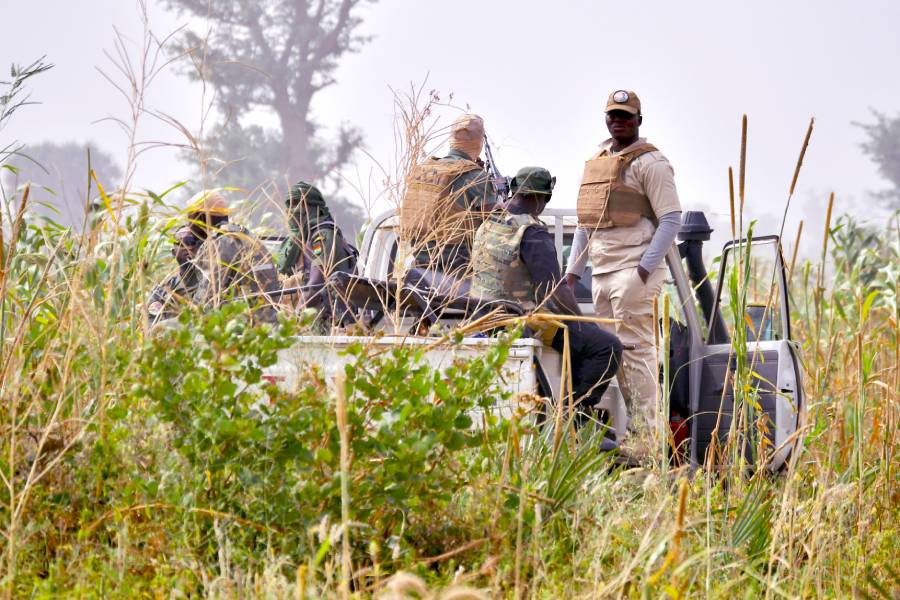
Nigerien soldiers patrol the Maradi region near the border with Nigeria. (Photo: AFP)
Where forces cannot move quickly or reposition with confidence, even well-trained troops are reduced to static targets, unable to contest militant freedom of movement or shape the rhythm of operations. Without reliable, responsive mobility, the opportunity to pre-empt insurgent actions is repeatedly lost, leaving commanders to absorb attacks rather than prevent them.
In several recent engagements across the region, insurgent forces were able to mass, maneuver, and launch coordinated attacks largely because government units lacked the speed and lift capacity to disrupt them early.
Across the Sahel, the cumulative effect of these mobility challenges has consistently undermined operational coherence, demonstrating that without reliable ground and air mobility, tactical superiority is unattainable.
Readiness, Logistics, and Sustainment
Logistical fragility remains one of the most persistent constraints on the endurance and effectiveness of African security forces.6 Units frequently operate with insufficient ammunition, food, vehicle spare parts, medical supplies, and communications equipment. Embedded logistics elements are often weak or absent, leaving frontline troops dependent on long, exposed supply lines. The consequences were starkly illustrated in Mali’s western regions, where JNIM’s fuel embargo on the cities of Kayes and Nioro du Sahel paralyzed movement and exposed the vulnerability of military supply chains. Even escorted convoys were repeatedly ambushed.
Medical evacuation and casualty-care gaps further erode operational endurance and decisiveness. Troops deployed in remote areas often have little confidence that wounded colleagues can be evacuated quickly or treated effectively. This depresses morale, but more importantly, it shapes commanders’ tactical decisions: units become risk-averse, avoid maneuver beyond the reach of medical support, and hesitate to hold exposed positions. These constraints directly weaken the defensive resilience of isolated bases.
Logistical fragility remains one of the most persistent constraints on the effectiveness of African security forces.
Insurgent groups such as ISWA have learned to exploit this vulnerability. Their attacks on remote garrisons are designed not only to inflict casualties but also to sever supply and evacuation routes. Once medical and logistical support is cut off, commanders face mounting pressure to withdraw—both to avoid further losses and because they cannot sustain wounded personnel. As seen repeatedly in Nigeria, isolated bases with inadequate casualty evacuation (CASEVAC) arrangements are rapidly overwhelmed or abandoned, ceding territory and initiative to insurgents who understand that disrupting evacuation and resupply is often as decisive as breaching the perimeter.7
Efforts to address these challenges have produced mixed results. Forward-deployed logistics bases—such as those established in Borno and Yobe—initially improved resupply by positioning fuel, ammunition, and maintenance assets closer to frontline units. Yet these gains proved temporary. As insurgents adapted, the forward bases became vulnerable to attack, and sustaining them grew increasingly difficult as fragile supply chains came under pressure. Once resupply faltered, many of these positions were either abandoned or left isolated, prompting a shift toward “super camps” that concentrated forces in a smaller number of fortified locations.8 While intended to reduce casualties and protect resources, this approach ceded large swaths of territory to insurgents, reinforcing a cycle of territorial contraction that ultimately undermined operational effectiveness.
The inability to establish reliable logistical corridors across contested terrain has effectively ceded vast rural areas to militant groups. Until logistics, sustainment, and medical support are strengthened, military operations will continue to be reactive, short-lived, and unable to generate lasting security effects across the battlespace.
Optimizing Integrated Tactical Units in Force Structures
Transforming the ability of African security forces to counter irregular threats requires a fundamental redesign of tactical formations and the operational systems that support them. The experiences of forces in Nigeria, Mali, Burkina Faso, and Niger demonstrate that success against insurgent groups hinges not only on munitions and manpower but also on force structures, ISR integration, mobility, and troop sustainment.
Operating across vast rural spaces such as the bushlands of Borno State or the forests of eastern Burkina Faso requires modular, company-level combat teams integrating infantry, fire support, ISR, communications, engineering, and mobility elements. These teams must maneuver independently, strike quickly, and sustain short-duration offensive operations while remaining connected to reliable fire support, CASEVAC, and logistics systems. Achieving a force structure that employs combined arms modular operations requires addressing several gaps within current military organizations. Restructuring African forces along these modular and intelligence-led principles provides the operational backbone required for any successful campaign.
The inability to establish reliable logistical corridors across contested terrain has effectively ceded vast rural areas to militant groups.
The doctrinal foundations for this maneuver-modular approach already exist. Nigerian and regional staff colleges teach operational mobility, deception, and intelligence-led action, yet these principles remain weakly implemented due to structural inertia, limited training, and chronic shortages of enablers.
Improving tactical effectiveness, however, requires more than organizational redesign. It also demands embedding intelligence, mobility, sustainment, and specialized capabilities into everyday operations. Intelligence-driven warfare must become standard practice. This requires placing ISR assets—UAV teams, reconnaissance patrols, and observation sensors—at battalion and company levels, with troops trained to interpret data, share feeds in real time, and cue fire support. In effect, a company commander should be able to direct mortar, artillery, or air strikes immediately upon detecting militant movement. Well-trained special forces reconnaissance teams can further refine targeting, but only if tightly linked to units with rapid strike capability.
Viewed as an integrated system, these measures—embedded ISR, enhanced mobility, decentralized sustainment, strategic use of special forces supported by predictable readiness cycles—provide a coherent framework for transforming how African forces confront irregular threats.
When implemented collectively rather than as isolated fixes, combined arms modular operations enable units to maintain tempo, maneuver with confidence, and convert intelligence into timely action. Crucially, this approach allows militaries to shift from absorbing insurgent blows to shaping the operational environment and constraining militant freedom of movement. By aligning force structures, training, and enablers around modular-mobile formations, African forces would be far better positioned not only to withstand attacks but also to outmaneuver and degrade the insurgent networks that continue to dominate large parts of the Sahel and Lake Chad Basin. The accompanying conceptual diagram illustrates how a combined arms modular operations framework can guide such transformation.
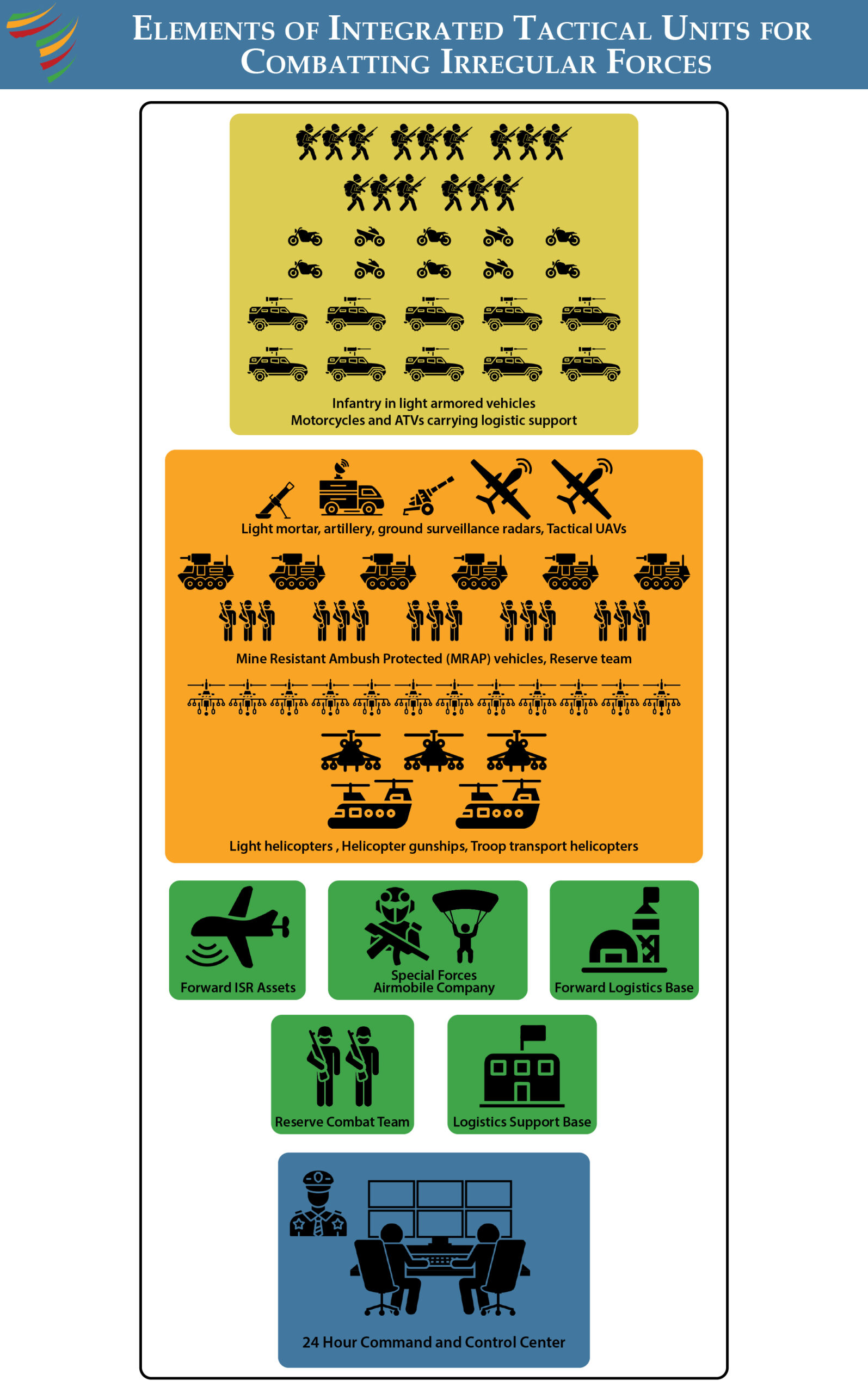
The diagram demonstrates how multiple modular combat teams—each composed of infantry in MRAPs, light armored vehicles, and motorcycle-mounted logistics and fire support elements—form the core of the battle group. Built-in ISR, mobility, communications, and fire support allow these teams to operate semi-independently while remaining connected to a 24-hour battle group and brigade-level command center. This modularity enables rapid dispersal and concentration of force, swift adaptation to changing conditions, and reduces vulnerability to ambushes or supply interruptions. The following provides a series of general practical steps African forces can take to adopt combined arms modular operations.
Embed tactical ISR connected to 24-hour command and control. Using layered ISR—forward reconnaissance patrols, tactical UAVs organic to modular teams, and dedicated ISR platforms feeding both battle group and operational headquarters—returns multiple operational advantages to the military. This architecture creates a continuous sensor grid across the battlespace to ensure that soldiers respond in real time to quickly evolving threats.
The capacity to capture, fuse, and transmit ISR at multiple echelons enables commanders to accelerate the sensor-to-shooter loop and direct mortar, artillery, aviation, or airmobile strike teams with real-time accuracy. Such integration is central to countering mobile insurgents, detecting infiltration routes, and preventing surprise attacks. Near constant communication between ISR elements in the field and commanders shortens the decision cycle and enables precision engagements that return the tempo of operations to military forces.
Enhance operational mobility to create unpredictability. Mobility platforms require urgent reform. Vehicles must be light, maneuverable, durable, and easily repairable to function in harsh terrain. Motorcycle units offer clear advantages due to their speed and off-road reach, but they must be adapted to carry logistic loads and support weapons, such as mortars or heavy machine guns. Using tricycle or other multipurpose platforms presents one option.
Greater mobility—both on the ground and in the air—remains central to regaining the initiative.
Employing wheeled armor, motorcycles, and rotary-wing assets—including light helicopters with machine guns, gunships, and troop-carrying helicopters—returns the element of surprise to military operations. This multilayered mobility system allows units to traverse difficult terrain, project force deep into contested areas, and respond quickly to emerging threats. The vast and rugged landscapes where irregular conflicts are unfolding require tactical superiority as well as increased operational mobility to extend the reach and speed of combat units.
Forces need all-terrain troop-carrying vehicles and protected platforms that can operate across diverse environments without constant mechanical failure. MRAPs provide protected mobility for troops operating in high-threat environments.
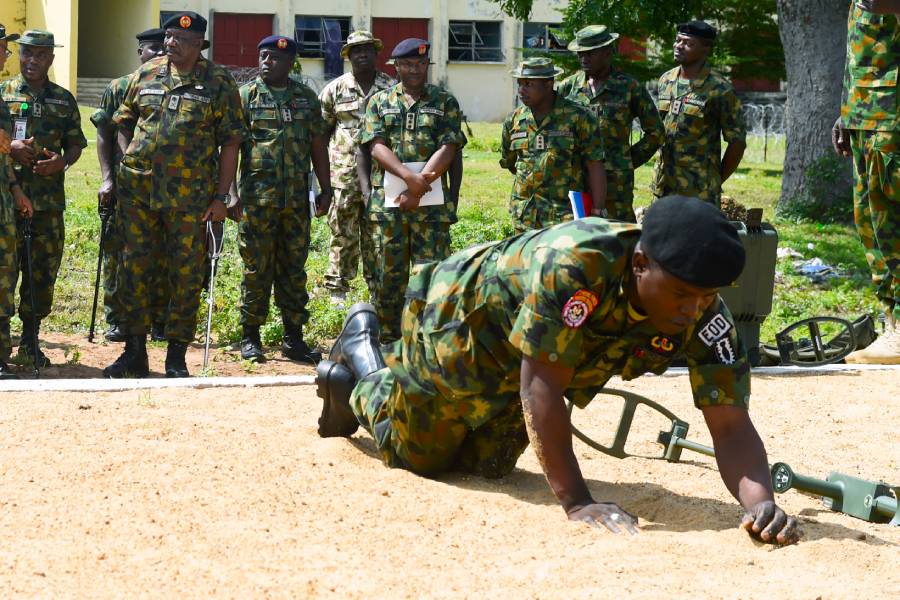
A soldier demonstrates how to check for IEDs with a metal detector at the Nigerian Army School of Military Engineering. (Photo: AFP/Pius Utomi Ekpei)
Expanding rotary-wing lift—through national investment, regional pooling, or mission-specific arrangements—would significantly improve responsiveness and allow for timely reinforcement of isolated positions. Helicopters deliver the speed, vertical lift, and close air support necessary for rapid reinforcement, evacuation, and precision engagement, complemented by additional capabilities from the Air Force. Together, these capabilities allow modular teams to dictate tempo, create unpredictability, and prevent militants from massing forces or controlling terrain.
These teams must operate within robust communications networks that link them to one another and to headquarters, backed by dedicated airmobile assets for rapid reinforcement, casualty evacuation, and resupply.
Greater mobility—both on the ground and in the air—remains central to regaining the initiative. The goal should be to outmatch insurgents in mobility and firepower, while also ensuring force protection.9
Regain the tactical advantage through superior capabilities. Night-fighting capability remains a critical gap. Most units lack night-vision devices, thermal sensors, and the surveillance systems necessary for effective 24-hour operations. In irregular warfare—where surprise, mobility, and tempo shape outcomes—lacking the ability to fight at night forfeits a decisive advantage. Fully capable company-level teams must therefore be equipped and trained to operate day and night, supported by reliable communications, persistent aerial surveillance, and mobile logistics delivered by light helicopters and well-coordinated ground resupply.
Develop integrated support chains at each operational level. Sustainment embedded at every level ensures endurance, survivability, and momentum. The centrality of forward sustainment—through forward logistics bases, motorcycle-borne resupply, integrated medical elements, CASEVAC-capable helicopters, and rear logistics support hubs—cannot be overstated. These capabilities must accompany maneuvering units rather than remain far in the rear. Embedding sustainment directly into the tactical architecture prevents operational stagnation, reduces vulnerabilities, and enables forces to conduct long-duration missions with confidence.
Recasting logistics and casualty care as combat-critical functions, rather than rear-area services, would significantly enhance operational endurance.
Decentralized and coherent sustainment networks—capable of sustaining operations at company, battalion, and formation levels—strengthen morale, preserve combat readiness, and ensure that dispersed modular units can maintain momentum across complex operational environments. When fuel, ammunition, maintenance, and medical support are positioned too far from maneuvering units, even minor disruptions can isolate troops, erode their ability to fight, and force withdrawals that concede the initiative to insurgent groups. Recasting logistics and casualty care as combat-critical functions, rather than rear-area services, would significantly enhance operational endurance and allow units to maintain momentum during dispersed or high-tempo operations.
Align training and readiness with the demands of modular operations. The enduring weakness in basic soldier training remains a central constraint on the effectiveness of integrated tactical units. Modular formations depend on soldiers who can operate semi-independently, coordinate fire support, maneuver under pressure, and sustain dispersed operations. Where basic soldier skills are weak, efforts to decentralize force structures are unlikely to succeed.
In Nigeria, for example, poor marksmanship remains a persistent deficiency—many soldiers struggle to competently fire and handle their rifles due to chronic ammunition shortages and the absence of structured, standards-driven marksmanship programs. These gaps directly undermine the small-unit confidence and reliability that integrated tactical units require to function effectively. Affordable training technologies, including simulators and digital firing systems, would significantly enhance troop proficiency and should be adopted across all combat and support arms. Strengthening infantry fundamentals is, therefore, a prerequisite for more adaptive force design.
Modular formations depend on soldiers who can operate semi-independently, coordinate fire support, maneuver under pressure, and sustain dispersed operations.
Shoring up regular infantry training can be followed by attention to specialist roles embedded in modular units such as mortar teams, light artillery crews, armored operators, engineers, and counter-IED units. Without adequate preparation and familiarity with supporting capabilities, dispersed operations lose coherence and responsiveness. Access to reconnaissance tools such as small UAVs further reinforces these teams’ abilities to operate as part of an integrated formation.
Regular rotation cycles. Sustaining momentum in counterinsurgency operations requires predictable readiness and rotation cycles that balance deployment, rest, and retraining—not the continuous, exhausting deployments seen in the operational theatre.10
Regular rotations allow for cross-training in communication, reconnaissance, medical support, and light-infantry tactics. This readiness protects morale, prevents skill atrophy, and allows units to refresh both basic and specialist competencies, enhancing adaptability during periods of heightened operational demand.
Strengthen reserve and airmobile forces to consolidate tactical gains. Fielding adequate reserve forces and dedicated airmobile elements enables commanders to sustain momentum beyond initial contact. The combined arms modular structure incorporates reserve combat teams and a dedicated special forces/airmobile company under operational control. These elements provide vital surge capacity for rapid reinforcement, exploitation of ISR-derived opportunities, flanking maneuvers, hostage recovery, and precision interdiction. Their integration within the modular force design ensures that tactical gains are consolidated quickly and effectively, preventing operational momentum from dissipating in the absence of responsive follow-on forces.
Aligning Tactical Formations with Strategic Vision
Integrated, mobile, and sustainable tactical formations are foundational enablers of success in counterinsurgency environments.
Tactical transformation alone will not win Africa’s irregular wars, but without it, broader efforts are likely to falter. Integrated, mobile, and sustainable tactical formations are not optional enhancements—they are foundational enablers of success in counterinsurgency environments. While strategic vision and political solutions remain essential, they must be underpinned by tactical units capable of translating intent into effect on the ground.
Reorganizing African tactical forces strengthens the military’s ability to respond with speed, precision, and resilience. Most importantly, this anchors battlefield gains within a coordinated campaign framework that aligns security operations with governance and stabilization outcomes. Without this coherence, African forces may continue to struggle against adaptive insurgent threats, undermining prospects for sustainable peace and security across the region.
General (Ret.) Dr. Fatai Alli is a retired major general in the Nigerian Army and holds a PhD in area studies from the University of Portsmouth, United Kingdom.
Notes
- ⇑ Africa Center for Strategic Studies, “Africa Surpasses 150,000 Deaths Linked to Militant Islamist Groups in Past Decade,” Infographic, July 28, 2025.
- ⇑ Adetayo Sowale, “State and Non-State Security Actors in the Complex Borderlands Between Nigeria and the Republic of Benin,” African Security 18, no. 3 (2025).
- ⇑ Anouar Boukhars, “Adapting Benin’s Battle with Violent Militant Groups,” Africa Security Brief No. 46, Africa Center for Strategic Studies, January 2026.
- ⇑ Ernest Ogbozor, “Counterinsurgency Airstrike Mishap, Intelligence Failure and Civilian Harm in Northern Nigeria – 2014 to 2024,” Journal of Policing, Intelligence and Counter Terrorism 20, no. 2 (2025); Samuel Oyewole, “Struck and Killed in Nigerian Air Force’s Campaigns: Assessment of Airstrike Locations, Targets and Impacts in Internal Security Operations,” African Security Review 30, no. 1 (2021).
- ⇑ Mathieu Pellerin, “Major Jihadist Attack Exposes Military Failings in Burkina Faso,” Analyst’s Notebook, International Crisis Group, May 15, 2025.
- ⇑ Michael Shurkin, “Strengthening Sahelian Counterinsurgency Strategy,” Africa Security Brief No. 41, Africa Center for Strategic Studies, July 2022.
- ⇑ Ali Oladimeji Shodunke, “Boko Haram and Counterinsurgency Operations in Nigeria: Explicating the Military Ordeal,” African Journal on Terrorism 11, no. 2 (2021); Folahanmi Aina, “Why Islamic State is Expanding its Operations in North-Eastern Nigeria,” The Conversation, May 28, 2025.
- ⇑ Stella Wolf, “Nigeria’s Super-Camps Strategy: Early Gains, Disappointing Outcomes,” Security Praxis (blog), June 26, 2020.
- ⇑ Helmoed Heitman, “Optimizing Africa’s Security Force Structures,” Africa Security Brief No. 13, Africa Center for Strategic Studies, May 2011.
- ⇑ Freedom C. Onuoha, Chikodiri Nwangwu, and Michael I. Ugwueze, “Counterinsurgency Operations of the Nigerian Military and Boko Haram Insurgency: Expounding the Viscid Manacle,” in J. Tochukwu Omenma, Ike E. Onyishi, and Aloysius-Michaels Okolie, eds., Ten Years of Boko Haram in Nigeria: The Dynamics and Counterinsurgency Challenges (Cham: Palgrave Macmillan, 2023), 69-94.