
Sudan: Darfur Governor Asks UN to Replace Adre Crossing, Citing Military Use
Minni Arko Minawi, Governor of the Darfur region and leader of the Sudan Liberation Movement, on Monday called on the United Nations to replace the Adre border crossing, alleging it is being used for military purposes by the Rapid Support Forces (RSF) and the United Arab Emirates. The Adre crossing, which links Chad with West Darfur—currently under RSF control—is a primary artery used by the UN and humanitarian agencies to deliver aid to the Darfur and Kordofan regions. During a meeting in Geneva with Gemma Connell, acting head of the UN Office for the Coordination of Humanitarian Affairs (OCHA), Minawi urged a review of the crossing’s status. According to the Sudan News Agency, Minawi claimed the RSF and the UAE have diverted the route for military logistics, creating additional security and logistical hurdles. … In a separate meeting with Mirjana Spoljaric, President of the International Committee of the Red Cross (ICRC), Minawi called for intensified efforts to access RSF detention centres and reach the forcibly disappeared. Sudan Tribune
Over 10,000 Displaced People Reach Sudan’s Roseires
The Sudanese Doctors Network said on Wednesday that more than 10,000 displaced people from the Geissan district on the border with Ethiopia have arrived in Roseires, the second-largest city in the Blue Nile region. Government sources in the Blue Nile region told Sudan Tribune that a buildup of forces from a coalition of the Rapid Support Forces (RSF) and the SPLM-N is threatening Geissan, triggering a massive wave of displacement from the border area. Last week, the rebel alliance seized control of the strategic city of Kurmuk, which also borders Ethiopia. This intensified the flight of civilians toward Ed Damazin, the capital of the Blue Nile region. … The organization warned of a looming humanitarian catastrophe and a worsening health crisis due to the absence of medical services and the potential spread of disease and malnutrition. The Blue Nile region is currently grappling with a continuous displacement crisis, with more than 10 camps already established. Sudan Tribune
Nigeria: Army Chief Shaibu Leads Security Assessment Team to Plateau
Chief of Army Staff (COAS), Lieutenant General Waidi Shaibu, on Thursday, led heads of security agencies on an on-the-spot assessment of the security situation in Jos, Plateau State. The visit forms part of ongoing efforts to restore calm and entrench lasting peace across the state. Col Appolonia Anele, Director of Army Public Relations, said, ‘Upon arrival, the COAS was received by the Governor of Plateau State, Caleb Mutfwang, in a clear demonstration of strong civil-military cooperation and a shared commitment to addressing emerging security challenges. During the visit, the COAS received a comprehensive operational briefing from the General Officer Commanding 3 Division and Commander, Joint Task Force Operation Enduring Peace, Major General Folusho Oyinlola. The briefing highlighted ongoing operations and proactive measures being implemented in synergy with other security agencies to contain threats, protect lives and property and stabilise affected communities. As part of his engagements, Lieutenant General Shaibu also interacted with community leaders and residents, reassuring them of the unwavering commitment of the Nigerian Army to safeguarding all law-abiding citizens. Vanguard
Traders Turn Smugglers, Two Years after Sahel Countries Exit ECOWAS
Since the withdrawal of Mali, Burkina Faso and Niger from the Economic Community of West African States (ECOWAS) to form the Alliance of Sahel States (AES), regional trade has not collapsed, but it has been fundamentally reshaped. Formal trade corridors have weakened under the weight of new tariffs, export restrictions and political uncertainty, but the movement of goods has not stopped. Instead, it has shifted into informal channels, mostly through smuggling, which is creating a parallel economy that is harder to regulate and more expensive to operate, with the costs ultimately borne by ordinary people. … Export bans introduced in the AES countries to protect domestic markets and encourage local value addition have instead trapped commodities within their borders, while the introduction of a 0.5 percent levy on ECOWAS-related goods has added another layer of cost to an already strained system. The result is a fragmented market in which goods are harder to move, more expensive to trade, and less accessible to those who need them most. PR Nigeria
Burundi Says 13 Killed in Explosion at Military Ammunition Depot
Thirteen people were killed and 57 injured when ammunition exploded due to an electrical short circuit on a Burundian military base on Tuesday night, the army said. Burundi army spokesperson Gaspard Baratuza told a news conference on Wednesday that houses, buildings, vehicles and military equipment were destroyed in ammunition depot blast in the country’s commercial capital of Bujumbura. The explosions reverberated across the city, sending plumes of smoke into the sky and prompting terrified residents to seek shelter. A Bujumbura resident who lives nearby said the explosions lasted several hours. “There was about six hours of projectiles flying overhead and landing randomly,” the resident told Reuters, declining to be identified. “We just had to shelter where we were.” Reuters
Libya’s Haftar Acquires Combat Drones despite UN Embargo
Eastern Libya’s military leader, Khalifa Haftar, has acquired what appear to be Chinese and Turkish combat drones, Reuters reporting has found, despite a long-standing U.N. embargo on supplying weapons to the divided North African country. Commercial satellite images show at least three drones at Al Khadim airbase, located in the desert about 100 kilometers east of the city of Benghazi, between late April and December. Their arrival has not previously been reported. What appeared to be ground control equipment for the aircraft was still visible this year, according to three weapons experts who reviewed the images. Unmanned aerial vehicles (UAVs) played a significant role during a 2014-2020 civil war in Libya, when Haftar’s Libyan National Army (LNA) tried to overthrow the U.N.-recognised government in Tripoli on the grounds it was harbouring armed gangs and “terrorists”, which it denied. … The arrival of new combat drones at Al Khadim “would be a huge symbolic win” for Haftar, reinforcing his hold over the east and much of the south, including major oilfields, and strengthening his hand in negotiations to form a unified Libyan government, said Anas El Gomati, head of the Sadeq Institute, a Libyan think tank. Gomati said the weapons could also be used to defend supply lines to the Rapid Support Forces paramilitary group in neighbouring Sudan. Reuters
Uganda, Egypt Discuss Iran War Impact on Africa’s Energy and Food Prices
Uganda’s state minister for foreign affairs has met with Egypt’s foreign minister in Cairo to discuss how the ongoing war involving Iran is affecting Africa’s energy security, inflation and food prices. Badr Abdelatty and Henry Oryem Okello took questions from reporters during a press briefing in Egypt’s new administrative capital, just east of Cairo. Their meeting comes as Egypt looks for ways to cut back on oil-powered electricity during the U.S.-Israel war with Iran, introducing at least one measure that challenges Cairo’s reputation as the city that never sleeps. The government has ordered new nationwide early closing times for shops, restaurants and cafes, forcing many to shut during key evening hours. … Egypt currently imports about 28 percent of its gasoline and 45 percent of its diesel. Abdelatty also said Egypt remains committed to backing water projects in Uganda and across the southern Nile Basin, including the construction of new dams. Africanews with AP
Italian Coast Guard Finds 19 Migrants Dead and Rescues 58 from Dinghy off Lampedusa
The Italian coast guard found 19 bodies and rescued 58 people after intercepting a dinghy filled with migrants that was in distress about 80 nautical miles from the southern Italian island of Lampedusa, a coast guard spokesperson said. The rescue took place Tuesday night with the Italian coast guard operating in the Libyan search and rescue zone during rough weather conditions, said spokesperson Roberto D’Arrigo on Wednesday. “We were the only ones able to intervene, as there were no other ships or rescue teams in the area. Sea conditions were pretty extreme, with waves of more than 6-7 meters (20-23 feet),” he said. D’Arrigo said the migrants had probably departed from Libya. The victims likely died of hypothermia but the cause of the deaths still needs to be verified. … The tiny island of Lampedusa is the main entry point to Europe for migrants crossing the Mediterranean Sea from North Africa, with thousands dying during the perilous journey. Most of the deaths have been attributed to small boats setting off from the coasts of Tunisia and Libya. AP
Spanish Police Bust Underground Hashish Route from Morocco
Spanish police have discovered a drug-smuggling tunnel in the North African exclave of Ceuta, complete with a rail system and underground cranes to transport hashish from Morocco into Spain. Police said in a statement on Tuesday that the structure, concealed beneath an industrial warehouse, extended over three levels, including a descent shaft, an intermediate chamber for pallet storage, and the tunnel itself. Spain is a major entry point for hashish into Europe. Ceuta, along with the other Spanish exclave of Melilla to the east, forms the European Union’s only land border with Africa. Authorities seized 17 metric tons of the drug, 1.4 million euros ($1.6 million) in cash, and arrested 27 people in connection with the operation. The police did not disclose the street value of the haul. Hashish, derived from cannabis resin, is usually trafficked into Spain by sea using speedboats. Reuters
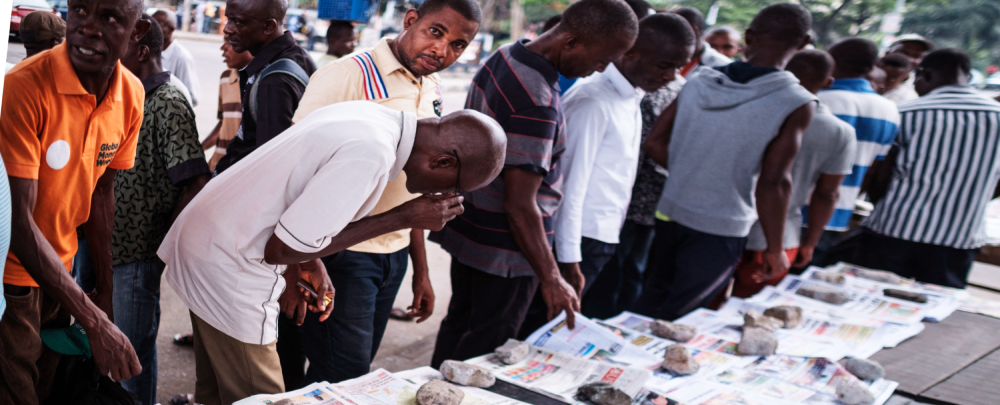
Congo’s World Cup Qualification Unites a Troubled Country and Brings a Rare Moment of Joy
Congo’s World Cup qualification came courtesy of Axel Tuanzebe’s extra-time goal following a corner to secure a 1-0 win over Jamaica in Tuesday night’s game in Guadalajara, Mexico. That goal and the victory over Jamaica brought a huge relief for millions in the central African nation who have long been accustomed to news of Rwanda-backed M23 rebels fighting with government forces in the east in a decades-long conflict that has resulted in one of the world’s largest humanitarian crises, with at least 7 million people displaced. The last time Congo participated in the World Cup was the 1974 edition in Germany. Then, the country had a different name, Zaire. It also had a different reality from today’s in which Rwanda-backed rebels control large swathes of land and territories in its mineral-rich eastern region. “Look at this crowd, we are full of joy because the victory is ours, we are very happy,” said an overjoyed Alain Kagama at a bar in the city of Goma, the epicenter of the violence which has been under rebel control for over a year. “It has been a long time since we smiled, but today we are happy,” Kagama added. AP
New Funding Transforms Lives by Expanding Electricity Access across Africa
More than 730 million people worldwide still lack access to electricity, about 600 million of them in Africa. Limited access constrains health care, education, digital connectivity and job creation. New financing aims to accelerate progress. The European Investment Bank pledged more than $1.15 billion in March for renewable energy projects across sub-Saharan Africa, including hydropower, solar, wind and grid expansion. The Rockefeller Foundation also announced in March at the Africa Energy Indaba in Cape Town, South Africa, that it will invest an additional $10 million to support electrification programs in at least 15 African countries. The funding will be deployed with the Global Energy Alliance for People and Planet to strengthen national programs and support government reforms. “African governments are choosing to transform their energy sectors by committing to national energy compacts and investing in African-led solutions,” said William Asiko, senior vice president at the Rockefeller Foundation. The investments support the Mission 300 initiative led by the World Bank and the African Development Bank, which aims to connect 300 million people in sub-Saharan Africa to electricity by 2030 through grid expansion and decentralized solutions such as mini-grids and off-grid solar. AP
Campaign for African Artifacts Looks to AI to Expedite Return
A new AI-powered tool is helping track restitution work underway across Africa. Launched this week by pan-African research organization Open Restitution Africa, the platform helps to collate and narrativize the often-fragmented research and bureaucracy involved in the return of artifacts to Africa, many of which were stolen by Europeans during the colonial period. Restitution negotiations are usually “Europe-to-Africa conversations,” co-founder Molemo Moiloa told Semafor, adding that while major European museums will have dedicated staff working on restitution, on the continent, many claims are taken up by museum workers or community members during their spare time. “When different stakeholders collaborate across different lines, that’s when restitution breakthroughs happen,” fellow co-founder Chao Tayiana Maina said. Semafor