
This will be a pivotal year for charting the trajectory of Guinea’s transition back to a democratic path. A military junta led by Colonel Mamady Doumbouya seized power from Guinea’s first democratically elected president, Alpha Condé, in September 2021. As part of a 10-point transition roadmap negotiated with the Economic Community of West African States (ECOWAS), the junta has committed to holding presidential and legislative elections by December 2024.
On the surface, the junta’s engagement with ECOWAS has distinguished it from other military putschists in West Africa. The Guinean junta has similarly maintained the prohibition that leaders in the transitional military authority are barred from serving in a new government.
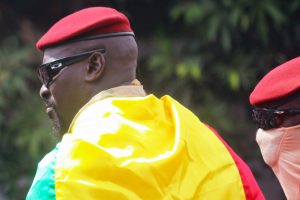
Mamadi Doumbouya. (Photo: Aboubacarkhoraa)

The Guinea situation is also distinctive in that the military ousted a president who had violated the Constitution’s two-term limit—despite widespread popular protests against the term limit extension and its legally dubious justifications. The junta in Guinea, moreover, has allowed some public debate on genuine constitutional reforms (though has excluded important opposition voices). Proposed reforms include subjecting executive appointments to parliamentary oversight, creating stronger protections from political interference for independent bodies, and reinforcing the country’s two-term presidential term limit.
The Guinean military regime has notably declined to join the alliance of military juntas (Mali, Burkina Faso, and Niger) that have actively challenged ECOWAS while recognizing one another’s illegitimate claims to power.
Despite the Guinean junta’s stated commitment to proceed with the transition, its implementation has lacked transparency, timeliness, or adequate budgetary allocations, leaving civilian leaders to question whether the timetable will be respected or if the junta is merely stalling the return to democratic constitutional rule. Key points of contention include the junta’s plan to hold a census in advance of the election, which would then be the basis of a new voter registry. Doumbouya has also announced plans for a constitutional referendum in 2024, though the document itself remains to be drafted and details on the process are sparse.
The question Guineans now face is whether 2024 will be the point at which the country rejoins the democratic path.
Opposition leaders contend that both voter registration and election administration should be managed by independent bodies to expedite the process and to limit conflicts of interest—and that any constitutional reforms should wait until there is a legitimate, democratically elected government in place. A focal point for 2024, therefore, will be whether the election will precede the constitution review process.
Guinea’s main political parties and civil society organizations, organized under the banner of the Forces vives de la Guinée (FVG), have mounted periodic protests to make these points and demand the junta hold to the transition timetable in a transparent and participatory process.
The junta has at times responded to these challenges by intimidating journalists and civil society leaders who have criticized the regime. This has included the use of armed militias and arrests when cracking down on protests, which the junta has banned since 2022. The media space remains restricted with several outlets banned and access to internet periodically suspended.
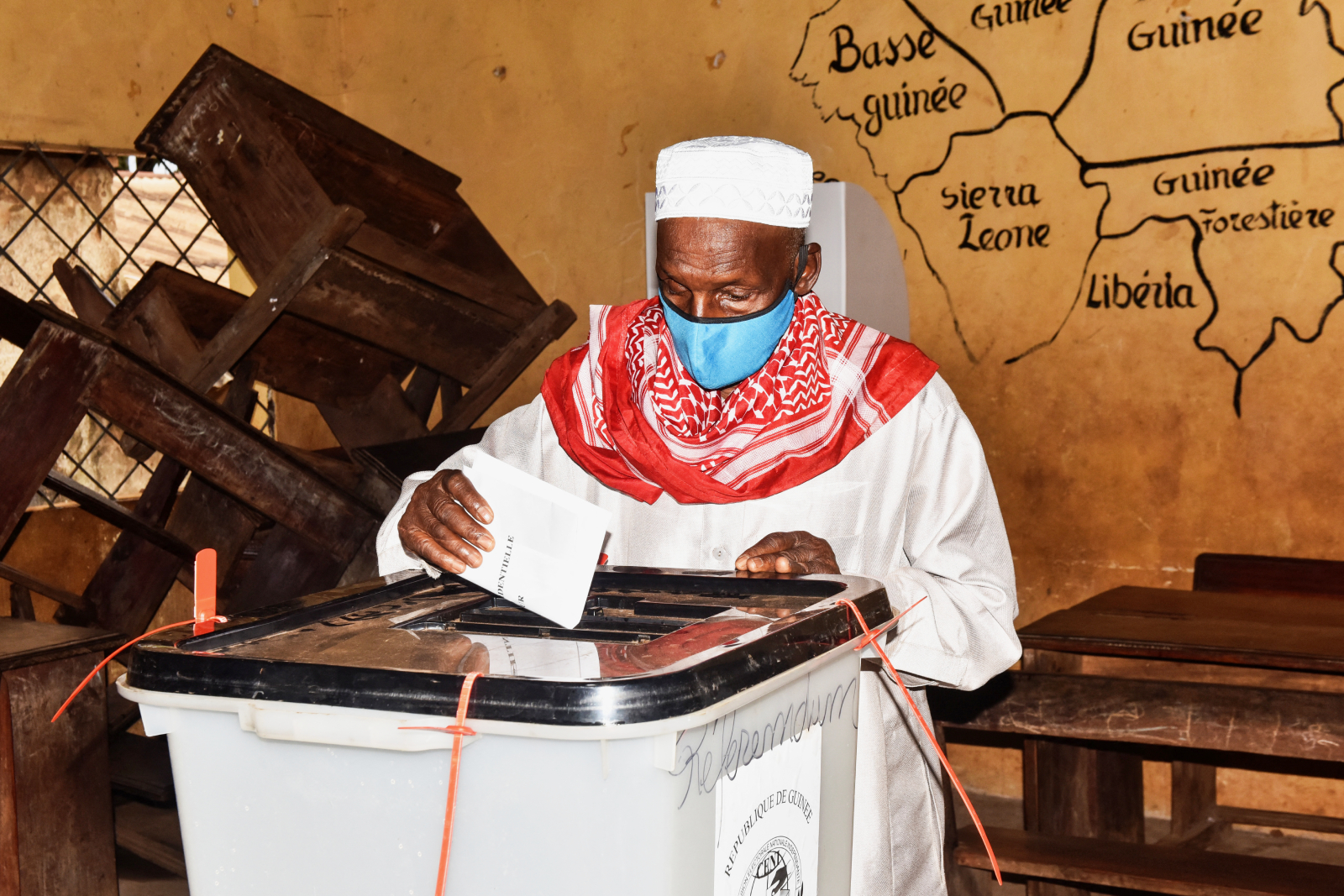
A man casts his ballot at a polling station in Conakry on October 18, 2020, during the Guinea presidential elections. (Photo: AFP/Cellou Binani)
This resistance to military rule points to Guinea’s resilient civil society and democracy movement. Guinea was one of the last African countries to realize competitive multiparty elections, which did not occur until 2010. This milestone was reached only after the infamous 2009 stadium massacre of more than 150 civilian protesters and the rapes of dozens of women orchestrated by the military government of Moussa Dadis Camara. The long-delayed trial for those responsible only began in 2022, under the Doumbouya junta, though it has proceeded in fits and starts.
Guinea’s civilian resistance was built from a long legacy of repressive, unaccountable rule. Guineans suffered greatly under the 25-year dictatorial reign (1958–1984) of Sekou Touré followed by the 24-year regime (1984–2008) of General Lansana Conté.
These hardships and hard-earned rights have seared a deep commitment for democracy in the Guinean psyche. Term limits are a particularly visceral issue given the decades-long rule of previous regimes. This is why the resistance to Alpha Condé’s extraconstitutional third term gambit was so impassioned and widespread.
The question Guineans now face is whether 2024 will be the point at which the country rejoins the democratic path. Doing so would open the country to renewed investment, development, and economic growth. In its decade of democratic progress, Guinea realized a median annual per capita economic growth rate of 2.9 percent. This compares to economic growth of less than one percent for the 25-year period before 2010.
A return to civilian democratic rule would also open Guinea’s military to a more robust spectrum of security cooperation.
A return to civilian democratic rule would also open Guinea’s military to a more robust spectrum of security cooperation funding and training—which could be critical as the militant Islamist insurgency in Mali escalates ever closer to Guinea’s northern border.
Russian interventions to derail the Guinean transition can be expected given Russia’s long involvement in bauxite mining in Guinea, Moscow’s support for Condé’s third term, Russia’s outsized influence with the other Sahelian military juntas, and the Kremlin’s purposeful efforts to undermine democracy elsewhere in Africa.
Despite the many obstacles to a smooth democratic transition in 2024, there are viable trajectories, incentives, and popular will for Guineans to do so. The outcome is likely to come down to the persistence of Guinean civil society, vigor of engagement by ECOWAS and international democratic actors, and assurances for the military in a post-junta Guinea.