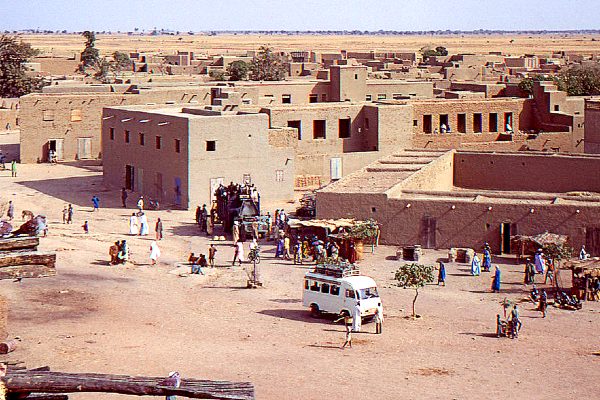
West Africa: Governance and Security in a Changing Region
By Abdel Fatau Musah. International Peace Institute, 2009.
Militant and terrorist groups are a prime source of insecurity in West Africa, but the management of natural resources, market for illicit goods, border administration, and other factors drive and shape the sub-region’s threats. To more effectively confront them, governments and civil society within the ECOWAS sub-regional bloc must collaborate to ensure both national ownership and the strengthening of collective security. [PDF]Africa’s Irregular Security Threats: Challenges for U.S. Engagement
By Andre Le Sage. Institute for National Strategic Studies, 2010.
African states face a wide array of unconventional threats that generally are transnational and interconnected. The many domestic militant groups, international criminal enterprises, and democratic governance and institutional deficits common across the continent require multi-dimensional strategies bounded by the rule of law, vigorously implemented by African leaders, and continually supported by international partners. [PDF]Security and Development in Sub-Saharan Africa - Looking to the Future
Security and Development in Sub-Saharan Africa - Looking to the Future.By Moeletsi Mbeki. Speech delivered at Commander's Speaker Program at the U.S. Africa Command, January 2010.
Africa’s intra-state conflicts and their cross-border consequences continue to hobble development of social anchors that are critical to state stability. These social and development hurdles are hindering Africa's ability to establish secure, democratic, and economically prosperous states. At bottom, "the challenge facing Sub-Saharan Africa is not State building as many analysts believe. The immediate challenge most of Africa faces is society building." more
U.S. Security Engagement in Africa
By William M. Bellamy. Security Brief. Africa Center for Strategic Studies, June 2009.
A significant development in Africa over the past decade has been the generalized lessening of violent conflict. Revitalized, expanded international peacekeeping, bolstered by a newly launched African Union (AU) determination to tackle security challenges, has reinforced this trend. But, much more cohesive interagency coordination under strong White House direction is required if the United States is to contribute to Africa’s sustained stability given the region’s persistent conditions of poverty, inequality, and weak governance.
[PDF] English; [PDF] French; [PDF] Portuguese
For additional reading go to: Africa Security ChallengesAfrica: Confronting Complex Threats
Africa: Confronting Complex Threats. By Kwesi Aning. International Peace Institute, 2007.
Africa’s security challenges are increasingly defined by fragmentation of political authority, mounting political influence of armed sub-state actors, and increased vigilantism. The reliance of non-state combatants on external sources of funding and logistical support, meanwhile, underscores that peace and security on the continent is closely linked to the cooperation of contiguous countries. [PDF]
For additional reading go to: Africa Security ChallengesConflict Trends in Africa, 1946-2004
Conflict Trends in Africa, 1946-2004. By Monty Marshall. Center for Systemic Peace; Africa Conflict Prevention Pool, 2005. Evidenced-based analysis of Africa's conflict trends over the past 60 years. Captures overall decline and shifts in types of conflict facing Africa over this time. Highlights the challenges of state formation instability and the politics of ethnic exclusion. [PDF]
-
Africa Security
- Experts
- Experts’ Publications
- ACSS Publications
- U.S. Policy
- Security Issues
- Electoral Security
- Africa Security Challenges
- Combating Urban Organized Crime
- Conflict Prevention or Mitigation
- Countering Extremism
- Counter Narcotics
- Democratization
- Identity Conflict
- Irregular Warfare
- Maritime Security
- Natural Resources and Conflict
- Peacekeeping
- Piracy
- Post-Conflict Reconstruction
- Preventing and Reversing Military Coups
- Regional and International Security Cooperation
- Security and Development
- Security Sector Reform
- Stabilization of Fragile States
- Countries and Contexts
- Official Documents